 Retro Replay Retro Replay gaming reviews, news, emulation, geek stuff and more!
Retro Replay Review
Gameplay
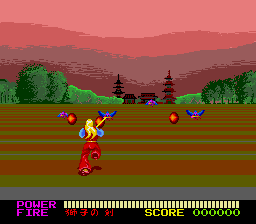
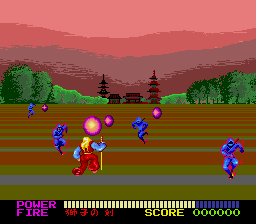
Jinmu Denshō starts with the kind of momentum that makes an arcade action game hard to put down. You are a samurai running into the screen, sword ready, while monsters rush or fly toward you from the horizon. The basic job is easy to understand—meet evil creatures before they meet you—but the behind-view angle makes every approach feel a little more urgent than a standard side-scroller.
What starts to click is the rhythm of reading distance. Close enemies call for the sword, while shurikens give you a way to reach threats farther up the road. Statues matter because smashing them can leave behind health or more shurikens, so they are not just scenery to swipe at; they are part of your survival plan. You have to decide when to prioritize a pickup and when to stay focused on the creature already bearing down on you.
The ability to run back on yourself is a smart wrinkle. It lets you reposition rather than treating every encounter as a straight-ahead charge, and it helps the game feel more like a moving combat lane than a simple race forward. Later platform-jumping sections change that rhythm again. They add welcome variety, but they also raise the pressure: depth judgment is already important here, and jumps ask you to be even more deliberate.
Frustration will come from that same perspective. Enemies arrive from a distance, and the game demands that you judge when they are truly in range rather than merely visible. If you enjoy the particular challenge of Space Harrier-style action, that tension is the point. If you want forgiving controls or a relaxed sword adventure, Jinmu Denshō will likely feel harsh.
Graphics
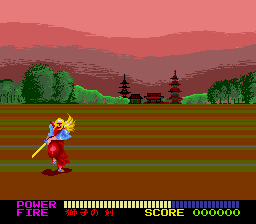
The game uses a behind-the-samurai view that sends creatures running and flying toward the screen. That perspective makes the action easy to understand at a glance: distant enemies grow quickly as danger closes in, while the player character remains the fixed point of the charge.
Story
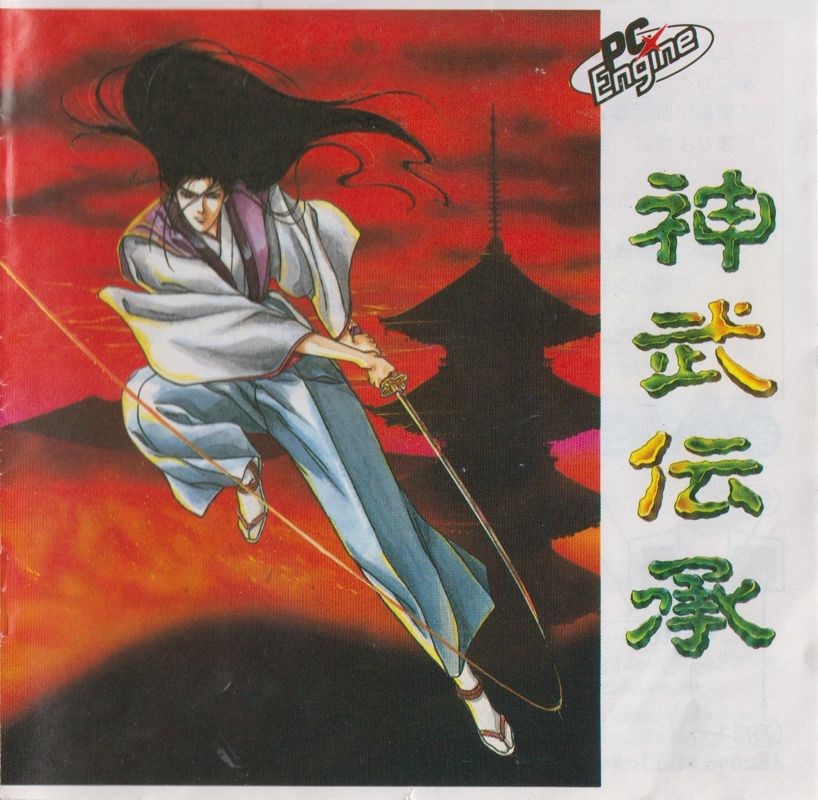
This is a direct good-versus-evil setup: a samurai cuts through evil creatures with sword and shuriken. The game puts its energy into the next attack and the next obstacle rather than asking you to linger over plot details.
That simplicity suits the format. You are not waiting for a complicated narrative hook before the game gets moving; the hook is being dropped onto the path and told to survive what comes at you. The samurai theme gives the action a clear flavor without slowing its arcade pace.
As a result, story-minded players may find little to hold onto beyond the premise. Jinmu Denshō uses its theme as a frame for combat, and the real sense of progress comes from pushing into later stages and handling their added jumping challenges.
Overall Experience
Jinmu Denshō is memorable because it does not settle for a plain sword-action template. Its forward-moving, into-the-screen combat has a frantic pull, and the combination of sword strikes, ranged shurikens, breakable statues, retreating, and later jumping keeps the journey from becoming entirely one-note.
It is also an unapologetically demanding game. You need to learn its sense of space, react to enemies that close in from afar, and stay alert for resources without losing sight of immediate danger. The payoff is not comfort; it is the satisfaction of adapting to an odd, energetic arcade challenge.
Give it a chance if you enjoy early action games that ask you to master a distinctive viewpoint and accept a few rough edges in exchange for character. Jinmu Denshō will not win over everyone, but for a gamer who wants a samurai-flavored take on the Space Harrier formula, it has enough ideas to be more than a curiosity.


Reviews
There are no reviews yet.