 Retro Replay Retro Gaming History, Reviews & Emulation
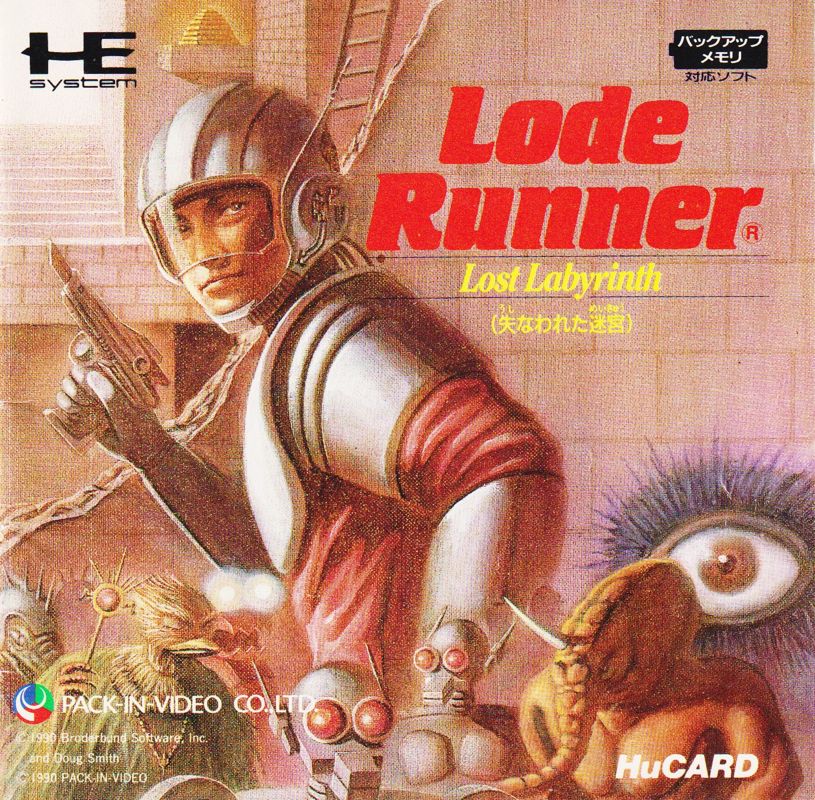
Retro Replay Review
Gameplay
The first few rooms make Lode Runner: Lost Labyrinth look wonderfully simple: collect all the gold and avoid the guards. Then you remember that your character cannot jump, and the whole game becomes a series of anxious little calculations. A ladder can be an escape route or a dead end. A rope can save you from a pursuing guard or leave you stranded in exactly the wrong place. The direct controls suit that pressure because success comes from committing to a route, not fumbling through a complicated command list.
Digging holes is where the game stops being a chase game and becomes a proper puzzle. Dropping a guard into the floor buys precious time, but the hole fills back in and the trapped guard respawns. That temporary advantage forces you to think ahead: where will the guard reappear, where is the next piece of gold, and have you just made your own route worse? You will absolutely lose runs to a bad dig or a greedy detour, yet the rules are clear enough that failure usually teaches a useful lesson.
The hundred levels are the real argument for this version. Since most differ from the original Lode Runner layouts, there is a steady supply of new route problems rather than a brief nostalgic repeat. Scrolling also makes the larger spaces feel less like a single frozen board; you have to keep a mental map of ladders, ropes, gold, and patrol routes as the stage moves around you. It can be unforgiving, especially if you want breezy platforming, but it becomes deeply satisfying once you learn to treat every screen as a plan waiting to be solved.
Graphics
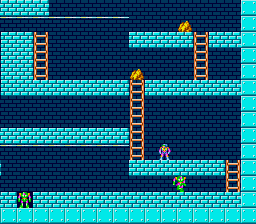
The side-view stages put the important pieces in front of you: gold, ladders, horizontal ropes, floor tiles, the lone runner, and roaming guards. Scrolling lets each level extend beyond one view, while the simple 2D layout keeps troop movement and your available paths easy to track during a tense pursuit.
Story
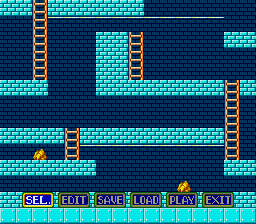
Lost Labyrinth tells its tale through immediate stakes rather than elaborate drama. You are a lone protagonist gathering gold from maze-like stages while guards try to stop you, and that is enough to give every room a clean, urgent objective.
The guards do more than fill the role of generic opposition because your answer to them is so physical: dig a hole, catch one in it, and use the brief opening to continue your route. That repeated contest gives the game a tiny but effective rhythm of pursuit, escape, and recovery.
Because each level resets the same essential conflict in a new layout, the momentum comes from your growing command of the labyrinth rather than from narrative turns. If you like games whose “story” is the account of how you escaped an impossible-looking room, this stripped-down approach works.
Overall Experience
Lode Runner: Lost Labyrinth is sharp, difficult puzzle-platforming with no patience for careless movement. It asks you to observe first and act second, then punishes you when you mistake a temporary escape for a permanent solution. That can be frustrating in the moment, but it is the good kind of frustration: the one that makes you restart with a clearer idea of what you should have done.
Give it a chance if you enjoy compact arcade puzzles, route planning, and mastering strict rules. Skip it if what you want from a platformer is freeform movement or a forgiving recovery option; the lack of jumping is not a novelty here, it is the core constraint that shapes every decision.
For a useful comparison point within the series, the related Lode Runner release shows how durable the central gold-grabbing, guard-trapping idea has been. Lost Labyrinth earns its own place through its large set of mostly different, scrolling levels, and its best moments still arrive when a route that looked impossible suddenly becomes obvious.



Reviews
There are no reviews yet.