 Retro Replay Retro Gaming History, Reviews & Emulation
Retro Replay Review
Gameplay
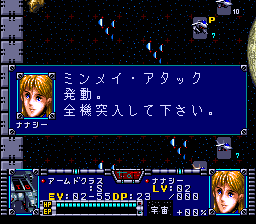
The first hour’s hook is straightforward: you take a squadron into a top-down battlefield, measure the distance to the Zentradi, and try to make the first exchange happen on your terms. Eien no Love Song is mission-based and linear, so it does not waste time pretending to be an open-ended war simulator. You move from tactical battle to tactical battle, with objectives that can vary even if wiping out the opposition is the usual order of the day.
What gives those battles some bite is the range and damage difference between weapons. A unit is not merely “strong” or “weak”; where it sits relative to an enemy matters, as does which attack it brings to the fight. The transformable ships and mecha are the natural center of attention, and special abilities such as healing add a useful reason to think beyond raw damage. Once you stop treating every turn as a rush toward the nearest target, the game’s tactical rhythm starts to click.
The catch is that combat itself plays out automatically in separate animated scenes. That puts the emphasis squarely on planning rather than moment-to-moment command. If you want to personally steer every exchange, this distance can frustrate you, especially when a decision has already been made and you are watching its consequences unfold. If you enjoy setting up favorable engagements and living with the result, it feels more like a reward for positioning than a loss of control.
The mission structure also means pacing depends heavily on your appetite for consecutive battles. There is a clear forward pull—humanity is at war with the Zentradi, and the next operation is always waiting—but this is a game built around tactical repetition with variations, not detours or freeform experimentation. Give it a chance if you like games where a clean formation and a well-chosen target matter more than flashy reflexes.
Graphics
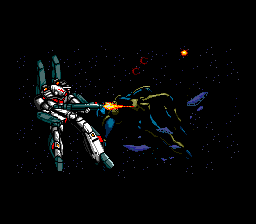
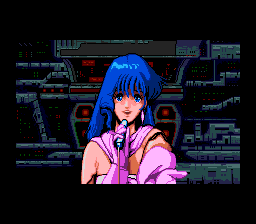
The main battlefields use a top-down view, making it easy to follow where your units and the enemy forces stand before a clash. When units meet, the game cuts away to animated combat screens, giving its ships and mecha a more dramatic stage than the map view alone can provide.
Story
Eien no Love Song works within Macross’s central conflict: humanity fighting the giant humanoid Zentradi. That gives the campaign immediate stakes without needing to build a science-fiction war from scratch. The game’s linear progression suits that backdrop well; each mission feels like another measured step through a larger military struggle.
Kiryu and the young woman Retorade are the most prominent pilots under your command. Their presence gives the campaign a focal point amid a roster of pilots and machines, rather than leaving the war as a purely anonymous sequence of maps. Still, the story is primarily carried by the campaign context and its battles, so come for a Macross-flavored tactical campaign rather than a heavily detailed character drama.
That focus has its own charm. There is something pleasingly old-school about a licensed strategy game that trusts the conflict, the pilots, and the hardware of its setting to do the work. Fans wanting another route through the franchise can also look at Chō Jikū Yōsai Macross: Scrambled Valkyrie, though Eien no Love Song is the one to choose for deliberate turn-based battles.
Overall Experience
Chō Jikū Yōsai Macross: Eien no Love Song is most enjoyable when you meet it on its own terms: a compact, turn-based Macross campaign where preparation determines the shape of combat. Its strongest moments come from recognizing a weapon-range advantage, arranging your force accordingly, and watching the plan resolve in the animated battle sequence.
It will not win over everyone. The linear campaign and automatic fights leave less room for improvisation than strategy games built around direct combat control. But the trade-off is a game with a clear, steady purpose, one that keeps attention on battlefield decisions rather than on constant mechanical busywork.
For Macross fans, the license and transforming machines make this an easy recommendation if you already enjoy tactical games. For strategy fans without that attachment, it is still worth trying if you can appreciate a focused mission game with positional combat and support abilities. The payoff is not novelty; it is the satisfying discipline of making a plan and seeing it hold.


Reviews
There are no reviews yet.