 Retro Replay Retro Gaming History, Reviews & Emulation
Retro Replay Review
Gameplay
The first few matches are easy to understand because Kabuki Ittōryōdan begins from familiar fighting-game ground. You punch, you kick, and you look for openings to use the move set that separates your chosen character from the rest. That directness gives the game a quick, pick-up-and-play pull, especially if you want a match rather than a long buildup.
The roster is small at eight characters, but it is not a lineup of simple palette swaps in concept. Kabuki can bring a sword into the fight, while Okuni can burn opponents with fire; the broader cast mixes protagonists, villains, supporting characters, and Mantou the ape. That variety matters more than the raw headcount. Switching fighters should change the kind of attacks you want to lean on, whether that means pressing close with stronger melee options or trying to make room for a ranged, magic-like strike.
Scenario Mode is where the game risks feeling thin. You may select any character, then fight through friends and enemies one at a time, with no story framing to make the encounters build toward anything. If you like arcade ladders for their own sake, the format is clean and unobtrusive. If you need rivalries, cutscenes, or a sense that each battle has stakes, repetition can set in quickly.
Vs. Mode is the better reason to return with another person, since it lets both of you choose freely from all eight fighters. Life Attack offers a more solitary alternative by feeding your selected character random AI opponents. Neither mode changes the fundamentals, but each gives the uncomplicated combat a different rhythm: deliberate matchups with a friend, or a less predictable run against the computer.
Graphics
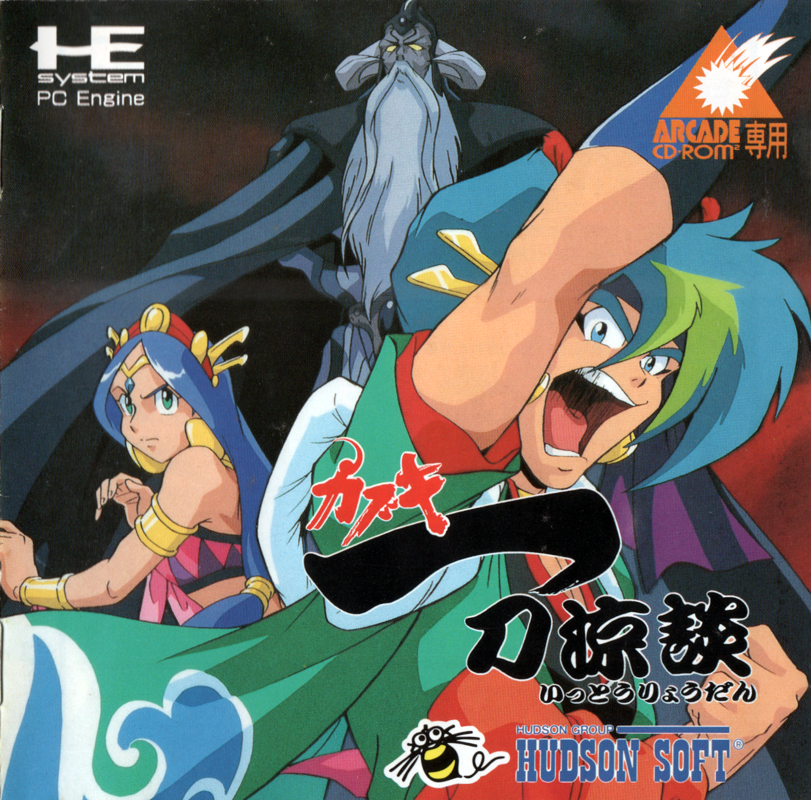
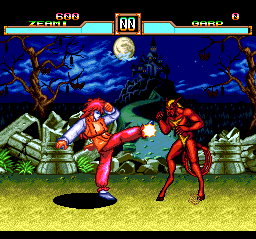
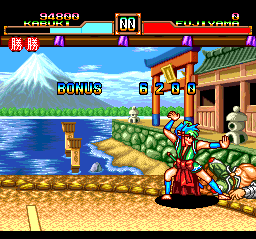
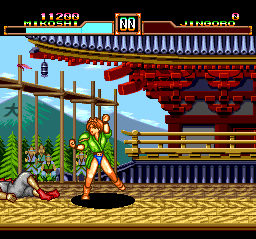
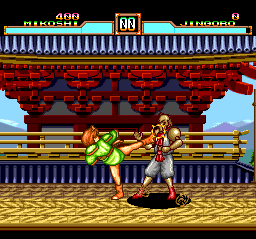
This is a side-view, anime and manga-styled fighter built around recognizable Fūun Kabuki Den characters. The focus is on watching Kabuki, Okuni, Zeami, Kikugorou, Garp, Mantou, and the rest face one another in direct one-on-one battles rather than on elaborate story scenes.
Story
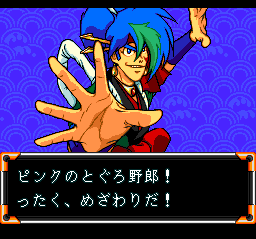
There is effectively no story here, and the game does not pretend otherwise. Characters fight each other for no stated reason, including allies meeting as opponents in Scenario Mode. That makes Kabuki Ittōryōdan feel less like a narrative continuation and more like a cast reunion arranged around fights.
For fans of Fūun Kabuki Den, the pleasure is likely in the collisions themselves: Kabuki Danjuro, the actor and world-savior, sharing a roster with heroes, villains, support characters, and Mantou. The game treats all of them as valid combatants, which gives the matchups a playful anything-goes quality.
Newcomers should not expect this spin-off to introduce the Tengai Makyō universe or explain who anyone is. The character names and roles add flavor, but they do not develop into a plot. You either arrive already happy to see the cast, or you treat them as a colorful group of fighters with different attacks.
Overall Experience
Kabuki Ittōryōdan is a narrow but honest spin-off: a straightforward one-on-one fighter using a familiar cast, not a grand new chapter in its parent series. Its strongest asset is how quickly it lets you test character-specific moves and settle into matches. The weak point is equally clear: a tiny roster and story-free ladder leave it with limited momentum when you play alone for long stretches.
You will get the most out of it if the idea of Kabuki and company fighting their own allies and enemies already sounds fun. The cast selection has a lively mix, and two-player Vs. Mode gives that mix a practical reason to exist. A friend across the room can turn a modest set of fighters into an evening of rematches and character experiments.
As a solo game, it is harder to recommend beyond a short arcade-style session, because Scenario Mode offers battles without a larger payoff. Still, its no-nonsense structure has a certain charm. If you want an old-school fighter centered on a specific Japanese RPG cast and can enjoy the combat without demanding a campaign, it is worth a curious spin; everyone else will likely find its novelty fades fast.


Reviews
There are no reviews yet.