 Retro Replay Retro Gaming History, Reviews & Emulation

Retro Replay Review
Gameplay
The best thing about 400 Days is how quickly it puts a choice in front of you and refuses to let you feel comfortable about it. You pick one of five faces from a board of missing people, enter a compact vignette, and start making calls under the same timed-dialogue pressure that defined the first season. This is not an expansion that asks you to relearn the formula. It trusts that you know why a paused silence can feel worse than saying the wrong thing.
Each survivor’s section has its own situation and tone, which keeps the short runtime moving. Vince begins on a prison bus as the outbreak erupts; Wyatt’s story turns a nighttime escape into a nasty decision on a back road; Russell meets danger while travelling alone; Bonnie is caught between an older couple in a fraying relationship; and Shel has to protect her younger sister within a larger truck-stop group. You can play these stories in any order, so the structure encourages you to follow your curiosity rather than march through a prescribed sequence.
The interaction remains deliberately light. You will talk, inspect limited spaces, make consequential choices, handle quick-time events, and occasionally shoot. There are no classic adventure-game puzzles to slow the pace, which is mostly a strength: these stories want your attention on people rather than inventory logic. A few scenes add hiding, running, cover shooting, and a rock-paper-scissors minigame, while one sequence asks you to drag a body and release it at the right moment to line up shots on walkers. These additions provide a little variety without changing what this series is about.
Frustration can creep in when the game turns urgency into a fail state. Certain actions must be completed in time or an essential character dies, forcing a replay. That can make an otherwise tense scene feel more like trial and error, especially in a collection built around preserving the weight of first decisions. Still, the individual episodes are compact enough that retrying does not become a major drag.
Your earlier first-season choices carry forward, and 400 Days records its own outcomes for the next season. The familiar end-of-episode statistics are here, alongside another set of results tied to the larger bridge it is building. Do not come in expecting every branch to become a wholly separate story; come in ready to own your response to pressure, even when the broader plot funnels back together.

Graphics
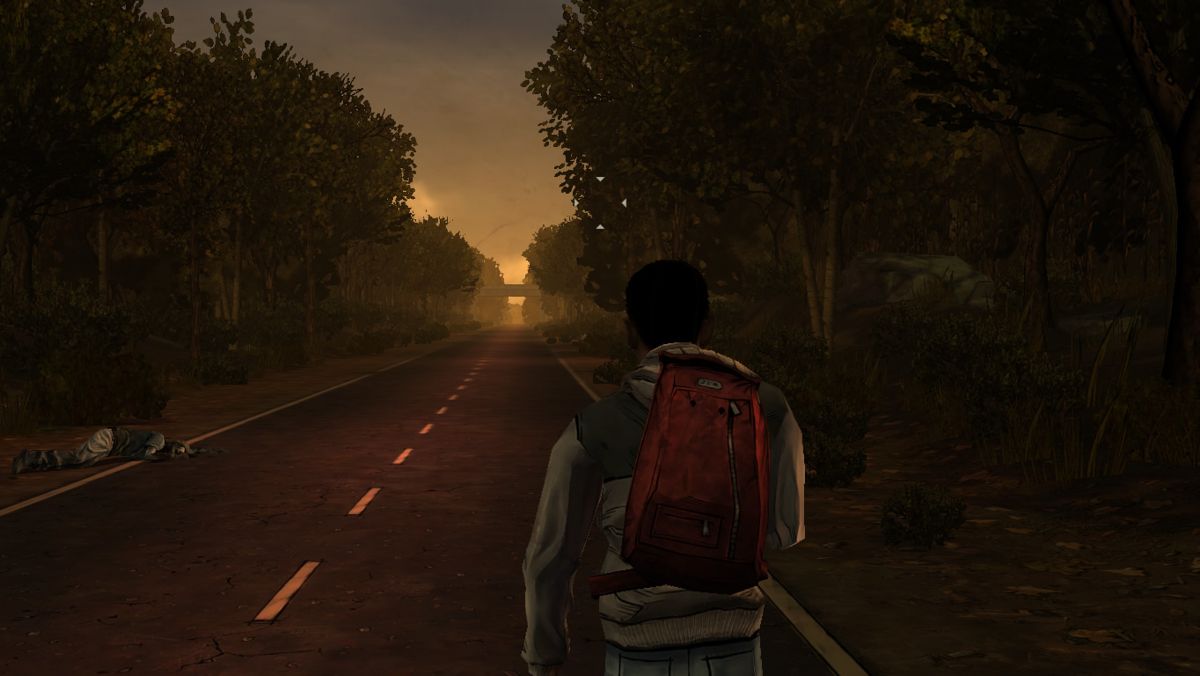
The game uses the same stylized, comic-book-inspired look as the first season. The missing-persons board is a strong framing device: selecting a photograph, then seeing it torn away after a story ends, gives these brief episodes a tangible sense of accumulation. The action stays easy to parse in its confined locations, from the prison bus and dark roadside to the truck stop where the stories converge.

Story
400 Days understands that a zombie outbreak is most effective when the walkers are not the only threat in the room. Across its five time jumps, from day two to day 400, the writing keeps returning to fear, mistrust, loyalty, and the compromises people make when they think nobody will rescue them. The truck stop acts as a useful anchor, making these separate lives feel like they belong to the same battered stretch of Georgia.
The anthology format is both the DLC’s strength and its limitation. You get several sharp introductions and little time to settle in, so not every thread can hit with the force of a full-season relationship. But the brevity gives the better scenes a mean efficiency. There is no room to coast when a stranger needs a ride, a group wants someone punished, or a younger sibling is watching what you choose.
The final epilogue is the reason to finish every vignette. It brings together many of your decisions and turns the episode from a set of disconnected side stories into a genuine handoff toward season two. It does more setup than resolution, but that is appropriate for a bridge chapter. The payoff is seeing that your choices have helped shape a community, however precarious it may be.
Overall Experience
This is a good piece of The Walking Dead, though not an essential replacement for a full season. Its five-story structure offers more variety than one continuous plot, and the strongest segments capture the series’ particular gift for making you dread a dialogue choice more than an approaching walker. The opening selection board is immediately inviting, and the ability to tackle the stories in any order makes the whole package easy to play in a few sittings.
It works best after the first season, not only because it requires that game or one of its episodes to run, but because it relies on your familiarity with Telltale’s rhythm and carries choices forward. Newcomers would be better served by starting with The Walking Dead; returning fans will appreciate this as a concise look at other survivors living through the same catastrophe.
At a 7.3, 400 Days lands as a worthwhile interlude with a few mechanical bumps and a deliberately incomplete ending. Give it a chance if you want more moral pressure, more hard choices, and a direct thread into season two. Skip it only if you need a long, self-contained story rather than a tightly packed collection of bleak snapshots.


Reviews
There are no reviews yet.