 Retro Replay Retro Replay gaming reviews, news, emulation, geek stuff and more!


Retro Replay Review
Gameplay
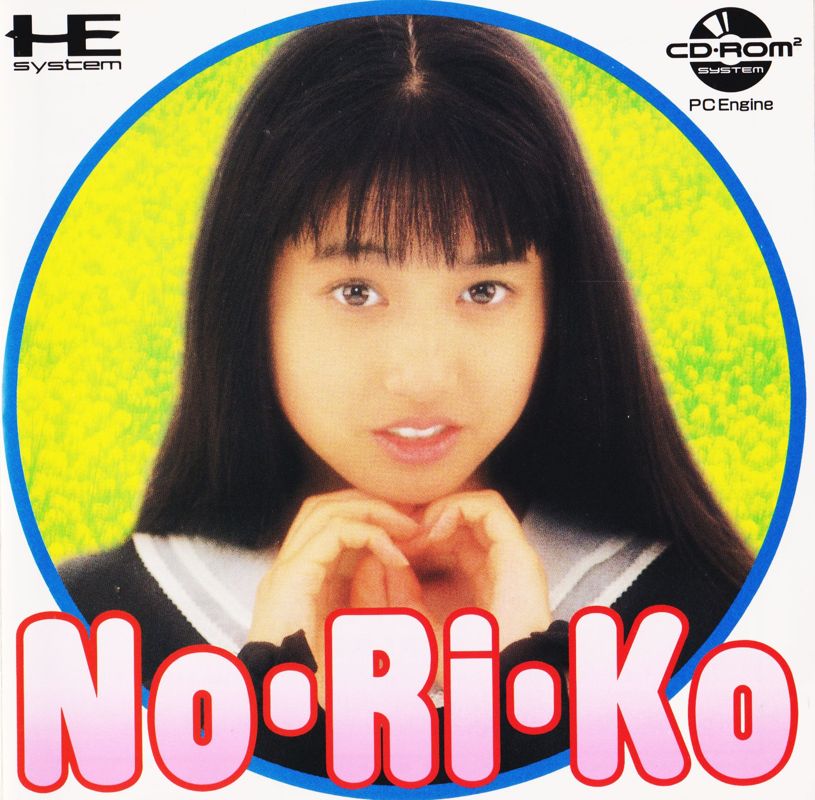
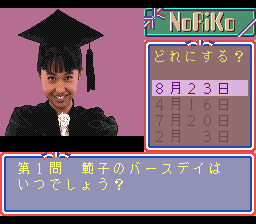
No・Ri・Ko starts with an immediately unusual bit of wish fulfillment: you play a fan who meets Japanese pop singer Noriko Ogawa and gets to spend time with her. Rather than building a conventional adventure around that setup, it plays like an interactive movie. You watch scenes, wait for a prompt, and choose what your character does next. If you enjoy poking through early CD-era experiments, that alone can be enough to make the opening intriguing.
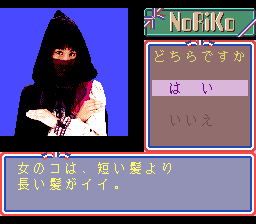
The trouble is that many decisions are reduced to finding the correct answer. Pick wrong and you may hit a Game Over, which gives the experience a stop-start rhythm instead of a convincing sense of conversation. You are not so much shaping a relationship as trying to avoid stepping on the game’s hidden rakes. That can be entertaining in a curious, old-school trial-and-error way, but it is easy to get frustrated when a casual choice carries such a blunt penalty.
There is at least a little variety in the date’s structure. At certain points you choose where to go with Noriko, though committing to one destination can lock out others. Small diversions such as taking photographs of her and playing rock-paper-scissors break up the prompts. They do not turn No・Ri・Ko into a deep game, but they help it feel less like a completely passive slideshow and give repeat runs a modest reason to exist.
Graphics
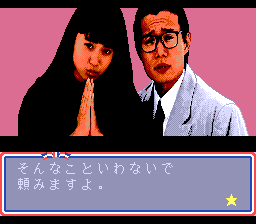
The game uses digitized snapshots of real actors, with Noriko Ogawa at the center, so its scenes have the distinctive look of an early interactive photo album rather than hand-drawn animation. That makes the celebrity focus direct and unmistakable: you are looking at a real performer in posed, date-like scenarios, not an illustrated stand-in.
Music clips are part of the package, reinforcing the idol-media angle. The combination of still imagery and audio has undeniable novelty, even if it remains far removed from the fluid moving images the term FMV may lead you to expect.
Story
The story is deliberately slight: a fan meets Noriko and takes her on a date. That is the whole engine, and No・Ri・Ko does not need much more plot to pursue its central fantasy. Your choices decide actions and, at times, destinations, so the route has some branching around the edges.
It is also a premise that lands awkwardly now. Ogawa was fifteen at release, and placing you in the role of the fan taking her on a date gives the material an uncomfortable undertone that is hard to ignore. The game’s interest is historical and celebrity-driven rather than dramatic; do not go in expecting a nuanced romance or a layered visual-novel narrative.
Still, the simplicity makes its intent clear. No・Ri・Ko is built around the sensation of proximity to an idol, with the decisions functioning as interruptions and tests inside that encounter. If that particular slice of 1988 Japanese pop culture fascinates you, the thin story is part of the artifact’s specificity. If it does not, there is little narrative momentum to pull you through the wrong turns.
Overall Experience
No・Ri・Ko is much more interesting as an early multimedia curiosity than as an adventure game. Its mix of photos, music, choice prompts, location branches, and mini-games captures a moment when CD technology invited developers to build experiences around real performers. You can feel the experiment in every scene, for better and worse.
The best way to meet it is with patience and a willingness to replay after a bad choice. Treating every prompt as a high-stakes puzzle will quickly sour the mood, while treating it as a short, peculiar idol interactive makes its limitations easier to accept. The route choices and occasional diversions provide a little participation, but they never overcome the rigid right-or-wrong design.
For most gamers, the payoff is not strong enough to justify seeking it out purely for play. For fans of TurboGrafx CD oddities, early FMV, or Japanese idol media, however, it is a memorable time capsule. It remains a narrow recommendation, but a sincere one: there is nothing quite ordinary about this particular experiment.



Reviews
There are no reviews yet.