 Retro Replay Retro Gaming History, Reviews & Emulation


Retro Replay Review
Gameplay
The first few minutes of Sylphia offer the clean arcade promise that scrolling-shooter fans know well: keep moving, fire constantly, and turn incoming enemy waves into power-ups. You fly upward through a Greek-inspired monster invasion rather than a science-fiction battlefield, yet the rhythm is unmistakably traditional. That is not a complaint. There is real comfort in a game that understands the value of immediate danger and immediate response.
The four ranged attacks are the heart of the game. Fire blasts, lasers, spreading fire, and homing missiles cover the familiar shooting-game bases, while the colored orbs make weapon pickups easy to identify. The best moments should come from matching your firepower to the crowd: a spread attack for enemies pouring across the screen, homing missiles when targets arrive from awkward angles, or a more focused option when you want to cut through a tougher threat. Because each weapon can be powered up, collecting the right orbs has more weight than simply grabbing every item that drifts by.
A single stored special attack adds a useful release valve. Since you can hold only one charge, it is not something to throw away casually; saving it for a packed wave or a dangerous situation makes it feel like a small, meaningful decision. That kind of restraint suits the game’s arcade roots. You are not juggling a sprawling system—you are reading the screen, preserving your best options, and trying not to let the action get ahead of you.
Frustration is likely to depend on how much patience you have for genre convention. Sylphia is built around repeated waves and familiar weapon archetypes, so it will not convert someone who finds vertical shooters monotonous. But for a fan, that focus can be a virtue: the game stays centered on movement, shooting, pickups, and the gradual pleasure of building a stronger arsenal.
Graphics
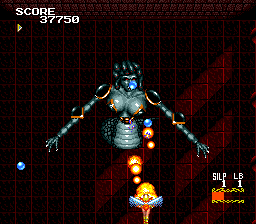
The vertically scrolling action puts Sylphia herself, airborne enemies, and ground-based monsters in the same moving battlefield. The Greek-myth setting gives the shooter a more fantastical image than the usual fleet of spaceships, while the colored weapon orbs make pickup choices easy to spot amid the action.
Story
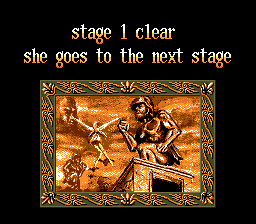
Sylphia begins with a suitably dramatic arcade-game setup. A fearless maiden dies trying to defend her hometown from monsters, and Athena restores her to life as a flying demi-goddess. It is a brisk revenge-and-rescue premise, but it does more than merely decorate the box: it gives the constant forward assault a personal motive.
The story does not need to carry the whole experience to work. In a shooter, the important question is whether the framing makes you want to push into the next wave, and a resurrected heroine striking back at the monsters that overwhelmed her is a strong enough answer. Athena’s intervention also neatly explains why the heroine is suddenly capable of taking the fight to foes in both sky and ground.
Do not come expecting an elaborate mythological retelling. Sylphia uses Greek mythology as a sharp action hook, not as a dense narrative puzzle. That is the right scale for this kind of game: a clean reason to care, then back to blasting monsters.
Overall Experience
Sylphia sounds like a confident genre piece rather than a game chasing novelty. Its strength is how clearly its parts line up: an immediately understandable vertical-shooter structure, a useful range of weapon types, power-ups tied to each attack, and a special move worth saving for trouble. You know what you are doing almost instantly, but there is still room to make better choices as the screen gets busier.
The Greek-myth coat of paint helps it stand apart from interchangeable space shooters, especially because the heroine’s resurrection directly feeds into the action. More importantly, Compile’s shooter pedigree is felt in the straightforward weapon logic described here: each pickup promises a different way to handle pressure instead of adding needless complication.
Give Sylphia a chance if you want a focused vertical shooter with a fantasy angle and enjoy mastering a small set of weapons. The payoff is not a grand story revelation; it is the dependable rush of surviving a crowded wave with the right powered-up attack in hand and one last special charge ready to spend. That is a modest ambition, but it is often exactly what an arcade shooter needs.


Reviews
There are no reviews yet.