 Retro Replay Retro Gaming History, Reviews & Emulation
Retro Replay Review
Gameplay
All Our Asias starts with a sharp emotional reason to keep moving. Yuito cannot have the conversation he needs with his dying father, so he enters a risky Memory World Visitation instead. That premise gives even its simplest exploration a sense of purpose. You are not being asked to grind through systems or prove your reflexes. You are walking into someone else’s past, looking for context that ordinary conversation can no longer provide.
The controls are intentionally straightforward: third-person movement, conversations, and light platforming carry the whole trip. That restraint fits a game this short. There is no combat loop to interrupt the reflective tone and no elaborate puzzle structure padding out the running time. Once that rhythm clicks, it is easy to accept All Our Asias on its own terms as a guided, personal exploration game.
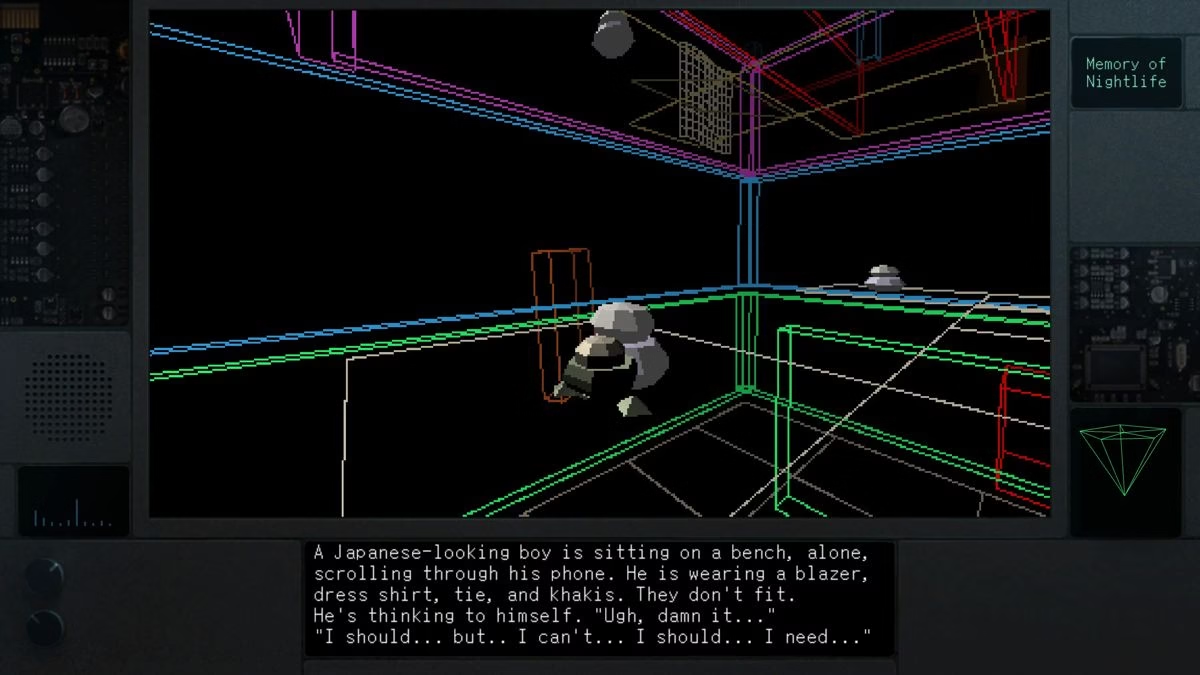
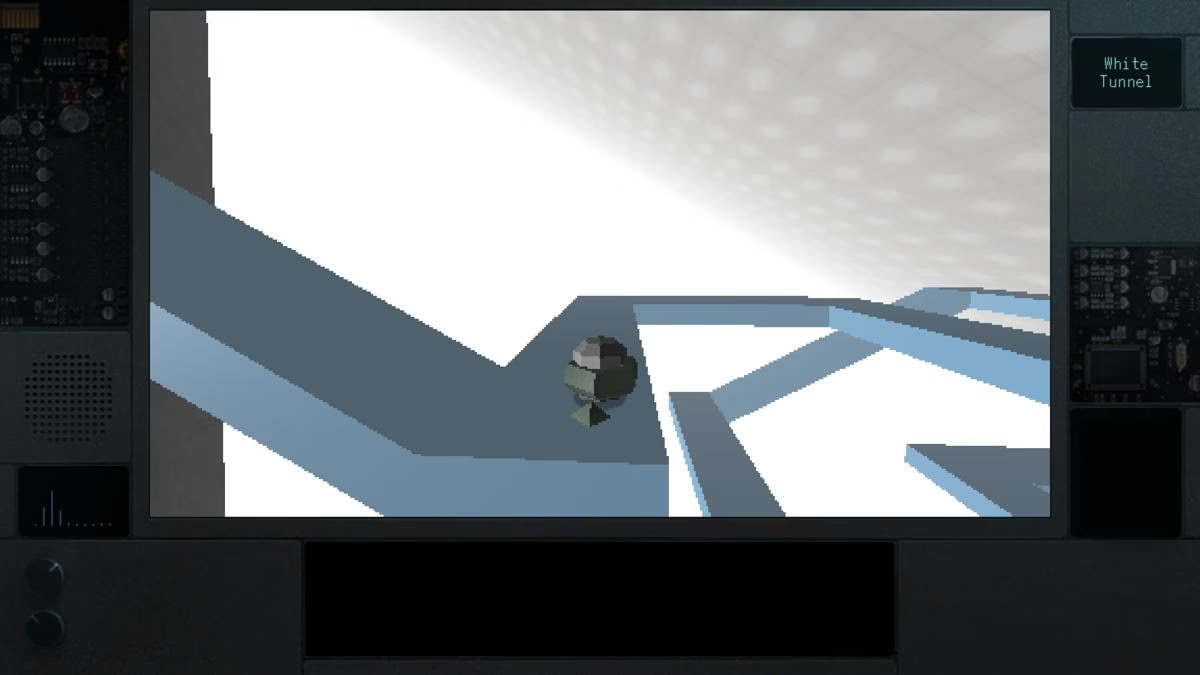
The friction comes from navigation. In the nightclub-like area, glowing wire-frame rails cross and overlap around the route, and their intersections can make distance hard to judge. Later, thin slate-blue ramps cut through a bright white space, where the edges and intended path can also be difficult to read. It is not a deal-breaker, but the platforming can pull you out of the conversation when you are trying to work out where a jump will land.
Graphics
The game leans into its stated PSX/N64-era influence with rough, abstract 3D spaces. One memorable area surrounds a small rounded gray-green robot-like avatar with blue, green, magenta, and orange wire-frame architecture, while faceted gray figures hover in the darkness. Another strands the character on sharply angled blue-gray ramps under a cloudy ceiling and a nearly blinding white void. Those scenes have a strange, handmade look, even when their intersecting rails and thin walkways make navigation tougher than it needs to be.
Story
Yuito’s situation gives All Our Asias its weight. He is a 31-year-old Japanese-American hedge fund analyst raised in the United States, and his father is on life support after a long estrangement. The game does not need a huge plot apparatus to make that setup sting. The cruel timing is immediate: whatever answers Yuito finds, they arrive too late for a direct exchange with his father.
Memory World Visitation is a strong frame for this subject because it turns family history into a place you can inhabit rather than a file of clean answers. The journey is explicitly concerned with race, nationality, identity, and distance within a family. That focus makes the small scale feel deliberate. It is interested in what shapes a person and in how incomplete another person’s understanding can remain.
This is not a sprawling role-playing story with room for every thread to be tied off. Its strength is the intimacy of its question, not the breadth of its world. If you are willing to meet it as a compact, sometimes uncomfortable meditation on inheritance and estrangement, the premise has real emotional bite. The developer’s page for All Our Asias is useful if you want the original outline of Yuito’s journey and its short intended scope.
Overall Experience
All Our Asias is worth your time if you want a short adventure built around thought and mood instead of mastery. Its best quality is its refusal to bury an intimate subject under busywork. You move, talk, and make your way through alien memory spaces, and the game lets its core concerns stay front and center.
The rough spots are equally clear. Light platforming in abstract 3D spaces can be needlessly fussy, particularly when rails overlap or a narrow ramp fades into white. Since the game is only two to three hours long, those moments do not become a permanent drag, but they can test your patience in a work that otherwise asks for close attention.
Give it a chance if a focused, personal story sounds more appealing than a mechanically dense adventure. Fans of the same co-creator’s Anodyne may recognize the interest in dreamlike exploration, though this is a very different game: a 3D, conversation-led memory journey rather than a 2D action adventure. Its imperfections are visible, but so is its willingness to tackle difficult feelings without stretching them into a larger game than they need to be.


Reviews
There are no reviews yet.