 Retro Replay Retro Gaming History, Reviews & Emulation
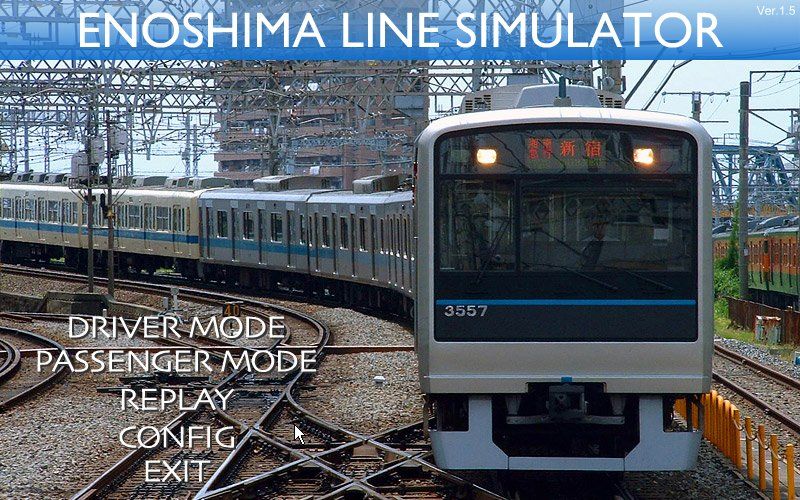

Retro Replay Review
Gameplay
The first run is liable to catch you out because the journey looks so simple. You only need to cover 4.2 km from Chogo to Sakuragaoka, yet every decision is tied to a basic commuter-driver dilemma: make time, but do not arrive too fast to stop correctly. Watching time, speed, and the remaining distance to the next station gives the trip a compact pressure that works surprisingly well.
Its strongest idea is that speed is not automatically success. Push too hard and you risk passing the designated stop zone; hesitate too long and the timetable ends your attempt just as surely. That makes braking judgment the heart of the game. Once that balance starts to click, a short route becomes something you want to replay for a cleaner, calmer run.
The hard failure conditions also make this a demanding simulation for its size. Being late or driving past a station means game over, so there is little room to recover from a bad approach. Some gamers will find that unforgiving structure motivating, especially when chasing a better evaluation for time, stopping position, and comfort. Others may decide the penalty is too steep for such a brief trip.
Graphics
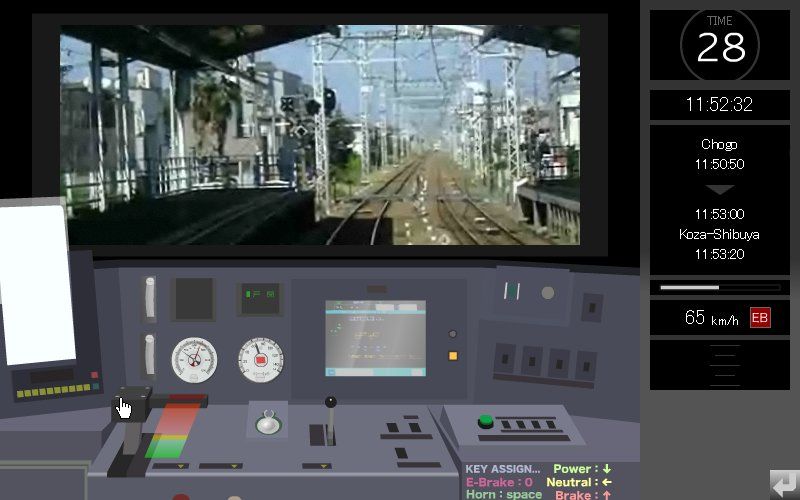
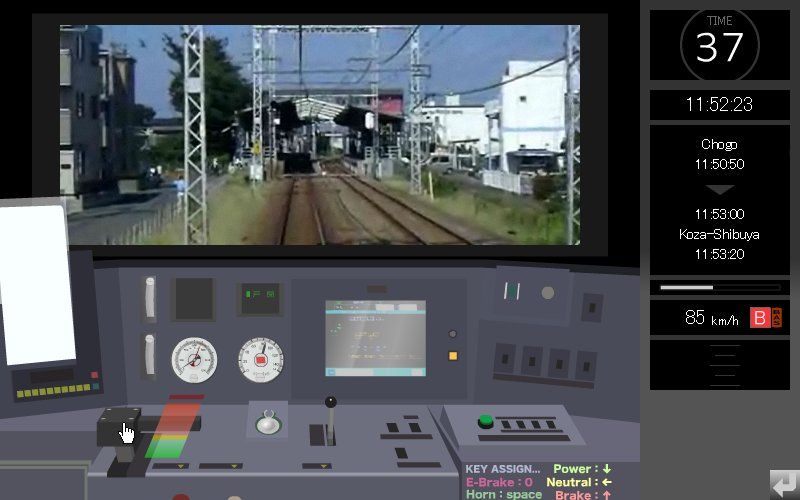
This is a Flash-movie-based train simulator, and the useful visual information is concentrated in the driving display. A readout on the right keeps time, speed, and distance to the next station in view, which is exactly what you need while judging an approach.

Story
There is no story pulling you down the line. The trip itself is the premise: take a commuter train from Chogo to Sakuragaoka and do the job properly.
That absence suits the game’s small scale. Rather than asking you to invest in characters or plot, it puts all the weight on the routine and the result of your driving.
If you need narrative context to make a simulation memorable, this will feel bare. If the fantasy of executing a precise everyday rail service is enough, the lack of detours keeps the focus where it belongs.
Overall Experience
Enoshima Line Simulator is a compact challenge built around a very specific pleasure: learning the route well enough to arrive promptly, stop accurately, and keep the ride comfortable. The post-trip evaluation gives your performance a purpose beyond merely reaching the end, turning each successful journey into a score to improve.
Its small scope means it works best in short sessions. You can sit down for a run, make one bad braking call, and immediately understand why you want another attempt. There is a clean cause-and-effect quality to that loop, even when the game-over rule stings.
Give it a chance if you enjoy train simulations as tests of timing and control rather than as huge railway sandboxes. The route is brief and the rules are strict, but the payoff is real when you finally turn a modest commuter run into a smooth, on-time performance.


Reviews
There are no reviews yet.