 Retro Replay Retro Gaming History, Reviews & Emulation
Retro Replay Review
Gameplay
Your first hour is mostly about learning to live at Talma’s pace. You milk goats, turn that milk into cheese, gather eggs, cook, water vegetables, and keep birds from bothering the garden. None of it is framed as a race toward a larger, richer farm. This is subsistence work, repeated because the day demands it, and that immediately sets it apart from games that turn every crop and animal into a ladder toward expansion.
The merchant gives the routine some useful shape. Cheese and other goods can be traded for hay, seeds, fables, unusual items, and shotgun shells, so your chores feed back into practical choices without turning the homestead into a spreadsheet. Choosing what to do with a day has a pleasing looseness, too. You can stay focused on the farm, head into the desert, pause to reminisce, or draw in the dirt. The game leaves room for idle thought, which is more important here than efficiency.
Repetition is the dividing line. When you are attuned to its mood, the familiar circuit of goat, garden, kitchen, and merchant becomes absorbing because you feel the weight of Talma carrying on. When you are not, the same circuit can become monotonous with surprising speed. Go in wanting a compact, reflective farming routine rather than deep management systems, and the game has a much better chance of clicking.
Graphics
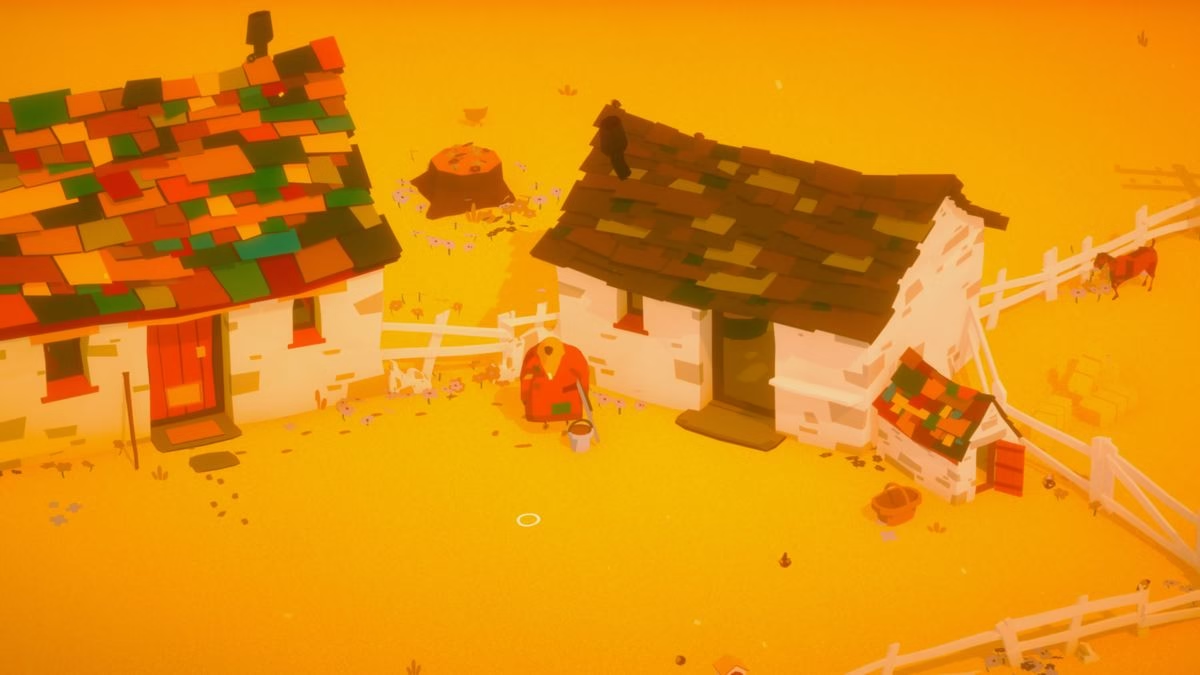
The angled overhead view makes Talma look tiny against her sandy orange-yellow surroundings, a bundled figure in a red-orange coat moving between whitewashed stone buildings, fences, a well, flowers, and goats. Uneven, multicolored roof tiles give the homestead a handmade charm, keeping this lonely place from looking sterile.
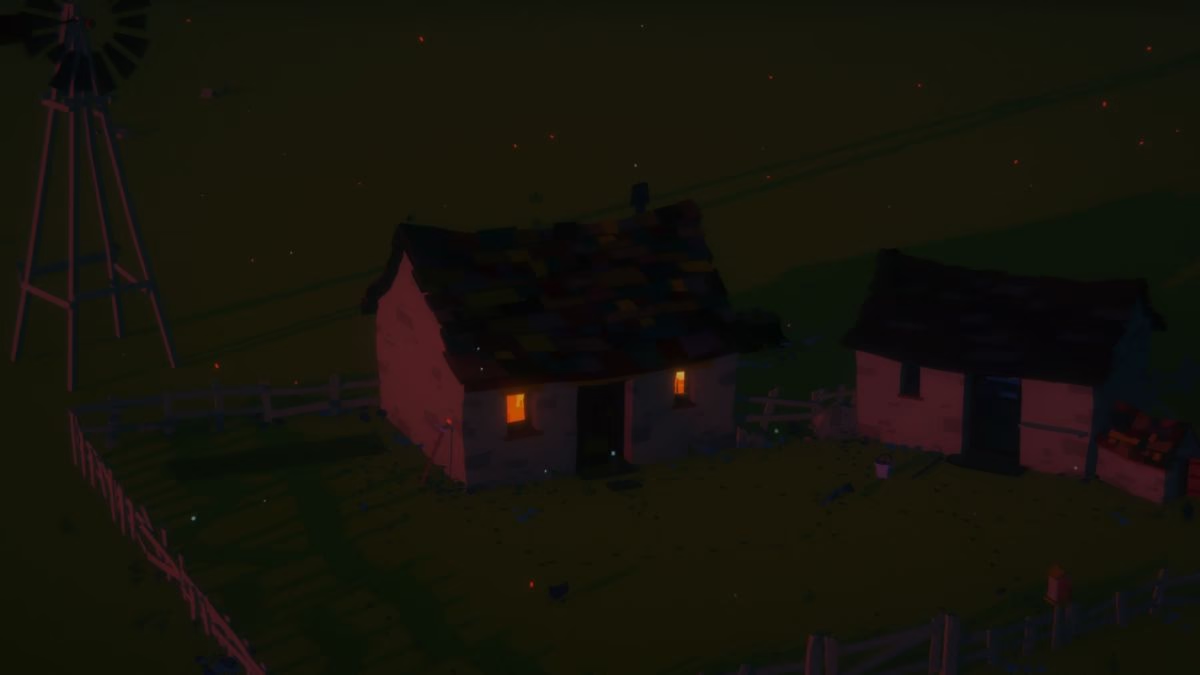
At night, dark olive shadows swallow much of the farm, while warm orange windows and tiny red points break through the darkness. It is a striking mood, though animals and smaller details can be hard to pick out once the light falls.
Story
The Stillness of the Wind finds its emotional force in what remains after departure. Talma stays at the homestead while everyone else has gone to the city, and the merchant becomes her only human contact. That is already enough to make even an ordinary delivery feel charged.
The letters brought back from the city become increasingly disturbing, giving the daily chores an accumulating sense of unease. The game does not need to interrupt its farm work with grand plot machinery. Instead, it lets the contrast do the work: you water vegetables and make cheese while news from far away changes how isolated the homestead feels.
Its concerns with aging, family separation, life, and loss land because Talma is not merely observing them. She still has work to do. If you want another game that touches family separation and mortality, All Our Asias is a worthwhile contrast, though that game explores memory worlds rather than settling into this game’s repeated farm chores.
Overall Experience
This is a thoughtful, melancholy game that asks you to meet it halfway. Its best moments come when a familiar task, a quiet walk, or the merchant’s arrival makes you feel the distance between Talma and the city. The game earns that feeling through routine rather than spectacle.
It will not suit you if you need constant novelty or want farming to snowball into a grand project. The chores are intentionally central, and they can test your patience. For the right mood, though, that friction is part of the point: routine becomes both comfort and burden.
The payoff is worth it for anyone drawn to intimate stories told through ordinary work. The Stillness of the Wind is a modest but memorable follow-up to Where the Goats Are, with more emotional weight than its quiet days first suggest. For release details and more on Talma’s farm life, the publisher’s page for The Stillness of the Wind is useful.


Reviews
There are no reviews yet.