 Retro Replay Retro Gaming History, Reviews & Emulation
Retro Replay Review
Gameplay
Zero Gear takes the basic kart-racing idea and makes it much less interested in a clean run to the finish. Boosting, flipping, spinning, and sliding are all part of its physics-driven action, while weapons and power-ups give every competitor a chance to upset somebody else’s plan. That creates a more boisterous kind of race, where holding first place is only one concern.
The selection of modes is one of the strongest reasons to give it a look. Race supplies the familiar competitive foundation, but Tag, Goal, and Target shift the group toward different kinds of contests. That variety matters because it gives the same karts a purpose beyond circling a course, especially when a group wants to change pace without leaving the game.
The weapons set the tone. Tornadoes, repulsor shields, and love-seeking L.U.V. bots give the equipment an intentionally ridiculous character, and that is a big part of Zero Gear’s charm. Anyone after a disciplined driving contest may lose patience when power-ups take over a close match, but the game is more entertaining when everyone accepts that disruption is part of the point.
Graphics
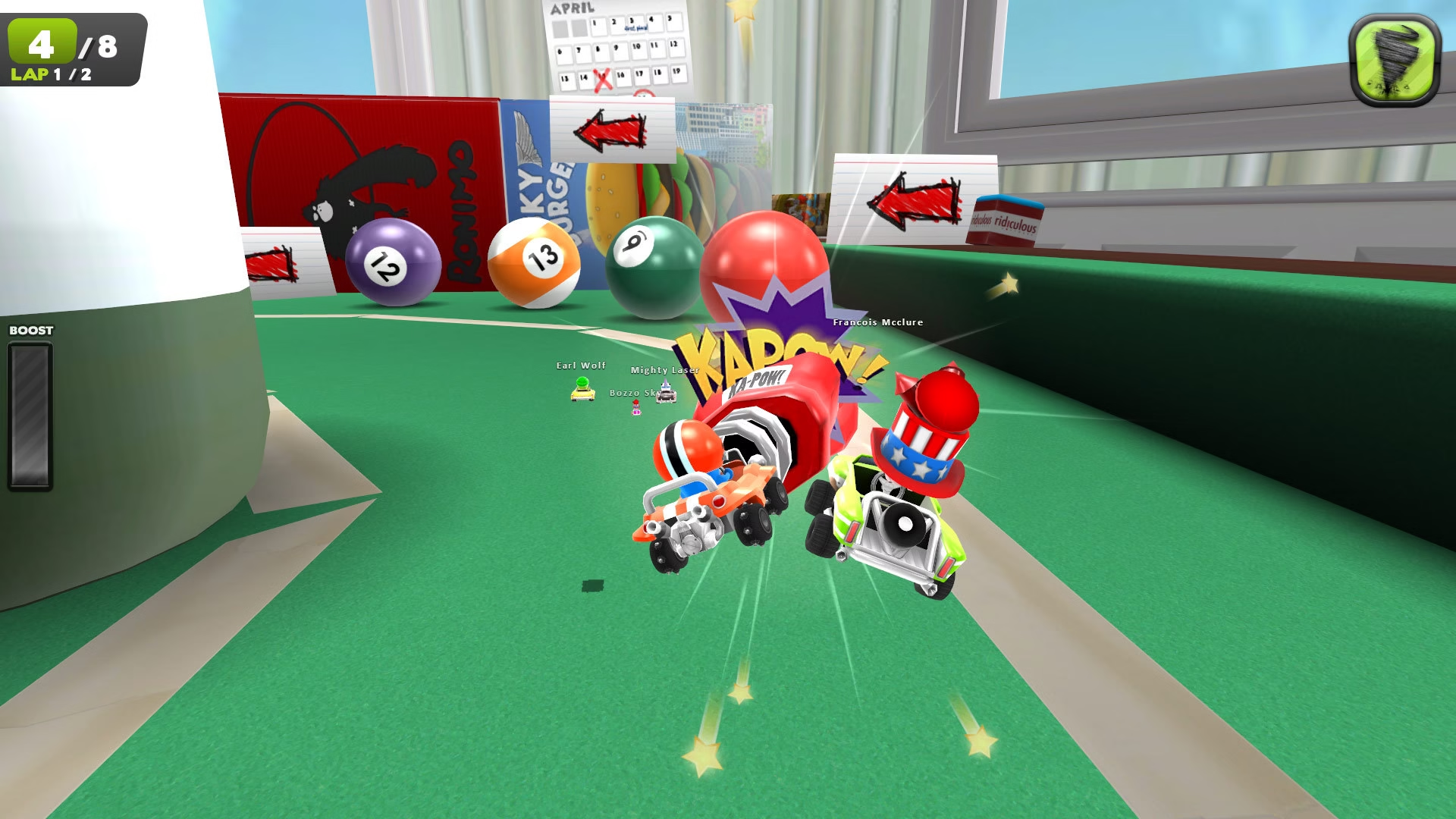
Tiny karts race across green pool-table felt while enormous billiard balls and household objects loom around them. Red arrow signs look sketched onto scraps of paper, and a collision produces a bright comic-book KAPOW. The toy-sized cars and oversized surroundings give the racing a playful sense of scale. Large hats and colorful vehicles make individual drivers easy to distinguish in this scene, although the crowded action can compete with the route markers for attention.
Story
Zero Gear gives its competition a toy-box personality. Customizable drivers and karts supply the player’s presence in a round, while the equipment turns a straightforward contest into something much less sensible.
A love-seeking L.U.V. bot is a good example of that tone. Alongside tornadoes and repulsor shields, it gives the confrontation a ridiculous vocabulary that fits the small cars and oversized play spaces.
The match objectives supply the immediate stakes: Race, Tag, Goal, and Target offer different reasons to chase the other competitors. The appeal rests on those shared contests, with the character customization letting a group put its own faces on the confusion.
Overall Experience
Zero Gear has a solid multiplayer foundation: up to eight competitors, more than 15 maps, customizable karts and characters, and four named modes. There is enough variety here for a regular group to avoid treating every session as the same race repeated again. The alternate modes are particularly important because they give a match a different focus without abandoning the kart-combat premise.
The trade-off is clear. Physics-driven movement and absurd power-ups can make a close contest feel volatile, so this is not the best choice for somebody who only wants precise, uninterrupted racing. For the right group, though, that volatility is the payoff. A shield, tornado, or L.U.V. bot can turn a routine lead into a fresh problem, keeping everyone involved until the round is over.
Readers familiar with Mario Kart Wii will recognize the broad appeal of arcade kart competition, while Zero Gear also offers its own Tag, Goal, and Target modes alongside physics-based combat. It is worth the time when the goal is a loud, goofy online game where changing the outcome matters as much as driving a tidy lap.



Reviews
There are no reviews yet.