 Retro Replay Retro Gaming History, Reviews & Emulation
Retro Replay Review
Gameplay
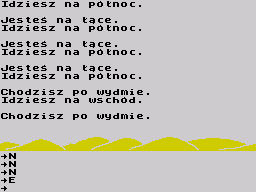
The first hour of Puszka Pandory is likely to feel less like being guided through an adventure and more like being set loose on an expedition. You are investigating an uninhabited island, and the game lets you move freely across it in pursuit of a missile system. That immediate lack of rails has real pull: every direction feels like it might take you closer to the answer.
Then the island’s scale starts to sink in. There are 1,600 locations, most of them empty, so progress asks for patience and a willingness to search without constant rewards. That can make an ordinary move feel tense when you are hoping to uncover something useful, but it can also become frustrating when another stretch of terrain yields nothing. This is not a game built to flatter impatience.
Its text-parser format makes the experience especially suited to gamers who like deliberate exploration and the old-school habit of keeping notes. The payoff is in building your own understanding of the island rather than being hurried from one obvious objective to the next. Give it a chance if a large, largely silent space sounds intriguing; skip it if you need frequent puzzles, characters, or discoveries to maintain momentum.
Graphics
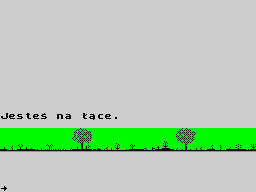
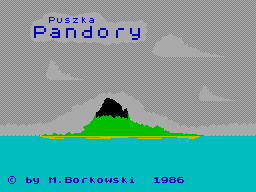
The ZX Spectrum screen adds a scrolling graphic and a colored border to show the terrain beneath your current location. It is a modest visual aid, but a useful one: while the island is explored through text, that shifting terrain cue gives your wandering a little more shape than a bare text display would.
Story
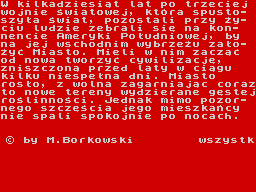
The premise is clean and urgent. In the remains of a post-apocalyptic world, a missile system threatens further destruction, and your job is to locate it on an abandoned island and destroy it. There is no need for a complicated setup when the central mission already gives every uncertain step a sense of consequence.
What works best is the contrast between that world-ending threat and the isolation of the search. You are not charging through a busy war zone; you are combing a deserted place for the means to prevent catastrophe. That makes the objective feel less like heroics and more like a grim piece of survival work.
Because the island is so large and mostly empty, the narrative comes through the act of investigation as much as the stated goal. If you enjoy filling in the atmosphere yourself, the sparse setup leaves room for that. If you want a text adventure driven by a steady stream of plot turns, the story may feel too thin between discoveries.
Overall Experience
Puszka Pandory is compelling precisely because it is uncompromising. Its enormous island and free movement create the feeling that you have been handed a place to genuinely investigate, not merely a sequence of rooms designed to feed you the next solution. When the search clicks, that freedom can make the mission feel personal.
The trade-off is substantial. Most locations are empty, and that emptiness is not a minor wrinkle; it defines the rhythm of the game. You will either appreciate the lonely, methodical hunt or find that the distance between meaningful moments drains the urgency out of the missile threat.
For a certain kind of retro adventure fan, that friction is the recommendation. Bring curiosity, tolerance for dead ends, and ideally some way to keep track of where you have been. Everyone else may admire the ambition more than they enjoy the journey. For game-specific background, see Puszka Pandory’s history and release information.


Reviews
There are no reviews yet.