 Retro Replay Retro Replay gaming reviews, news, emulation, geek stuff and more!

Retro Replay Review
Gameplay
The first few turns of Solar Fire should make one thing clear: this is not a game about casually drifting units toward the opposition. Any character that ends up adjacent to an enemy loses the rest of their movement and cannot shoot. It is a harsh rule, but it gives positioning real bite. A move that looks aggressive can instead hand the initiative away, so you have to consider not only where a Legionnaire can go, but what that square prevents them from doing.
You command six members of the Imperial Legion as they reclaim Security Zones from enemy control. The squad includes humans and robots, while each human Legionnaire has a warrior robot assigned to protect them. That setup gives the battles a pleasingly direct sci-fi military flavor, even if the objective stays brutally simple: eliminate the opposing force before it does the same to you.
There are five locations—The Asteroid Base, Rocket Site, Shuttle, Red Planet, and Outpost—and each has three starting arrangements, producing 15 scenarios. That is a sensible structure for a tactics game built around setup and maneuver. Different starts matter when adjacency can instantly shut down a unit’s ability to shoot; a poor opening route can become a problem before the fighting has properly begun.
Solar Fire will click most with you if you enjoy deliberate, constrained turn-based encounters and can accept a rule set that makes close contact risky. The victory-point system also acknowledges skill setting and enemy strength, giving tougher matches more weight. If you want broad objectives or a forgiving way to recover from overextension, the narrow win condition and punishing movement rule may wear on you.
Graphics
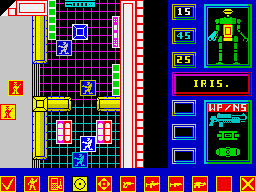
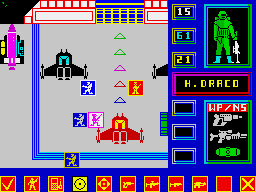
Solar Fire uses a top-down viewpoint suited to its tactical battles. From that angle, the important thing is the board position of humans, robots, and enemies: the game’s decisive adjacency rule makes knowing who is next to whom central to every turn.

Story
The story is functional military sci-fi: Central Command’s elite Imperial Legion has been sent to take back Security Zones that have fallen to enemy hands. It is a clean reason to move from an asteroid base to a rocket site, a shuttle, the Red Planet, and an outpost, without pretending the campaign is something more elaborate than a sequence of combat missions.
The strongest bit of flavor is the human-and-robot arrangement. Every human Legionnaire has a warrior robot programmed to protect its master, which gives the squad a specific identity beyond a row of anonymous units. It also makes the Legion feel like an elite force designed for dangerous recoveries rather than a generic army.
Do not come to Solar Fire for a sweeping plot or character-driven drama. Its narrative job is to frame the battles and keep the mission clear: reclaim the zones, remove the enemy, and secure control. For this kind of compact tactics game, that directness is perfectly serviceable.
Overall Experience
Solar Fire is at its best when its severe rules force a pause before every advance. The adjacency restriction is not a minor wrinkle; it is the game’s defining source of pressure, transforming nearby enemies into positional traps. When you anticipate that trap and preserve a useful firing position, the game’s stripped-down combat has genuine satisfaction.
Its limits are equally plain. Every battle ends through enemy elimination, so the scenarios live or die on the tension of their starting positions and the strength of that movement-and-shooting restriction. That will feel admirably focused to a patient tactics fan, and repetitive to anyone who needs varied mission goals to stay invested.
Give Solar Fire a chance if you like compact turn-based strategy with hard consequences for careless movement. It does not soften its central idea, but it applies that idea across 15 scenarios with enough variation in starting positions to make the next deployment worth considering. The payoff is a stern, thoughtful old-school skirmish game rather than a lavish campaign.


Reviews
There are no reviews yet.