 Retro Replay Retro Gaming History, Reviews & Emulation
Retro Replay Review
Gameplay
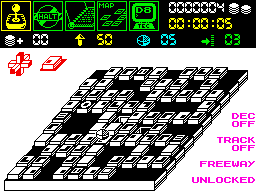
The first few boards pull you in with immediate, tactile decisions. You guide a pod from tile to tile in isometric rooms, collecting points and probing for exits, but every square has the potential to change your plan. Some take you to another board, some transport you elsewhere, question-mark blocks trigger random effects, and Targets relocate after you touch them. You are rarely just moving toward a finish; you are trying to leave the board in a state that still lets you survive and score.
Sophistry gets properly interesting once its level attributes start interfering with that basic loop. Decrement Status means a scoring tile loses value after you leave it and eventually disappears. Tracking Status is harsher still: most tiles vanish once you jump away from them. Suddenly, your route is a limited resource. Reaching a Target often resets the board, while spending bonus points on Uppers can raise tile values and even bring decremented blocks back. That makes points more than a high-score flourish—they are currency, insurance, and sometimes your way out of a self-made trap.
The friction is that this is an uncompromising game. Exit locks may demand a score or simply more time spent on a board, while different board types add time limits, score requirements around the Target, permanent disappearing blocks, and moving blocks. Seekers that hunt your pod can turn careful planning into a panic. Losing progress because you misunderstood a tile interaction will frustrate you, particularly before the game’s internal manual becomes familiar. Still, the map and between-board menu are useful breathing spaces, letting you study the current level and trade points for lives, keys, or Uppers.
Exploration gives the puzzle-solving a larger purpose. There are 21 levels of roughly 20 boards each, but only five are open at first. The other levels require keys, and all 64 keys are spread through the game world or available for purchase with accumulated points. That structure makes every successful detour feel valuable: you may be solving the board in front of you, but you are also building access to more of Sophistry’s maze.
Graphics
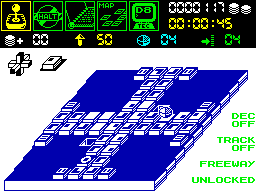
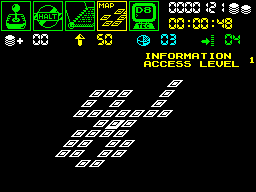
The isometric board view is a good fit for the game’s spatial puzzles. You can see the pod and the arrangement of tiles clearly enough to plan routes, while the individual blocks carry the burden of communicating the board’s many hazards, rewards, exits, and special functions. This is functional ZX Spectrum puzzle-game imagery rather than decoration, and it needs your attention.
Story
Sophistry does not lean on a narrative to carry you from level to level. Its sense of momentum comes from opening new areas, locating keys, and discovering what another board configuration will demand from you.
That absence suits the game’s abstract, rules-heavy nature. You are not waiting for a plot development; you are chasing the moment a complicated board finally makes sense and a route you thought was impossible becomes manageable.
The world map provides the closest thing to a journey. Teleporters, exits between boards, locked levels, and scattered keys turn the collection of screens into a connected place rather than a plain sequence of isolated puzzles. If you need characters or a plot hook, this will feel dry. If you enjoy mapping an unfamiliar game space, the progression has its own quiet pull.
Overall Experience
Sophistry earns its reputation as a brainy, demanding puzzle game because it keeps turning familiar goals against you. Score tiles are useful but may decay. Targets are rewarding but relocate. A safe route may stop being safe the instant Tracking Status removes the tiles behind you. The best moments come when you stop treating a board as a path to an exit and start treating it as a system you can manipulate.
Its score-driven economy is especially smart. Buying keys can accelerate exploration, but spending points on lives or Uppers may be what saves a difficult run. That tension gives the game a strategic layer beyond any single board, even if it can feel punishing when you spend badly or discover too late that a level’s conditions needed a different approach.
Give Sophistry a chance if you enjoy learning dense rule sets, making careful routes through hostile spaces, and accepting that failure is part of understanding the puzzle. It is not a relaxed score attack, despite all the points on offer. It is a stern, inventive isometric puzzle adventure whose payoff is the hard-won feeling of mastering a board that initially looked like nonsense.


Reviews
There are no reviews yet.