 Retro Replay Retro Gaming History, Reviews & Emulation
Retro Replay Review
Gameplay
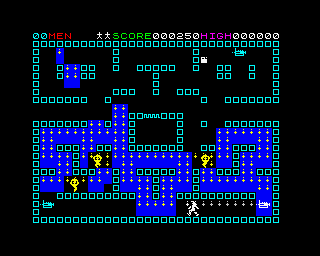
Spectres starts with an immediately understandable job: guide Eddie through a ghost-filled maze and leave light bulbs behind him. The twist is that the bulbs are only potential safety until you reach a generator. Hit one, and every bulb currently laid down lights up, turning ghosts in those illuminated sections into targets. It is a strong variation on the familiar Pac-Man-style chase, because each trip through the maze is also an investment in a future counterattack.
The first few runs are likely to be more cautious than triumphant. You can score simply by placing bulbs, but the bigger moments come from activating a generator after you have built a useful trail and then pursuing vulnerable ghosts. That forces you to think a step ahead: a long route can become a valuable lit hunting ground, yet it also leaves you exposed while you are trying to reach the generator.
The catch is wonderfully mean. A generator burns out after use, taking every bulb with it. Spectres therefore refuses to let you settle into a comfortable, permanently cleared route. You are always rebuilding your advantage, and a bad encounter can interrupt that plan. Being caught sends Eddie to the central electrified pen and costs a life, though your previously placed bulbs remain when play resumes. That small mercy keeps a mistake from wiping out all momentum and gives the next attempt some real purpose.
Graphics
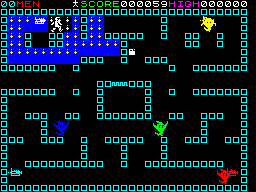
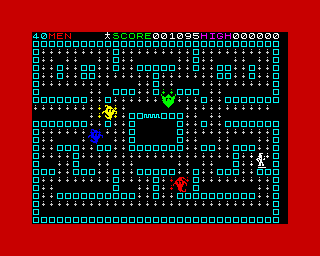
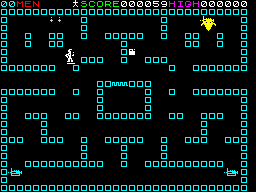
On ZX Spectrum, Spectres is built around the maze view: Eddie, ghosts, bulbs, generators, and the central pen all need to be read at a glance while you move. The light-bulb trail is the key image, because it lets you see the territory you have prepared before a generator switches the situation in your favor.
Story
There is not much plot to carry Spectres, but its tiny setup is memorable enough. Eddie is an electrician—effectively a maze maintenance worker—sent to replace bulbs in a building full of ghosts. It is a deliberately silly excuse for the action, and it suits an arcade game that needs you moving right away.
The premise does more than decorate the maze. The bulbs are your score, your temporary trap, and your route through danger, so Eddie’s work directly explains the game’s central rule. That is a cleaner fit than a generic hero-versus-monsters setup would have been.
Don’t expect character development or a larger mystery behind the haunting. Spectres tells its whole story through the repeated image of one worker trying to do a dangerous maintenance job while ghosts turn every corridor into a risk.
Overall Experience
Spectres earns its place as more than a Pac-Man imitation because the generator-and-bulb system changes the rhythm of the chase. You are not only escaping enemies or vacuuming up a maze; you are constructing the conditions for a brief reversal. When a carefully laid route lights up and nearby ghosts become catchable, the game’s simple idea clicks.
Its limitation is also its focus. Everything rests on repeating that same cycle of laying bulbs, reaching a generator, scoring on ghosts, and starting over after the lights vanish. If you need changing objectives or a story to sustain you, the loop may wear thin. If score-chasing and route planning are enough, the disappearing bulbs give the maze a pleasingly unstable edge.
Give Spectres a chance if you like early arcade games that derive tension from one sharp rule rather than a pile of extras. It is compact, unforgiving, and easy to grasp, but there is genuine tactical satisfaction in making a dangerous maze temporarily belong to Eddie instead of the ghosts.


Reviews
There are no reviews yet.