 Retro Replay Retro Replay gaming reviews, news, emulation, geek stuff and more!
Retro Replay Review
Gameplay
The first game of Colossus Chess X feels refreshingly straightforward: you sit down at a board and play chess, with a computer opponent built to take the details seriously. That matters more than it may sound. This program understands underpromotion, the fifty-move rule, and draws by repetition, so you are not playing a compromised version of chess where a clever endgame idea can fall apart because the software cannot keep up.
Its ability to achieve the king-bishop-knight mate is another welcome sign of ambition. That is the sort of technical endgame many casual chess programs fumble, and it gives Colossus Chess X the feel of a tool you can grow into rather than exhaust after a few easy wins. If you are learning, it is useful simply to know the machine can meet you in the parts of chess that demand patience and accuracy.
The opening book is where the program gains some real long-term pull. With 11,000 moves that you can modify, plus the ability to learn new lines from its playing experience, Colossus Chess X invites you to treat its opening knowledge as something more personal than a fixed script. You can work on the lines you care about and keep returning to see how the opposition develops. That is a much more interesting proposition than repeatedly facing an opponent that always begins the same way.
There is also enough variety around standard play to make practice less dry. Timed games let you put yourself under pressure, blindfold mode asks you to hold the position in your head, and the mating-problem solver gives the program a useful training role. The frustration is that chess software lives or dies on your willingness to bring your own goals. There is no broader adventure wrapped around the matches; if studying positions, testing openings, and playing serious games does not excite you, these extras will not transform it.
Graphics
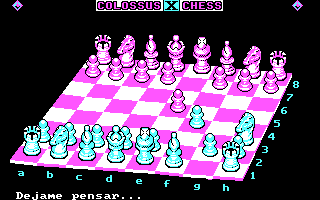
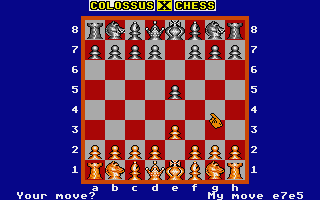
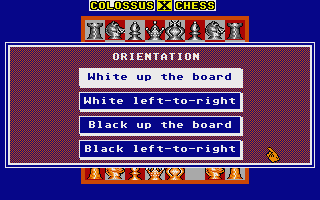
You can use a standard 2D board or switch to a freely rotatable 3D board, and four graphical piece sets let you choose the look that suits you. The 2D option is the sensible choice when you want to read a position quickly, while the rotatable board is a pleasant alternative for anyone who likes viewing the pieces as objects rather than symbols on a flat grid.
Music and speech add a little extra activity around the board, and a demonstration mode lets the program play without your input. The graphics are focused squarely on making a chessboard pleasant to use, not on distracting you from the position.
Story
There is no authored plot here, but chess has its own small dramas, and Colossus Chess X is built to let them play out properly. A quiet opening can turn into a tactical test, an endgame can become a long technical grind, and the clock can make a perfectly good position feel suddenly desperate. The story is the one you create across the board.
That makes the learning opening book more meaningful than it first appears. Over time, you are not only playing isolated games; you are building a history of familiar variations and revisiting the decisions that got you into trouble. If you enjoy recognizing an opening from last week and trying a better answer today, the game gives that continuity room to develop.
Blindfold play and mating problems shift the focus away from competition and toward mastery. They ask you to imagine the board, calculate clearly, and finish positions that have a definite answer. For a chess fan, that can be more satisfying than any scripted narrative because improvement is visible in the moves you stop missing.
Overall Experience
Colossus Chess X earns its reputation as a substantial early 16-bit chess program because it respects the full game. It is not content to offer a decorative board and a few casual matches; it accounts for difficult rules, supports serious endgames, and gives you several ways to practice. The payoff arrives gradually, as you realize the same program can serve as opponent, opening lab, puzzle tool, and clock-pressure sparring partner.
It is especially easy to recommend if you like treating computer chess as an ongoing hobby rather than a quick diversion. Start with standard 2D games, then experiment with the clock or use the mating problems when you want focused practice. Once you have a few preferred openings, the editable book and learning behavior become the reasons to keep it installed.
For context on the series’ earlier lineage, you can also look at Colossus Chess 3.0. Colossus Chess X is not trying to charm you with a fictional world; it wins you over by being a capable chess partner with enough depth to reward repeated, thoughtful play.


Reviews
There are no reviews yet.