 Retro Replay Retro Gaming History, Reviews & Emulation
Retro Replay Review
Gameplay
The best moments in Espionage come when a simple delivery route turns into a small tactical argument. You want to bring microfilm back to base, but an enemy agent can sit in exactly the wrong square, forcing you to decide whether to find a safer route, set up a capture, or risk losing momentum. Because the three agent types move differently, your twelve-piece team has more character than a set of identical counters.
Captures give the game its teeth. Jumping an opposing agent, draughts-style, is immediately understandable, and the score for eliminated agents means aggression can matter even when you are behind in the film race. That scoring mix is smart: a player who cannot simply sprint home with canisters still has reasons to fight for the board and preserve their own team.
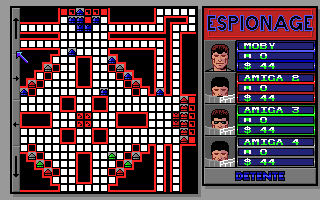
It does ask for patience. The board does not fit on one screen, so you must scroll to inspect the whole contest; that can interrupt the satisfaction of planning a long move. The hint option is genuinely useful when the movement rules are still settling in, while the last-move display helps you reconstruct what changed before your turn. Use both early rather than treating them as a crutch.
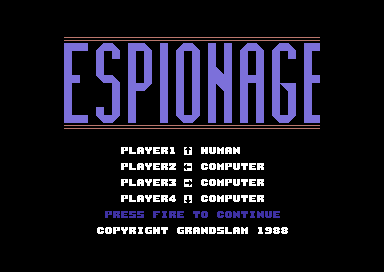
With up to four human or computer-controlled sides, Espionage can become a pleasantly busy contest of interference. A time limit can push turns along, or you can let the match run until every canister has been recovered. Neither format changes the fact that this is a deliberate board game first: success comes from seeing lines of movement and denying them to somebody else.
Graphics
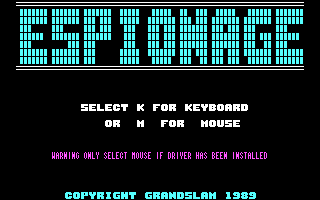
The action is shown from directly above on a scrolling board. That view keeps the pieces and their square-by-square movement clear, but the need to move around the board means you never get the whole tactical picture in one glance.
Story
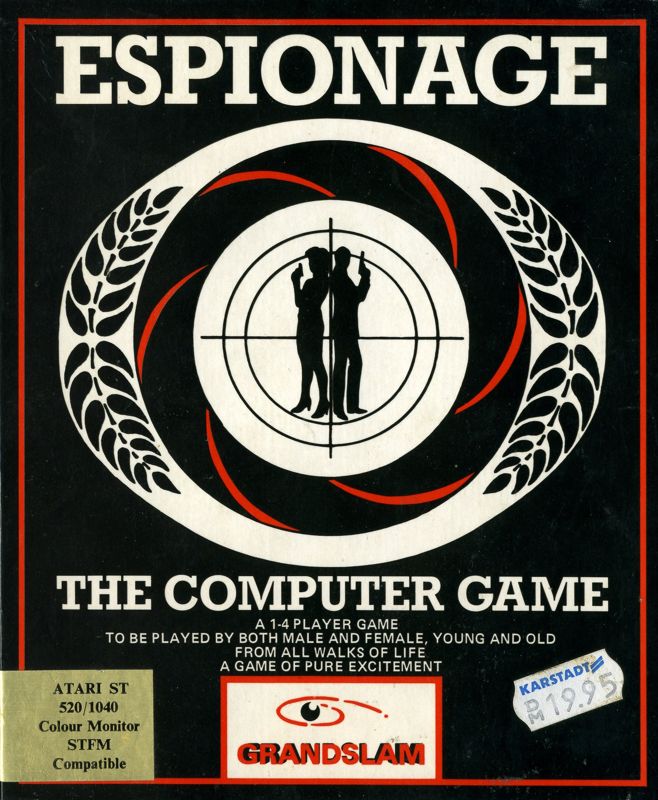
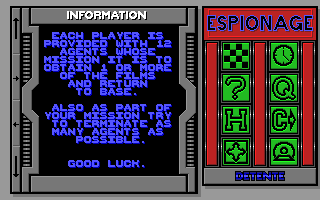
Espionage uses its spy theme as a clean competitive frame rather than a dramatic tale. You are trying to become Master Spy by returning microfilm canisters to base, with rival teams standing between you and the finish.
That premise fits the rules well. Courier-like work, surveillance, secret agents, and enemy eliminations all point back to the same Cold War-flavored contest, even if the real drama comes from the board positions rather than from characters or plot turns.
Do not come to it expecting an unfolding espionage adventure. The story is the match itself: a canister close to home, an exposed agent, and the question of whether one capture is worth opening a route for a rival.
Overall Experience
Espionage has the sturdy appeal of a board-game conversion that understands why the tabletop rules work. Different movement patterns give each turn a puzzle, captures prevent the film objective from becoming a bland race, and the final tally rewards more than one style of play.
Its limitations are equally clear. Scrolling around a board that cannot fit on screen slows down assessment, and the game’s enjoyment depends heavily on whether you enjoy calculating positional moves rather than reacting to spectacle. The spy wrapper adds flavor, but the rules carry the experience.
Give it a chance if you like chess-adjacent movement puzzles, draughts-like captures, and competitive games where a score can be earned through several avenues. It is less convincing as a quick, breezy strategy fix, but it has enough tactical friction to reward a group willing to learn how its agents work.

Reviews
There are no reviews yet.