 Retro Replay Retro Gaming History, Reviews & Emulation
Retro Replay Review
Gameplay
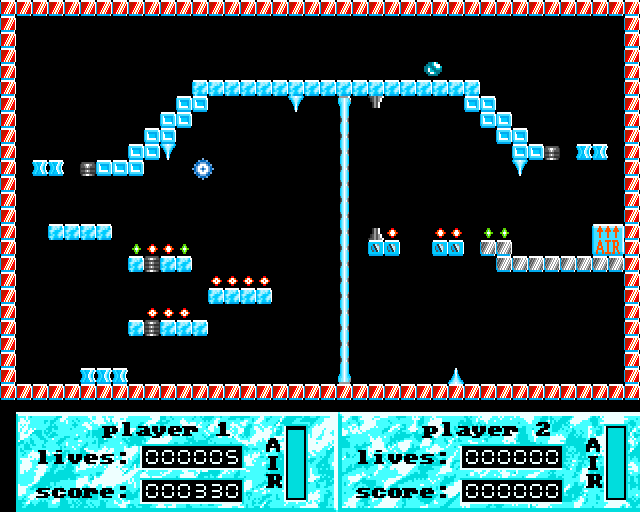
Iceball gets straight to the point: you are a bouncing ball, every level is one screen, and you need every diamond before you can call the job done. That directness is its strength. There is no long runway before the challenge arrives; you immediately start judging jumps between floating platforms and deciding whether a tempting diamond is actually worth the risk.
The catch is that the ball can only jump. That restriction sounds slight on paper, but it makes movement the whole game. You cannot simply correct a bad line with a more flexible set of moves, so successful runs come from reading the screen, committing to a route, and learning how much room each jump really gives you. Once that starts to click, the levels feel less like random hazard dodging and more like short obstacle puzzles with arcade timing.
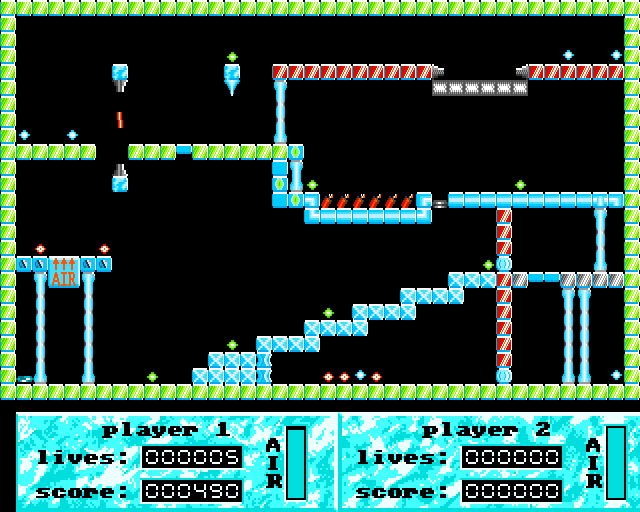
Hazards give the screens their bite. Stationary spikes and lasers punish sloppy routes, while moving dangers such as aliens and bombs force you to wait, react, or take a more cautious line. The air-pressure system is a particularly useful complication: special blocks are not optional decoration when the ball needs refilling, and fitting them into a diamond-collecting route can make a seemingly simple screen far tighter.
Frustration will arrive if you want a forgiving platformer. A bouncing character with only one basic action leaves little room to improvise after a mistake, and the game asks you to repeat and refine. But with 50 levels built around compact goals, that repetition has a purpose. Iceball works best in short bursts, when you are happy to spend a few attempts cracking one awkward screen rather than demanding constant forward momentum.
Graphics
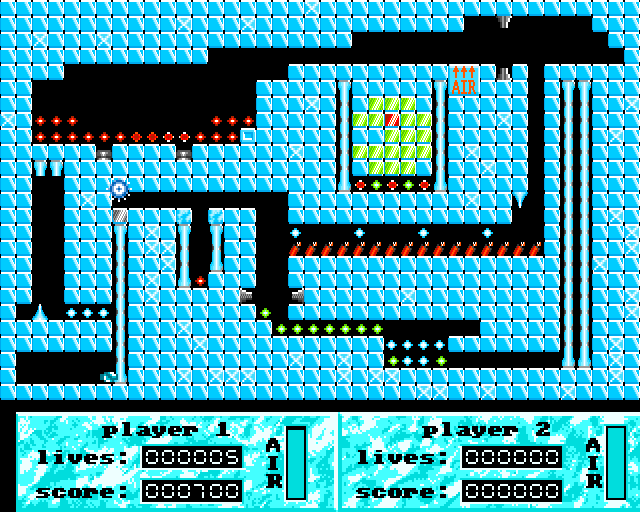
The side-view, non-scrolling stages keep the important pieces in front of you: the bouncing ball, diamonds spread across floating platforms, and the hazards blocking the route. Because each challenge fits on a single screen, it is easy to study where the collectibles sit and where lasers, spikes, bombs, or aliens threaten your next jump.
Story
Iceball is not interested in dressing its challenge up with a grand quest. Its premise is the story: a ball enters another hazard-filled screen and needs to collect every diamond to move on.
That bare framework suits the game’s arcade focus. Each level creates its own tiny drama through the order in which you dare to take diamonds, dodge danger, and visit an air-refill block before the ball runs out of pressure.
If you need characters, dialogue, or a larger narrative hook to stay invested, Iceball will feel austere. If a clean sequence of increasingly troublesome puzzle-platform screens is enough, the lack of detours helps keep your attention on the next route.
Overall Experience
Iceball is a compact, old-school test of control and nerve. Its best moments come when a level that looked hostile becomes understandable: you spot the safe sequence, make the jumps cleanly, keep the ball topped up, and clear the last diamond without donating another attempt to a spike or laser.
The game’s narrow move set is both the attraction and the barrier. It gives the 50 levels a focused identity, but it also means you have to enjoy precision, repetition, and learning from failure. There is little room here for casual button-mashing or rescuing a bad plan at the last second.
Give Iceball a chance if you like single-screen platform challenges where route planning matters as much as reflexes. It is not a sprawling adventure, and it does not need to be. For the right kind of player, its bouncing-ball limitations turn into a sharp, satisfying ruleset that keeps asking one good question: can you find a safer, smarter way through this screen?



Reviews
There are no reviews yet.