 Retro Replay Retro Gaming History, Reviews & Emulation

Retro Replay Review
Gameplay
The first hour has a pleasantly strange hook: you are not merely answering French grammar questions for marks, but doing it as a knight trapped in a sorcerer’s maze. At each junction, you choose a direction or an action in the spirit of a choose-your-own-adventure book, then enter rooms that may test your grammar or throw an enemy at you. That framing gives the exercises stakes that a worksheet simply cannot manage.
The pressure comes from the health system. Mistakes cost hit points, and hit points matter because monster encounters arrive automatically. There is no clever battle command to recover a bad situation: victory is decided by comparing your health with the opponent’s. That is blunt, but it gives every answer weight. If you rush a question, you are not just getting it wrong; you may be making the next unavoidable fight unwinnable.
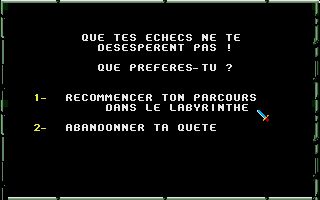
That same severity is the game’s biggest frustration. Defeat sends you back to the beginning, so progress can disappear after a chain of errors or poor choices. The final stretch also demands that you have collected enough magic letters to reconstruct the password after defeating Errare. Pay attention to exploration and treat letters as essential, not optional, or you risk reaching the climax without what you need.

Graphics
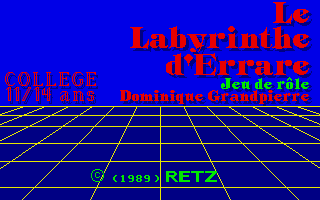
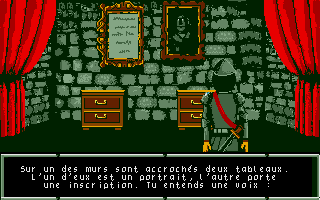
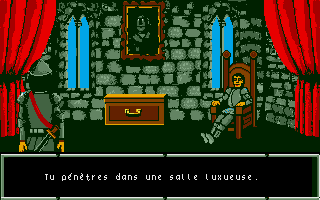
The game moves between static third-person displays, with rarer first-person views. Its maze adventure is therefore carried by individual room and intersection screens rather than fluid movement, fitting the book-like, decision-by-decision structure.
Story
The premise is cheerfully direct: King Littré the First sends you to restore proper French across his realm after the sorcerer Errare imprisons the enchanter Grévisse and corrupts the kingdom’s copyists. Grammar mistakes become cursed pages, and correcting the language becomes a heroic task rather than a classroom chore.
It is a thin fantasy story, but a useful one. Rescuing copyists, finding four keys, locating the grammar book, and gathering letters for a final password all give the lesson material a concrete purpose. You always understand why the maze matters, even if the narrative is more of a frame for questions than a source of dramatic surprises.
The wordplay in the names makes the tone clear: this is a French-language learning game that knows exactly what it is doing. Younger teens who can enjoy a pun-laden quest alongside grammar practice are the right audience; the story is unlikely to hold much mystery for an experienced adventure-game fan.
Overall Experience
Le Labyrinthe d’Errare earns its place as educational software by making failure matter. Grammar questions are not detached interruptions; they feed directly into survival, exploration, and the ability to finish the quest. When that loop clicks, you may find yourself slowing down, thinking through an answer, and remembering it because the alternative has real consequences.
Its limits are equally clear. Combat is automatic, exploration is built from static choices, and the restart-on-death rule is unforgiving. The game asks for patience and careful play rather than quick reflexes or elaborate strategy. That can turn revision into suspense, but it can also make a learner who is already struggling feel punished twice.
For an 11-to-14-year-old studying French grammar, the fantasy wrapper and escalating risk make this more memorable than routine drills. Give it a chance if you want learning software that commits to being a demanding game as well as a quiz. Skip it if you need generous checkpoints or want your adventure battles to involve more than the health total you bring into them.


Reviews
There are no reviews yet.