 Retro Replay Retro Gaming History, Reviews & Emulation


Retro Replay Review
Gameplay
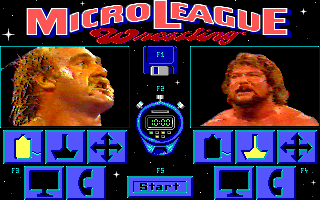
The first surprise in MicroLeague Wrestling is how little it resembles the button-mashing wrestling games you might expect. You do not directly steer Hogan around the ring or time strikes yourself. Instead, you choose a move from a menu and wait for the computer to decide whether it succeeds. The match becomes a contest of choosing options and living with the verdict rather than reacting moment to moment.
That approach has a certain novelty at first. Every selection carries a little tension because the game can turn your intended attack into a failed attempt, and the digitized result shot gives the outcome a small burst of theatricality. But the system also puts a firm distance between you and the wrestlers. When the computer rejects a move, it can feel less like you were outplayed and more like you were denied a chance to play.
One or two players can take part, and bouts can run for 10, 20, or 60 minutes. The shorter setting is the sensible place to start: it lets the unusual structure stay fresh before the repeated choose-and-resolve rhythm wears thin. The separate matchup disks add some variety, though the exact second opponent differs by platform: Randy Savage is available against Hogan everywhere, while Orndorff appears on Atari ST and Commodore 64 and DiBiase takes that slot on DOS and Amiga.

Graphics
The memorable images are the digitized stills of real WWF personalities. Wrestlers, managers, interviewers, commentators, and announcers appear around the bouts, while match results are also shown through still pictures rather than fluid in-ring animation. The look is dated, obviously, but it has the specific charm of an early attempt to put televised wrestling faces into a computer game.
Entrances, interview segments, crowd reactions, and ringside commentary give you more to look at than a bare match screen, and the accompanying theme renditions help sell the WWF-TV imitation. The still-image format is also its limitation: this is a slideshow-style wrestling experience, not a game built around animated physical action.

Story
There is no conventional campaign story here. MicroLeague Wrestling builds its drama from the matchup itself: Hogan facing Randy Savage, Paul Orndorff, or DiBiase depending on the version, with familiar WWF personalities turning up in the surrounding broadcast-style material.
The pre-match interviews and entrances do more narrative work than the bout system does. They establish the feeling that you are watching a made-for-TV wrestling confrontation, then the actual match strips that drama down to move choices and success checks.
That makes the game better suited to fans who enjoy the period WWF atmosphere than to anyone hoping for an evolving rivalry or a long-form wrestling career. Its small amount of context is flavorful, but it is there to frame the match rather than carry you through a larger plot.
Overall Experience
MicroLeague Wrestling is a fascinating mismatch of ambition and interaction. It works hard to recreate WWF television with digitized personalities, entrance material, interviews, commentary, and crowd reactions, then asks you to engage with the match through a menu and a computer ruling. For some retro fans, that peculiarity is exactly why it is worth seeing.
If you want to feel responsible for every grapple, reversal, and strike, frustration will set in quickly. The game asks for patience with its indirect combat, and longer bouts can make that limitation especially apparent. Treat it as a curious strategic interpretation of wrestling rather than an action game and you will have a better time.
At 6.4, it lands as a notable first WWF-licensed wrestling game with more historical pull than lasting competitive depth. Give it a chance if the era, the digitized WWF imagery, or the unusual design sounds appealing; otherwise, its lack of direct control is likely to be a deal-breaker. For release and historical context, the MicroLeague Wrestling history is useful background.



Reviews
There are no reviews yet.