 Retro Replay Retro Gaming History, Reviews & Emulation
Retro Replay Review
Gameplay
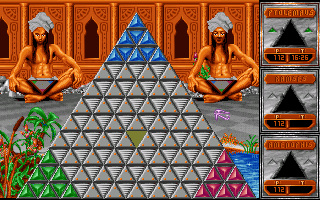
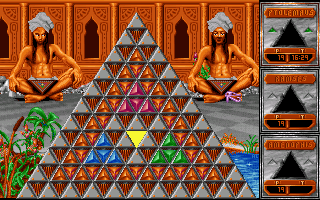
The first few turns of Osiris are about reading an unusual board: three sets of stones begin in the corners of a pyramid made from triangular spaces, and everybody wants a route toward the center. Moving a stone as many as four spaces sounds generous until its finite movement allowance starts to matter. Spend those moves too freely and a once-useful piece becomes permanently immobile, turning your own army into part of the board’s terrain.
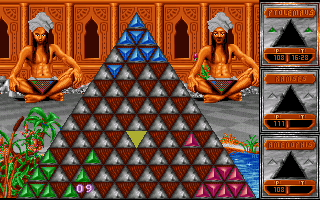
That restriction gives the game its bite. You are weighing progress against endurance, looking for ways to surround hostile stones while making sure your own pieces do not get boxed in. An enemy stone normally falls when two hostile stones surround it; an immobile one needs three. That difference makes the frozen pieces especially tense: they are harder to clear, but also easier to plan around. Osiris rewards the kind of player who enjoys seeing a position tighten over several turns rather than grabbing at the first available capture.
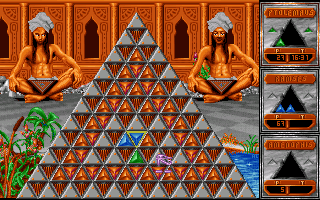
The treasure tomb is the rule that stops this from becoming a routine territory puzzle. Get a stone into the middle and that stone takes you out of the game, leaving the remaining sides three rounds to remove it. If it survives, the payoff is large. It is a wonderfully nasty switch in priorities: your apparent victory creates a shared emergency for everyone else. Captures score points too, so a tomb attempt is never the only concern, but it is the move that can make a quiet board suddenly feel desperate.
Multiplayer is where the design sounds sharpest, because every decision has two opponents watching for weakness. Solo play shifts the focus toward a lengthy set of 99 fields with rising difficulty. Stronger opponents are only part of the escalation; bombs and pre-immobilized stones change the board before you can shape it yourself. That is a solid fit if you prefer deliberate, replayable tactical puzzles, though the rules demand concentration and may feel unforgiving if you want a breezy puzzle game.
Graphics
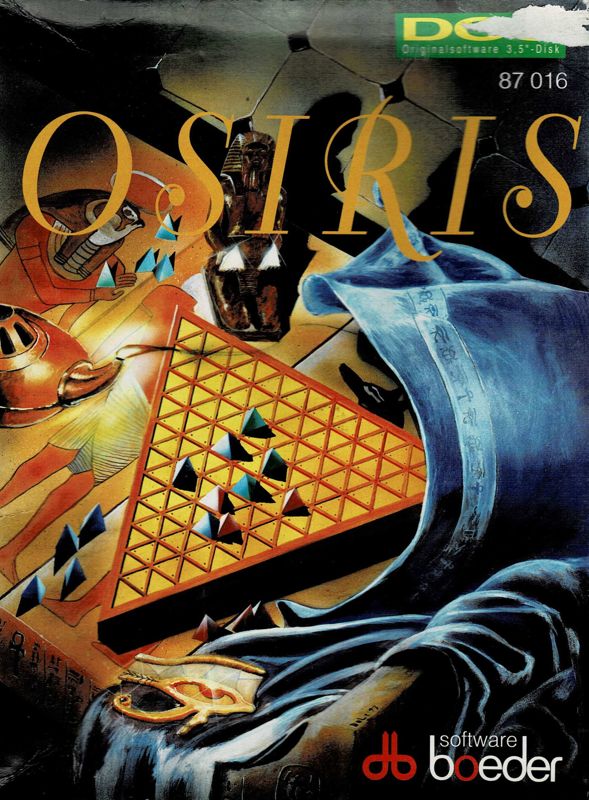
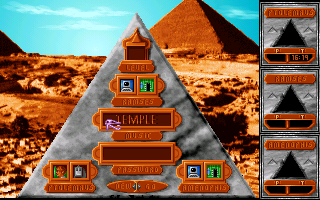
Osiris is built around a top-down, fixed board view: a pyramid split into triangular fields, with each side’s stones beginning in a corner and the treasure tomb sitting at the center. That geometry is the important thing your eyes need to track, since surrounding stones and blocked routes decide every match.
Story
Rather than telling a character-driven tale, Osiris uses the image of a treasure tomb at the pyramid’s center to give its abstract contest a destination. Each side begins at the edge and pushes inward, so the theme lands as a simple race into dangerous territory.
The most dramatic “story” comes from the tomb rule itself. A stone that reaches the center is no longer just another unit; it becomes the prize the other sides must destroy before the three-round window closes. That naturally creates betrayals, temporary shared interests, and last-second reversals without needing written plot.
The Egyptian framing is light, but it suits the board-game structure. You are not here for lore; you are here for the feeling of guarding an expedition into the center while rivals close around it.
Overall Experience
Osiris has the stern, satisfying feel of a strategy board game that expects you to learn by losing a few good-looking positions. Limited movement turns every stone into a commitment, captures punish careless placement, and the central tomb ensures that simply getting ahead is not the same as being safe.
Its strongest idea is that reaching the objective makes you vulnerable. Many tactical games build toward a finish line; Osiris makes the finish line a siege. That twist gives multiplayer matches a memorable rhythm, especially when two opponents must decide whether to cooperate long enough to stop the leader.
Give it a chance if you enjoy turn-based abstract strategy with positional traps, long-term planning, and a little table-talk tension. Skip it if you need fast action or forgiving experimentation. For the patient tactician, the escalating solo boards and cruelly clever tomb showdown make Osiris more than a simple race across a triangular grid.


Reviews
There are no reviews yet.