 Retro Replay Retro Replay gaming reviews, news, emulation, geek stuff and more!
Retro Replay Review
Gameplay
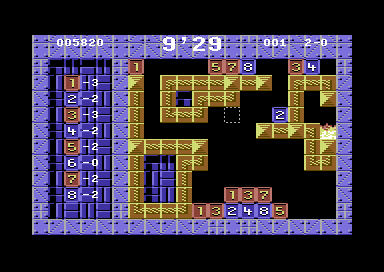
Th!nk Cross starts with the sort of rule set that makes you think you already understand it. Move blocks left or right; bring identical symbols or numbers together; remove every stone before time expires. Yet the side-on viewpoint and gravity turn that familiar matching goal into something far more deliberate than simply lining up pairs. Push one block from the wrong ledge and it falls, changing the entire shape of the board. A neat solution can collapse into a dead end in seconds.
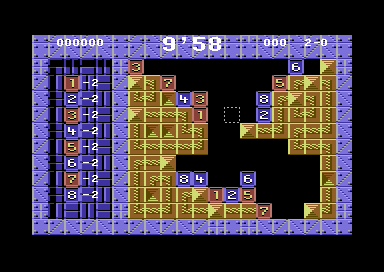
That tension is where the game earns its place among Puzznic-style puzzlers. You are not merely spotting matches, but considering order: which block has to fall first, which match must wait, and whether clearing one route will strand another piece. Conveyor belts, elevators, and fragile structures that can support only one block make the later boards feel like little machines waiting to be understood. When a sequence finally clicks, it is satisfying precisely because the solution seemed cramped and awkward a moment earlier.
The time limit gives every level a useful edge, though it can also make experimentation feel expensive. Th!nk Cross softens that old-school harshness with two uses of its help function per stage, returning the puzzle to its starting state without ending the attempt. That is a smart compromise: you still need to solve the puzzle yourself, but an unwinnable position does not automatically mean starting over from a lost life. Passwords every five levels also make a 150-level climb much easier to live with.
The score-earned bomb is another sensible safety valve. Being able to remove one chosen block can rescue a messy board, but it does not erase the need to understand the puzzle’s physical logic. The game is at its best when you use these allowances as insurance and slowly become good enough not to need them. Expect some trial and error, especially once moving level elements enter the mix, but the failures usually teach you exactly what you failed to account for.
Graphics
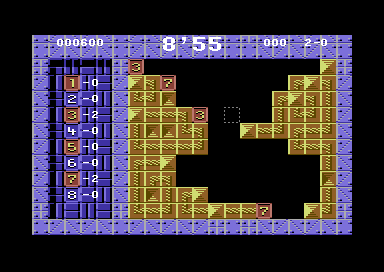
The action is shown from the side, with blocks carrying different symbols or numbers and dropping when their support disappears. That direct layout suits the puzzle well: you can see the ledges, the stack of stones, and the consequences of gravity without having to decode a busy board. It is a functional, clear look for a game whose real drama comes from a single misplaced push.
Story
There is no story pulling you from level to level here. Th!nk Cross is unapologetically about the next board, the next arrangement of marked blocks, and the next small moment of panic when the timer is still running.
That absence works in its favor because the puzzle progression supplies its own sense of momentum. Early stages teach you to respect falling blocks; later obstacles ask you to combine that understanding with conveyors, elevators, and unstable support. The changing problems give the campaign a steady arc without needing characters or plot dressing.
If you need a narrative reward between challenges, this will feel dry. If a game can hold your attention simply by putting a stubborn spatial problem in front of you, the lack of detours is refreshing. The only question that matters is whether you can clear the next screen.
Overall Experience
Th!nk Cross is a strong example of how much bite a small puzzle premise can have. Matching identical blocks is only the surface; gravity and stage machinery turn each level into a planning exercise where the obvious move is often the one that ruins everything. The result is tense, brainy, and pleasantly unforgiving without being needlessly punitive.
Its biggest strength is that it respects the player’s ability to learn. The help resets and occasional bomb prevent frustration from becoming total paralysis, but neither one solves the core problem for you. You still have to read the board, picture where pieces will land, and commit to an order of operations. That makes victories feel earned rather than handed out.
Give it a chance if you like puzzle games that reward patience, foresight, and repeated attempts at a compact board. The timed structure and potential for unwinnable positions will test your tolerance for pressure, but the restart tools make that pressure manageable. For anyone who enjoys taking apart a puzzle one careful push at a time, Th!nk Cross remains a worthwhile 7.2.

Reviews
There are no reviews yet.