 Retro Replay Retro Gaming History, Reviews & Emulation
Retro Replay Review
Gameplay
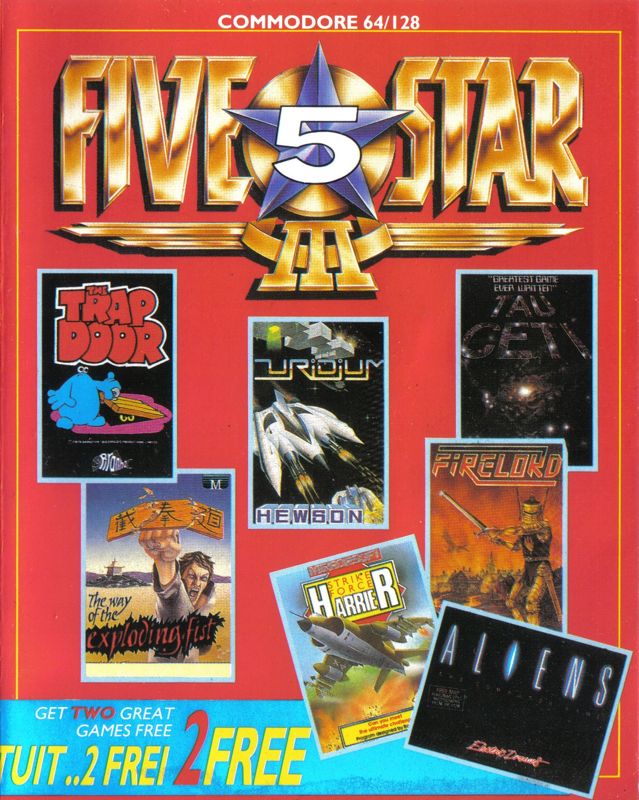
Five Star III is the kind of compilation that invites you to sample rather than commit. You can start with The Way of the Exploding Fist, bounce to Trap Door, then decide that Tau Ceti, Aliens, Firelord, or Strike Force Harrier is more your speed. That constant change is the package’s greatest strength. A weak first impression from one game does not sink the whole purchase, because there is always another completely separate challenge waiting on the menu.
There is no single learning curve here, and that is both liberating and awkward. Each game asks you to meet it on its own terms, so the collection can feel like several small first hours stitched together. If you enjoy testing yourself against different styles of old-school design, that is a terrific deal. If you want one game to steadily deepen and reward your investment, the stop-start rhythm can make Five Star III feel scattered.
Uridium Plus gives the Commodore 64 and ZX Spectrum versions a particularly strong extra hook. Its redesigned levels and added challenge make it more than a token bonus, while the ability to land at any time removes the need to wait for an instruction before doing so. On Amstrad CPC, Tempest takes that bonus slot instead. Either way, the seventh game matters: it turns a generous five-game pitch into a bundle with real room to explore.
Graphics
This is a collection rather than one unified game, so its look changes from title to title. The menu leads into seven separate 8-bit worlds rather than a shared cast, setting, or visual style, which suits the grab-bag appeal but also makes the package feel deliberately eclectic.
Story
Do not come to Five Star III expecting one narrative to carry you from start to finish. These are separate games collected under one label, and the compilation never tries to turn their titles or settings into a connected tale. You pick a game, enter its own world, and leave that world behind when you return to the selection.
That lack of a through-line is not a flaw so much as a statement of purpose. Aliens, Tau Ceti, Firelord, and the rest bring their own identities, but Five Star III is about the contrast between them, not a grand story binding them together. The shifting tone helps preserve the sense that every new selection could surprise you.
For a player who values character arcs and a final narrative payoff, this package will naturally feel thin. Its payoff is discovery instead: finding which of these standalone games earns another attempt, and which one becomes the story you remember from the box.
Overall Experience
Five Star III succeeds because it understands that a compilation should give you options, not merely fill space. The lineup has enough recognizable weight to make the bundle feel substantial, while the extra game prevents it from reading like a bare minimum collection. You are unlikely to love every included title, but you do not need to; one or two favorites can justify a compilation like this.
The frustration is equally clear. Quality and taste will vary across the seven games, and the format offers no smooth transition from one experience to the next. Some evenings you may spend more time deciding what to load than playing it. Yet that is also part of the period charm: Five Star III feels like owning a compact library, with every selection offering a fresh shot at finding your next obsession.
Give it a chance if you enjoy hopping between landmark 8-bit games and judging each on its own merits. The C64 and Spectrum editions are especially appealing for Uridium Plus, while the CPC version’s Tempest substitution gives it its own identity. As a unified game, it is inevitably uneven; as a broad, replayable selection of 1987 software, it is easy to recommend.


Reviews
There are no reviews yet.