 Retro Replay Retro Gaming History, Reviews & Emulation
Retro Replay Review
Gameplay
The first few turns of Bulls and Bears are easy to grasp: you begin with $50,000, look for stocks worth buying, and try to finish richer than your rivals. Then borrowing enters the picture and the game becomes more interesting. A loan can let you act now rather than wait, but it also turns every bad call into a more painful one. That simple pressure is the heart of the game.
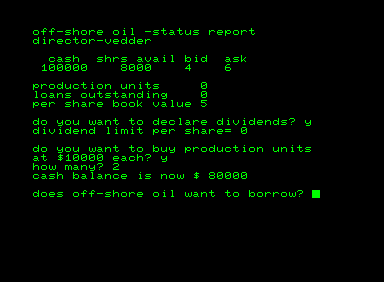
You are not limited to buying and dumping shares. After trading, you decide whether your companies declare dividends, purchase production units, or borrow from the bank. That gives the simulation a welcome sense that you are shaping the businesses behind the stocks instead of only reacting to prices. The decisions are compact, but they tug against each other in useful ways: money paid out as a dividend is money not spent expanding, and borrowed money can create opportunity or trouble.
With several people at the table, the race to out-earn the other investors supplies the drama that the bare rules need. You can play alone, and that is a sensible way to learn the flow, but competing with up to four others makes every cash total feel more consequential. If you enjoy games where a modest starting position becomes a test of timing, nerve, and financial discipline, this has a clean, focused hook.
Graphics
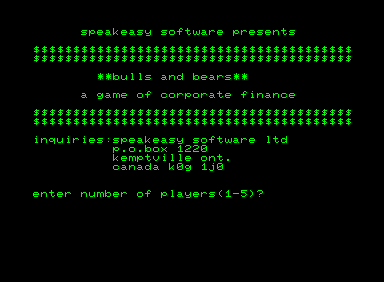
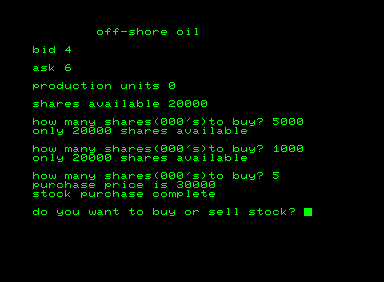
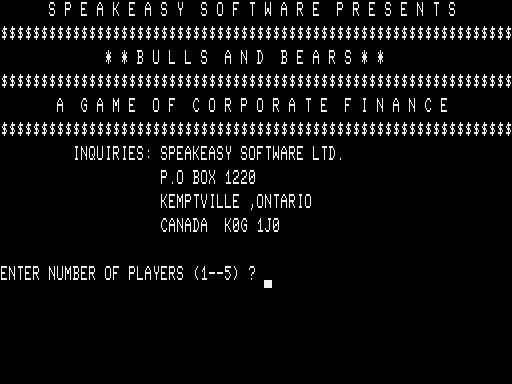
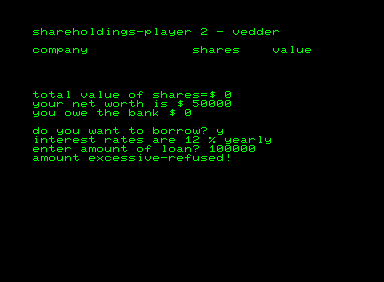
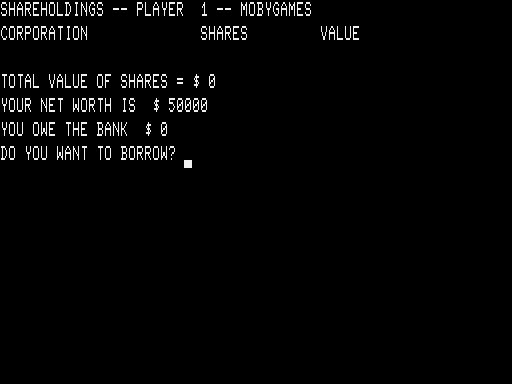
This is a text-based, spreadsheet-style Apple II game, built around fixed screens rather than animated market-floor spectacle. You spend your time with financial information and choices, so the look is functional and appropriately direct: the numbers are the point.
Story
There is no authored tale competing for your attention here. The story comes from your own climb or collapse: the moment a loan feels clever, the turn when a dividend decision seems perfectly timed, and the realization that another investor has quietly pulled ahead.
That emerging narrative works best in multiplayer because every participant supplies a natural rival. You are not saving a company for dramatic reasons; you are trying to end with more money than the person beside you. For a business simulation, that is enough motivation.
Solo play changes the tone from rivalry to self-testing. Without another player’s total looming over you, the game becomes a quieter exercise in whether your investment plan holds together.
Overall Experience
Bulls and Bears is lean, old-school financial competition. It does not bury its idea under a large rulebook or a parade of distractions. You trade, finance, and make company decisions in pursuit of the highest pile of money, and the game asks whether you can live with the consequences.
Its age shows in the text-heavy spreadsheet format, and anyone who needs constant motion or elaborate simulation detail will likely find it dry. But that dryness is also part of its discipline. The game puts the pressure directly on your judgment, where a risky loan and a poorly timed decision matter more than flash.
Give it a chance if you like compact business games, especially with a few competitive friends who enjoy comparing fortunes. The payoff is not a grand finale; it is the satisfaction of seeing a calculated plan outperform somebody else’s gamble. As a solo challenge it is serviceable, but as a shared contest it has the sharper edge.



Reviews
There are no reviews yet.