 Retro Replay Retro Gaming History, Reviews & Emulation
Retro Replay Review
Gameplay
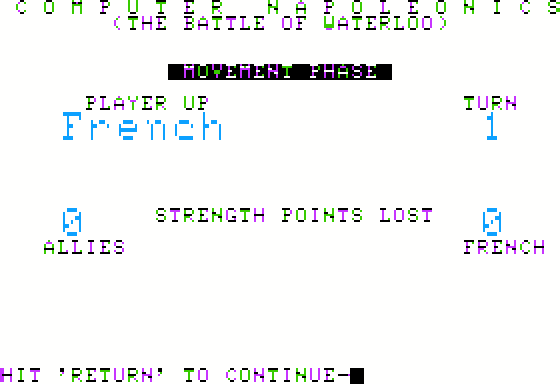
The first hour is less about grand Napoleonic drama than getting comfortable with the discipline of the turn structure. You move armies into position, engage in combat, then hand the initiative over. That sounds spare, and it is, but the pressure comes from knowing there are only ten turns in which to meet your side’s victory conditions. A bad commitment has little time to become a good idea.
The division-level scale is a sensible fit for Waterloo. You are not fussing over individual soldiers; you are weighing the placement of larger forces and deciding when combat is worth the risk. Once that rhythm clicks, the game becomes an argument about ground, timing, and whether you can create a favorable engagement before the clock runs out.
It is also a wargame that asks you to supply patience. Alternating turns and an hour represented by each turn make this a measured contest rather than an immediate-action strategy game. Two human opponents are likely to get the most out of its tension, since each movement can be read as a deliberate challenge. Against the computer, the same basic structure still gives solo players a focused historical puzzle.
Graphics
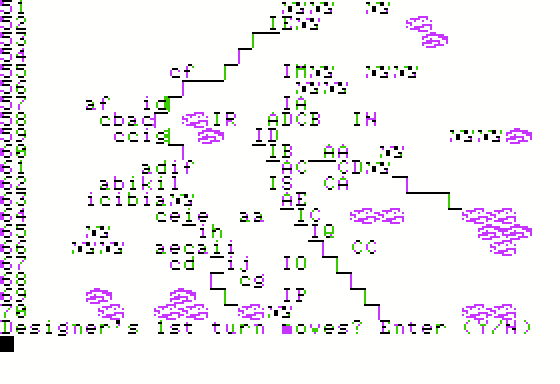
The top-down viewpoint keeps the emphasis on the battlefield and the movement of forces. This is an early Apple II wargame built around function: you are looking at positions and making military decisions, not admiring lavish battlefield detail.
Story
There is no separate campaign narrative pulling you from mission to mission. The drama comes from reenacting the Battle of Waterloo itself, with one side directing Napoleon’s forces and the other controlling the Anglo-Allied-Prussian armies.
That historical frame gives the match a stronger hook than an abstract strategy board. Every decision belongs to a famous confrontation, and the opposing objectives make the contest feel like a contest of commanders rather than a score chase.
The limited time span is especially important here. Ten turns, each representing roughly an hour, turns the battle into a concentrated day of decisions. You are not being asked to build an empire or manage a long war; you are being asked whether your plan can survive a crucial window.
Overall Experience
Computer Napoleonics: The Battle of Waterloo is narrow, deliberate, and unapologetically old-school. Its value lies in how directly it turns a major historical battle into a sequence of meaningful positional choices. If you want fast feedback or broad strategic options, its stripped-down format may feel dry.
For a gamer who enjoys early computer wargames, though, that focus is the point. The rules center on moving divisions and choosing engagements, while the ten-turn limit prevents the match from drifting into endless maneuvering. It asks for thought rather than flash, then rewards you when a careful placement leads to the fight you wanted.
Give it a chance if Waterloo interests you and you can enjoy a compact turn-based simulation on its own terms. It is less a sweeping history lesson than a concentrated command problem, and that restraint makes it more compelling than its bare-bones surface suggests.


Reviews
There are no reviews yet.