 Retro Replay Retro Replay gaming reviews, news, emulation, geek stuff and more!
Retro Replay Review
Gameplay
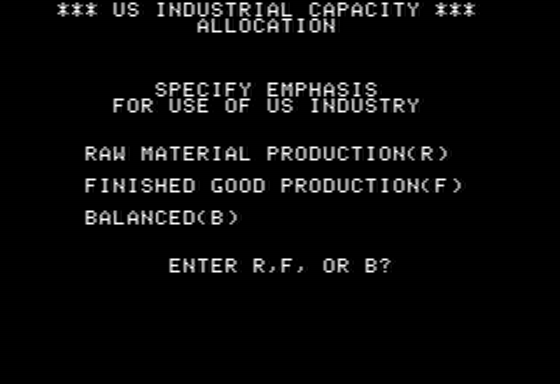
The first hour is less about grand geopolitical mastery than learning to live with constraint. You are juggling domestic resource production, the costs of maintaining forces, the ability to mobilize new ones, and the political action needed to court minor powers. None of these choices sits in isolation. Build too aggressively and you can strain the economy that must sustain your position; neglect the military and your bargaining position suffers. That interlock is the game’s best idea.
Diplomacy has real teeth because failure matters. Trade, military, and political treaties each feed the three victory measures—Gross National Product, Prestige, and National Security—but pushing a minor country too hard hurts both Prestige and its willingness to hear you out again. Choosing two victory measures before a scenario begins also gives each match a useful focus. You are not merely collecting agreements; you are deciding which kind of American success matters most right now, while racing an AI opponent chasing its own targets.
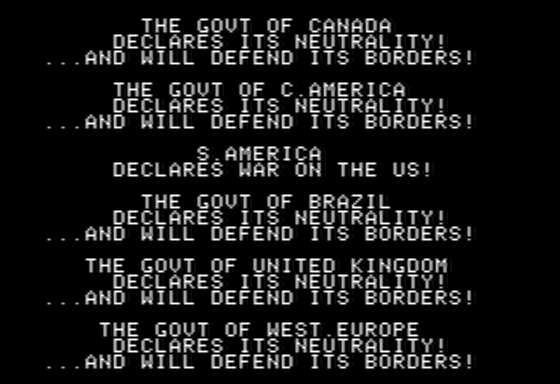
What starts to click is the value of restraint. A war against a minor country can hand you its treaties, which is tempting when negotiations stall, but it also raises world tension. That makes aggression a meaningful shortcut rather than a harmless optimal move. The catch is severe: once tension climbs high enough, the political game ends and Geowar begins. There is no diplomatic reset, no chance to talk the crisis down. You have committed the world to a different game.
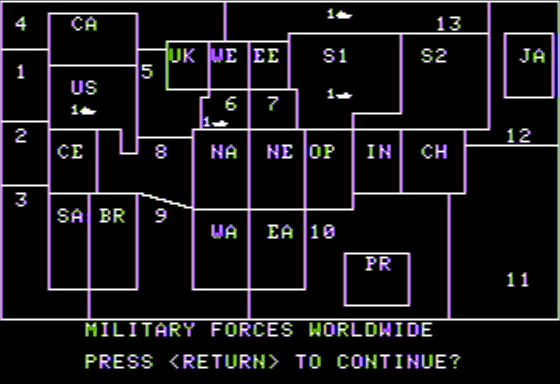
Geowar is a more direct turn-based wargame, paced in three-month turns. You build up, move units, manage air forces, and attack while trying to conquer and hold enough of the world before the other side does. Its clean objective gives the endgame urgency, but it is less distinctive than the anxious treaty-making that precedes it. The threat of Geowar improves Geopol more than Geowar itself improves the whole package.
Graphics
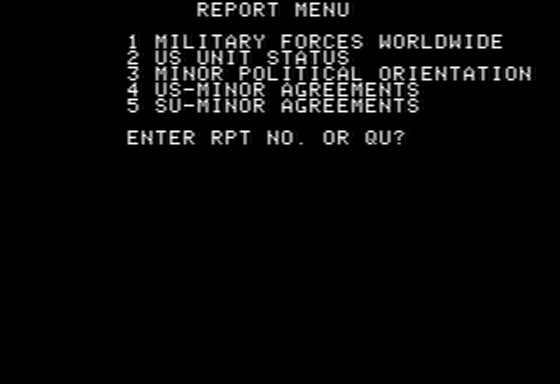
This is an austere, text- and spreadsheet-driven strategy game on Commodore 64 and Apple II. The emphasis is on values, treaties, resource points, and turn decisions rather than character animation or decorative detail. In the war portion, the top-down military view is there to track a global conflict and unit movement, not to provide battlefield drama.
Story
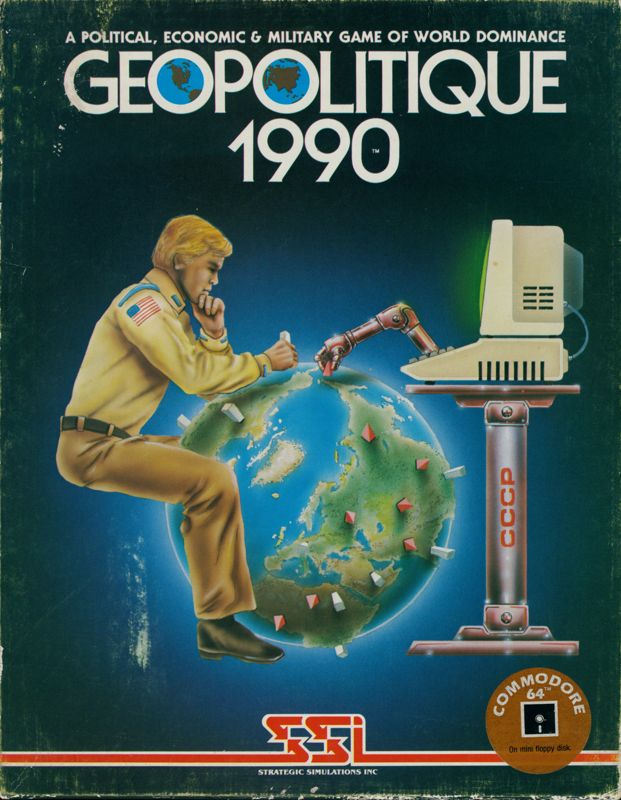
There is no character-led story to carry you through the campaign. Instead, Geopolitique 1990 builds its drama from the Cold War contest itself: the USA and USSR compete for influence while a small set of minor countries, often standing in for whole regions, become the ground on which that struggle plays out.
The seven scenarios give that premise some range. One begins from the political situation of 1984, while six imagine alternate 1990 situations. That is enough to make the game feel less like a single fixed puzzle and more like a series of escalating policy problems, each with different victory thresholds and priorities.
Its strongest narrative beat is entirely systemic: diplomacy deteriorates, world tension rises, and the careful political contest can become global war. Because that switch is permanent, your decisions create their own cautionary Cold War story. For background on the game’s history and release, the Geopolitique 1990 overview is useful context.
Overall Experience
Geopolitique 1990 is at its best when you feel the cost of every supposedly sensible decision. More troops can strengthen negotiations, but troops need support. A treaty can improve the exact measures you need, but a failed demand damages your standing. An invasion can solve one problem and create the only problem that truly matters: an uncontrollable global war. That chain of consequences remains compelling.
Its limitations are equally clear. The world is heavily compressed into just 14 minor countries or regions, so this is not a detailed simulation of international politics. The rules also demand patience; you need to enjoy examining production, capacity, and political resources before the larger strategic picture becomes satisfying. Anyone wanting swift battlefield tactics will likely find the economic and diplomatic setup slow.
Give it a chance if you enjoy old-school strategy that asks you to plan before it lets you fight. The payoff is not spectacle but a surprisingly pointed lesson in escalation: winning influence is difficult, and forcing the issue may leave you with a war that is easier to start than to win. It is a rough, narrow game, yet its political half has more bite than many broader Cold War simulations.


Reviews
There are no reviews yet.