 Retro Replay Retro Gaming History, Reviews & Emulation
Retro Replay Review
Gameplay
The first few turns of Rommel: Battles for North Africa have the pleasingly tense feel of arranging a large plan with too little time to execute it. You are not simply hunting enemy units across a hex map. Every scenario asks you to seize key locations before its turn limit expires, so an attack that looks successful can still be a strategic failure if it leaves the real objectives untouched. That pressure gives even its smaller operations a sharp edge.
At corps scale, the game puts you in command of broad formations rather than individual squads or tanks. Terrain and adverse weather can spoil an apparently straightforward advance, while supply, experience, and morale make it dangerous to treat every counter as interchangeable. The result is a game where you need to think about momentum: push too hard and a force may lose the strength needed to hold ground; move too cautiously and the calendar beats you.
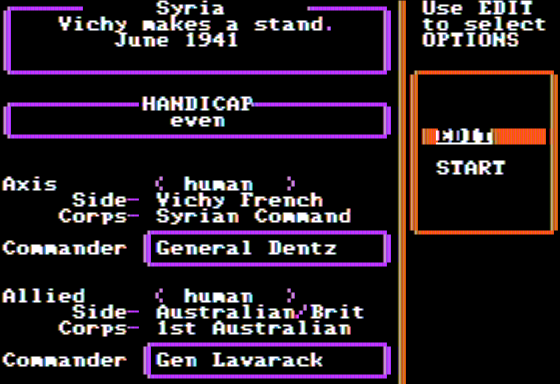
Eight scenarios offer a useful spread of North African fighting, from Syria and Sidi Rezegh to Alam el Halfa, Kasserine Pass, and Tebaga Gap. The alternate-history German invasion of Malta is a welcome change of pace. Better still, each scenario is playable from either side, which is more than a replay checkbox here: switching sides changes how you read the same roads, terrain, objectives, and deadlines.
This is firmly a deliberate hex wargame, and its rewards arrive when you start reading the map as a chain of logistical and positional problems instead of a battlefield that can be solved by attacking. If you want fast tactical fireworks, the pace will feel dry. If you enjoy working out when to conserve a formation, when to press an opening, and which objective is actually worth the risk, Rommel has real bite.
Graphics
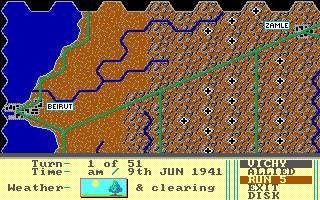
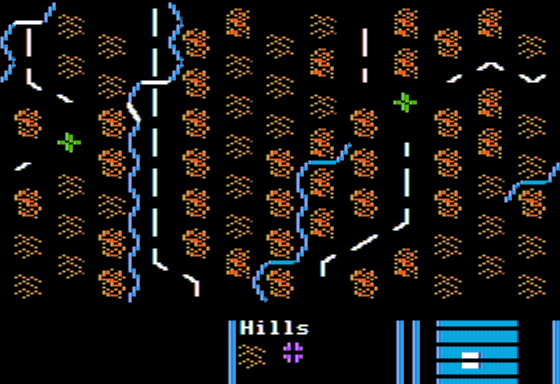
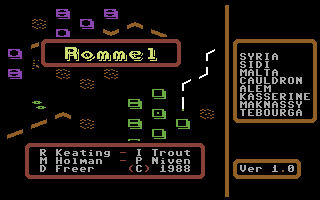
The action is viewed from above on hex-based battle maps, with unit graphics standing in for the forces under your command. It is a functional, old-school look built for following positions and fronts rather than characterful battlefield detail.
WarPaint lets you alter map and unit graphics, while WarPlan opens the door to making scenarios of your own. For a game of this vintage, that is a meaningful way to put your own stamp on the maps you spend so much time studying.
Story
There is no character-led campaign pulling you through North Africa. The drama comes from the historical operations themselves: Allied and Axis forces struggling over key ground in 1941 through 1943, each scenario framing a different military problem.
That stripped-back approach suits the subject. Syria, Sidi Rezegh, Alam el Halfa, The Cauldron, Maknassy, Kasserine Pass, and Tebaga Gap are not treated as a single sweeping narrative; they are separate contests with their own deadlines and objectives. You supply the story in the decisions that turn a contested hex into a narrow win or an unrecoverable delay.
The Malta scenario provides the one overt hypothetical, imagining a German invasion rather than reenacting a historical battle. It does not transform the game into a fictional war tale, but it gives veterans one scenario where the interest lies in testing the system against a counterfactual situation.
Overall Experience
Rommel: Battles for North Africa is satisfying because it respects your ability to make a plan and then punishes you when that plan ignores time, ground, and the condition of the troops carrying it out. Its eight scenarios are not enormous in number, but the ability to take either side gives them more life than the initial list suggests.
The included WarPlan scenario editor is a substantial bonus for anyone who wants to move beyond the supplied operations. Combined with the WarPaint map and unit graphics editor, it turns a self-contained historical wargame into something you can tinker with, reshape, and revisit. You can find additional game history and release context in this Rommel: Battles for North Africa overview.
Give it a chance if you like classic turn-based wargames that make victory about priorities rather than body counts. It asks for patience, comfort with hex maps, and a willingness to learn from a stalled offensive. In return, it offers a focused set of North African battles where every turn has a purpose and every captured objective feels earned.


Reviews
There are no reviews yet.