 Retro Replay Retro Gaming History, Reviews & Emulation


Retro Replay Review
Gameplay
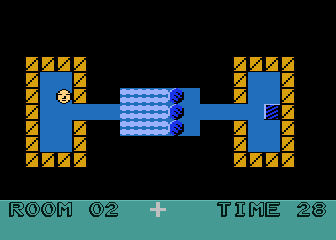
The Citadel starts with an immediately legible goal—get your character to the exit—but it earns its difficulty through the route there. Rocks can only be pushed one at a time and never pulled back, which means a casual shove can ruin a perfectly good plan. That familiar push-block tension gives the game its bite: before moving, you learn to look for the square behind an object, the corridor it may block, and the pit that might need it later.
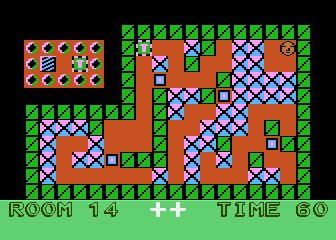
Boxes make the puzzles more interesting than a basic rock-pushing exercise. Since a row of boxes can move together, they invite broader plans and occasional moments where the board suddenly opens up. Pits ask for the right kind of object according to their shape, while teleporters can move your route somewhere less obvious. The strongest pull comes from untangling how those rules overlap, rather than merely finding a clear path to the exit.
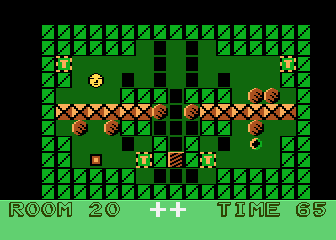
Bombs are where the game can turn a careful plan into a chain-reaction problem. You can push them into place, then use a trigger to destroy nearby objects and set off other bombs. That is a satisfying source of big solutions, but it also raises the cost of sloppy thinking. Add a time limit to every level and The Citadel becomes demanding in two ways at once: you need to think ahead, then carry out the plan without wasting moves.
Passwords are a welcome concession. A difficult puzzle can still stop you cold, but reaching later levels does not mean you must repeatedly work through the entire game from the beginning. If you like compact puzzles where an error teaches you exactly why it was an error, this structure has real staying power. If timers make you rush and resent experimentation, though, the pressure may wear thin before the later ideas can pay off.
Graphics
The Citadel uses a top-down, fixed-screen view that keeps each puzzle board in front of you at once. That is exactly the right angle for following rocks, boxes, pits, teleporters, bombs, and the exit; you can study the layout before making a commitment instead of fighting the camera.

Story
The story is deliberately spare: you guide a protagonist from one exit to the next through a citadel full of obstacles. The game puts its energy into the immediate problem on each screen rather than asking you to follow a long narrative thread.
That minimal framing fits the format. A blocked corridor, a pit, or a dangerous cluster of bombs becomes the situation you need to solve, and the route to the exit supplies the forward momentum.
Do not come looking for character drama or plot turns. The small victories are practical ones: recognizing what a level demands, preserving the object you need, and finally stepping through an exit that looked unreachable a few minutes earlier.
Overall Experience
The Citadel is a tough, focused puzzle game built around the pleasure of turning a cramped board inside out. Its rules are easy enough to grasp quickly, but the no-pulling rule and the need to place objects carefully ensure that understanding the rules is only the beginning. When a solution comes together—especially one involving grouped boxes, teleporters, or bomb chains—the payoff should feel earned.
The timer is the dividing line. It gives the puzzles urgency and prevents endless hesitation, yet it can also make a genre built on deliberate thought feel harsher than it needs to. You should give it a chance if you enjoy being punished fairly for a bad push and are willing to restart a plan with better information. You may bounce off it if you prefer leisurely trial and error.
For the patient puzzle fan, The Citadel has a solid core and enough interacting obstacles to keep the exit from becoming routine. It is not trying to charm you past its difficulty; it wants you to learn its logic, respect its limits, and take pride in a clean solution. That directness is its strength.


Reviews
There are no reviews yet.