 Retro Replay Retro Gaming History, Reviews & Emulation
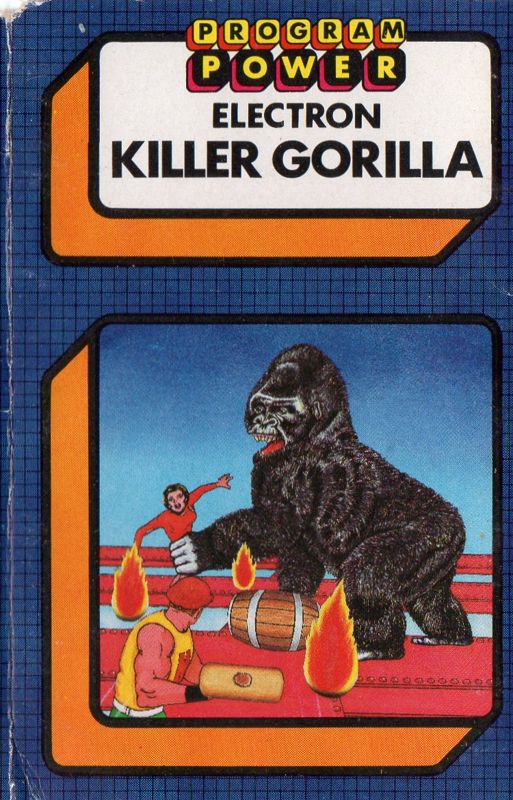
Retro Replay Review
Gameplay
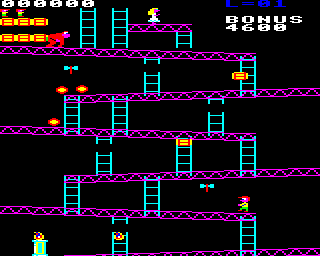
The first few minutes are wonderfully direct. You are climbing toward your captive girlfriend, watching the gorilla above and trying to decide whether to risk a ladder before the next barrel cuts off your route. There is no warm-up period and no room for sleepy play: you learn the rules by reacting, missing a jump, and immediately wanting another attempt.
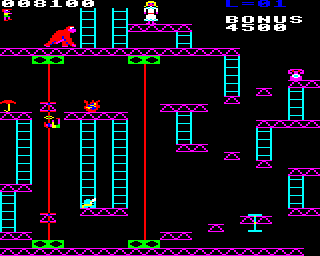
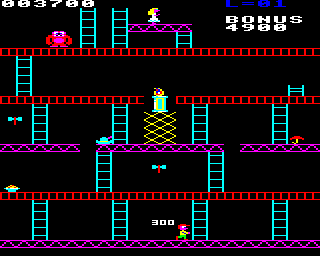
Each of the four screens changes what you need to watch. The barrel stage is the familiar foundation, with jumps, evasive climbing, and a short-lived hammer that lets you clear a path. Fireballs make that screen nastier because they do not simply roll in one predictable direction. The conveyor-belt stage asks for more patience as cement trays and shifting belt directions turn a safe-looking route into a death trap, while retracting ladders force you to time your climb instead of rushing it.
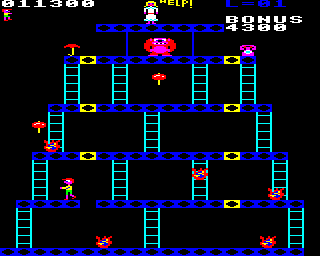
The last two stages provide the strongest change of pace. Dodging bouncing I-beams while boarding continuously moving elevators demands sharper movement than simply reading a barrel’s line, and the rivet screen gives you a focused objective: erase all eight supports without getting caught. Clearing that fourth stage does not end the challenge; it sends you back through the set at greater speed with more barrels and cement trays. That escalating loop is where the score-chasing hook starts to bite.
Frustration comes from the same stripped-down design that makes the game easy to understand. A small mistake can waste a run, and the compact set of stages cannot hide how closely it follows Donkey Kong’s blueprint. Still, the layouts ask for enough different kinds of timing that a determined player can keep finding cleaner routes and safer decisions.
Graphics
The action is shown from the side on construction-site screens built from girders, ladders, conveyor belts, elevators, and the rivet structure. Barrels, fireballs, cement trays, bouncing I-beams, and the gorilla’s threats give each screen a distinct thing to track, while the fixed layouts keep your next climb easy to judge at a glance.
Story
Killer Gorilla keeps its story as spare as an arcade cabinet. Your girlfriend waits at the top of the first three stages under the gorilla’s guard, and your only meaningful response is to climb.
That simple rescue setup works because it gives the repeated ascents a clear target. You are not wandering through a construction site; every risky ladder is another push toward the figure at the top.
The fourth stage swaps the climb for sabotage, having you remove the rivets that hold the upper structure together until the gorilla falls. Once that is done, the game returns to the beginning rather than developing the plot, so this is motivation for arcade action, not a narrative with turns to uncover.
Overall Experience
Killer Gorilla is a brisk, tough arcade platformer whose best quality is how quickly its challenges become legible. You can understand the objective in seconds, yet the changing hazards make each screen demand a slightly different rhythm.
Its biggest weakness is also impossible to ignore: this is an extremely close take on Donkey Kong. The construction-site rescue, four-screen structure, barrels, hammers, elevators, and rivet finale leave little doubt about its inspiration. That makes it a less compelling choice if originality is your main reason for exploring old games.
Give it a chance if you like compact high-score games where repetition is the point and improvement comes from memorising routes, tightening jumps, and staying calm as the pace rises. The payoff is not a grand finale; it is the satisfaction of surviving another faster loop with fewer mistakes.


Reviews
There are no reviews yet.