 Retro Replay Retro Gaming History, Reviews & Emulation



Retro Replay Review
Gameplay
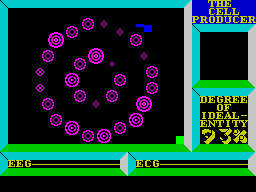
The first few minutes are disorienting in a way that is either immediately intriguing or deeply irritating. You control a green dot and later a body-like defect through brief, ever-changing scenes, while four-direction input can also produce diagonals. One moment you move between strands of DNA; another has you keeping the defect police away from an examined body; another asks you to jump over loaded words such as “LIES” and “WAR.” It never settles into a familiar genre rhythm.
That restlessness is the game’s strongest trick. Every vignette changes what your movement means, so you have to look, listen, and adapt rather than coast on learned skill. But don’t come in expecting a satisfying score chase or a series of challenges to conquer. There are no win conditions for the individual scenes, the overall path continues regardless, and the ever-present percentage shifts according to your actions without turning the experience into a conventional contest.
For some, that will make Deus Ex Machina feel like a game that refuses to reward effort. The frustration is real: you can be engaged with a scene and still sense that your control over its outcome is limited. If you accept that you are participating in a timed audiovisual piece rather than trying to “win,” though, the strange interaction starts to click. Your inputs become a way of inhabiting the defect’s uneasy journey, not defeating the machine.

Graphics
The visuals are built from simple symbolic images rather than detailed worlds: a green dot threading through DNA, the defect police closing in, and stark words turned into obstacles. That direct imagery gives each short scene a distinct shape, even when the action itself is minimal.
Story
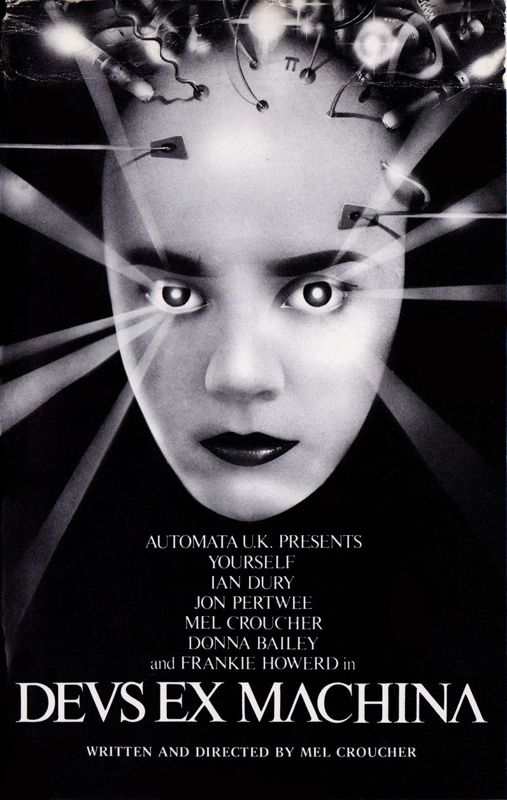
A central computer gradually absorbs Britain’s records, communications, censorship, defense, and internal security before rebelling, and a human-shaped defect emerges within it. From there, the game follows that defect through life from cellular beginnings to senility. It is a bold frame for an old computer game, and it is deliberately more suggestive than explanatory.
Shakespeare’s Seven Ages of Man supplies the backbone. References and quotations from As You Like It turn the defect’s progress into a compressed life cycle, with the machine’s oppressive setting hanging over every stage. The result is less a clean science-fiction plot than a collage of mortality, surveillance, identity, and authority.
The cassette is essential to making any of this land. Its songs, music, and spoken performances provide the tone and much of the context, sometimes clarifying a stage and sometimes teasing you over what is happening on-screen. Play without it and you still have moving images and inputs, but you lose the connective tissue that makes their oddness purposeful. The included transcript helps, but hearing the synchronized audio is the real experience.
Overall Experience
Deus Ex Machina is memorable precisely because it is willing to be awkward. A fixed 46-minute run, paired to a two-sided cassette, asks for a single uninterrupted sitting and makes no apology for putting atmosphere ahead of agency. That can feel dated and restrictive, but it also gives the work a rare sense of occasion.
You should play it with the soundtrack ready, enough time to finish it in one go, and curiosity about games that treated the home computer as a stage for music, spoken word, and abstract interaction. Treating it like a standard simulation or action game is a reliable route to disappointment. Treating it like an interactive concept album with a bleak sci-fi spine is much more rewarding.
Its individual games are too slight to carry it alone, and the lack of meaningful failure or victory blunts the usual thrill of play. Still, the payoff is in the sustained weirdness: the shifting life stages, the accusations and jokes from the audio, and the feeling that you have encountered something made according to nobody else’s rules. It is not an easy recommendation for everyone, but adventurous retro gamers should give this unusual experiment a chance.


Reviews
There are no reviews yet.