 Retro Replay Retro Gaming History, Reviews & Emulation
Retro Replay Review
Gameplay
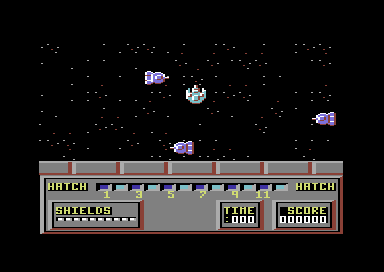
The main flight sequence is Discovery’s best decision. Instead of simply selecting minigames from a list, you pilot a ship over the station and contend with defense robots on the way to its hatches. That small layer of danger gives the game a pulse from the start. You are not just trying another diversion; you are trying to reach it with enough energy left to make the effort matter.
Energy ties the pieces together neatly. Hits drain it, death follows at zero, and finishing a minigame restores it. This creates a useful push and pull: aggressive movement through the station can get you to a hatch quickly, but careless flying can turn the next challenge into a recovery mission. For such a simple setup, it is a smart way to make the collection feel like one game rather than a cassette full of unrelated extras.
The individual challenges are where the experience gets uneven. Variations on arcade and traditional games are immediately understandable, so you can get into a round without a long learning curve. Reflex-heavy tests fit the surrounding shooter well, while the sliding puzzle and Solitaire-style material slow the pace in a way that will either feel like welcome variety or a frustrating interruption. Luck also has a noticeable say in the outcome, which can make progress feel less earned than it should.
Graphics
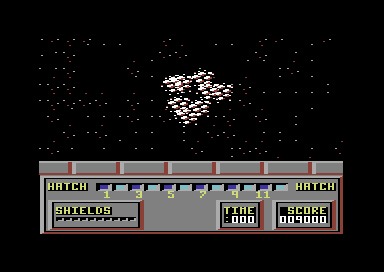
Discovery uses a top-down view for the station flight, with your ship moving across a space-station setting while defense robots threaten it. The hatches give the exploration a clear visual destination, and the separate arcade-style challenges naturally change the screen from one activity to the next.
Story
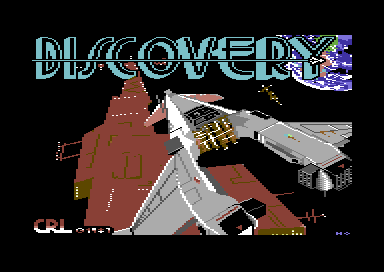
The story is thin, but it does exactly enough to frame the action. A long-lost space station has turned up, its defenses are active, and somebody has to shut them down before the place can be used again. That somebody is you, naturally.
There is no mystery to unravel in the material around the mission, and Discovery does not need one. The recovered-station premise is mainly an excuse for the hatches and the circuit-board hunt, but it is a better excuse than a bare sequence of score attacks.
As you assemble the pieces needed to disable the defenses, the objective stays clear. Do not come expecting character drama or a rich science-fiction tale; the story is a functional thread that keeps the arcade detours pointed toward a finish line.
Overall Experience
Discovery is easy to appreciate more than it is easy to love. Its central trick—linking a shooter, energy management, and a dozen minigames—has genuine charm, especially during the first hour when each hatch offers a new change of pace. The game feels purposeful in a way many simple collections do not.
That charm fades if a particular challenge does not suit you. Since the route to the ending depends on solving the games, a weak fit with the puzzle or luck-driven entries can stop the momentum cold. The shooter alone is not substantial enough to carry repeated frustration, and the familiar arcade variations do not always add enough of their own personality.
Give Discovery a chance if you enjoy compact Commodore 64 games that mix action with a little puzzle-solving and do not mind uneven minigames. The payoff is modest, but completing the circuit board and finally silencing the station defenses gives the whole odd package a satisfying sense of closure. It is a clever experiment with enough connective tissue to rise above a disposable assortment of clones.

Reviews
There are no reviews yet.