 Retro Replay Retro Gaming History, Reviews & Emulation


Retro Replay Review
Gameplay
Leap gets straight to the good stuff: a full 4-by-8 grid of pegs, one space opened up at the start, and a board that suddenly demands a plan. You move a peg horizontally or diagonally over another peg, removing the jumped piece. That single rule creates the familiar, satisfying puzzle-game tension of turning a crowded board into a sequence of carefully preserved opportunities.
The first few jumps are inviting because almost any opening feels productive. Pegs disappear, empty spaces multiply, and it seems as though you are making steady progress. Then the board starts punishing casual play. A jump that clears an awkward peg may also consume the landing space needed for a later move, leaving scattered survivors and no legal jump. That is the point where Leap either hooks you or loses you: success comes from thinking several moves ahead, not merely taking every available jump.
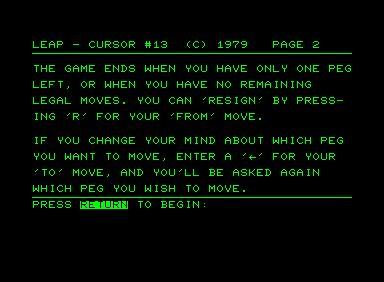
Choosing the first peg to remove gives you a little ownership over each attempt, while the random option is useful when you want the board to throw you a fresh starting problem. The Commodore 64 joystick controls suit this better than a fussy command interface would; this is a game about studying the grid and testing a route, not about entering notation. Its narrow focus is also its strength. There are no distractions between you and the next decision.

Graphics
The action stays on a fixed, top-down 4-by-8 grid filled with pegs. It is a bare-bones view, but one that makes the important information immediate: where the gaps are, which pegs can jump, and how quickly the board is closing in on itself.

Story
There is no character drama to carry you through a failed attempt; each board creates its own tiny arc. You begin with a crowded field, carve out a few encouraging holes, then reach the anxious late game where every remaining peg matters.
That stripped-down structure fits the puzzle. The “story” is the route you discover: whether an opening turns into a chain of smart jumps or collapses into an unsalvageable cluster. A complete clear is the ending worth chasing.
Because each run is so compact, failure does not feel like a major setback. It reads as a blunt answer from the board: that route was wrong, so try a different first removal and rethink the middle.
Overall Experience
Leap is a modest but honest logic game. Its rules take moments to understand, yet the 32-peg layout has enough room for bad instincts to catch up with you. The best moments come when you stop reacting to immediate jumps and start protecting the shape of the board for what comes next.
Frustration is part of the package. You can reach a nearly empty grid and still fail because the last few pegs no longer line up. If you need variety, a story, or lavish audiovisual reward, its single-minded format will feel thin. If you enjoy the hard-edged satisfaction of solving a compact spatial problem, that same simplicity is refreshing.
It is worth your time as a focused puzzle challenge rather than a game to sink into for an entire evening. Pick it up when you want a quick mental workout, accept that several attempts will end in a dead board, and savor the rare run where the final jumps fall into place.



Reviews
There are no reviews yet.