 Retro Replay Retro Gaming History, Reviews & Emulation
Retro Replay Review
Gameplay
Spell of Destruction starts with a simple fantasy promise—get through a castle and recover the First Element—but it quickly turns into a tense exercise in caution. You steer Drinn through connected, scrolling rooms, facing enemies while trying to determine which objects and spells matter. The first hour has the particular pull of an old-school adventure that refuses to spell everything out: every new room might contain a useful spell, a hidden chest, a threat, or the clue that makes an earlier obstacle make sense.
Combat is deliberately straightforward. Drinn can meet foes up close with his sword or attack from range with fireballs, while any successful enemy hit or contact drains his life energy. That makes crowded rooms dangerous even before puzzle-solving enters the picture. You are not simply looking for a route; you are trying to preserve enough health and magical resources to finish it. The keyboard selection and joystick activation setup asks for patience, especially when danger is nearby, but it also gives each spell choice a deliberate feel.
The finite spell supply is where the game earns both its tension and its frustration. Puzzle spells have to be found, and wasting a critical one can ruin an entire attempt. Dying does the same, sending you back to the beginning. That is a punishing structure, no question, and it will test your tolerance for replaying known ground. Still, the game does not leave you completely stranded: Find It points out hidden chests, while Tell Tale offers guidance when you are stuck. Use them wisely rather than treating them as a last resort.
This is a game for methodical note-takers and stubborn explorers, not anyone looking for breezy action. Progress feels earned because you must observe, conserve, and learn from failure. If you can accept that each error may cost a full run, the castle becomes a satisfying little puzzle box rather than a source of pure irritation.
Graphics
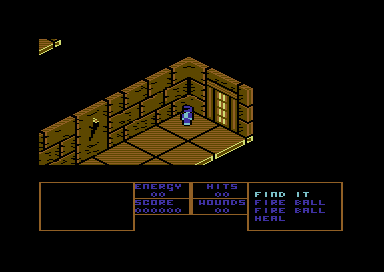
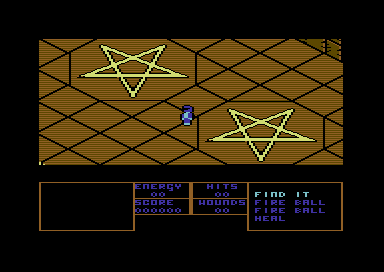
The action is shown from an isometric, diagonal-down view, with castle rooms scrolling as Drinn moves until he passes through a door. That viewpoint suits the mix of exploration, enemy avoidance, and direct combat: you can watch Drinn’s position relative to foes while scanning each room for possible puzzle leads.
Story
Drinn’s quest is framed as the final test required by a magician’s guild: retrieve the First Element from a dangerous castle. It is a clean setup, and a useful one. You are not saving the world through a sprawling fantasy saga; you are proving that you deserve to graduate.
That modest premise fits the game’s focus on trial and error. The castle is effectively the exam, with its enemies, hidden chests, limited magic, and obstacles all testing whether you can think ahead. Every carefully saved spell feels appropriate to the role of an apprentice magician trying not to fail the one assignment that matters.
Don’t come to Spell of Destruction expecting character drama or elaborate plot turns. Its story works as a sturdy reason to keep pushing deeper, while the real narrative emerges from your own runs: the spell you wasted, the room that killed you, and the eventual moment when a stubborn obstacle finally yields.
Overall Experience
Spell of Destruction is tough in a very 1985 way: it demands attention, remembers your mistakes only through the restart screen, and asks you to earn knowledge the hard way. The all-or-nothing consequence for death or wasting a vital spell is severe, but it gives the whole castle a pressure that more forgiving games rarely match.
Its 7.5 score feels right because the game’s strengths and rough edges are inseparable. The careful blend of action and item-and-spell puzzles makes progress rewarding, while the control arrangement and total restarts can turn a promising run into a sour one. You need to be in the mood to learn a hostile game rather than merely finish one.
Give it a chance if you enjoy isometric fantasy adventures that reward mapping, experimentation, and disciplined resource use. Skip it if repeated restarts sound exhausting or if you want combat to carry the experience by itself. For the right player, the payoff is the slow, satisfying conversion of a deadly unknown castle into a challenge you finally understand.


Reviews
There are no reviews yet.