 Retro Replay Retro Gaming History, Reviews & Emulation



Retro Replay Review
Gameplay
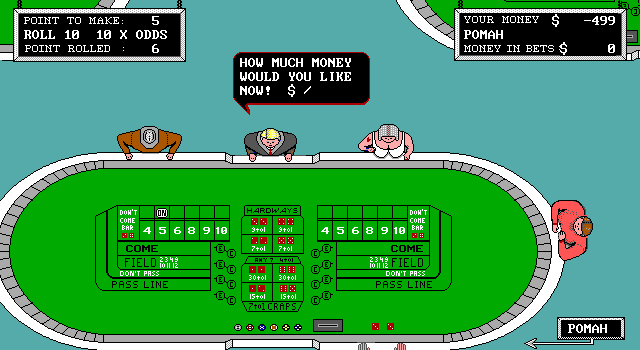
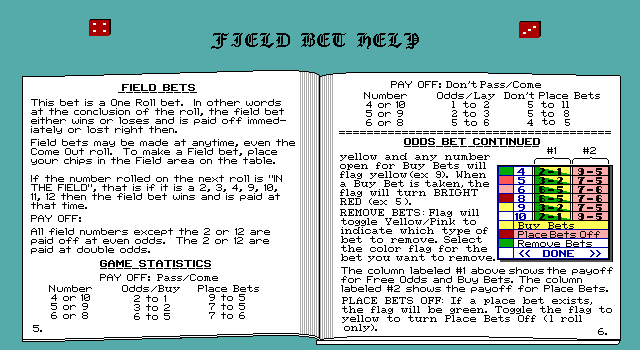
The first few rounds of Casino Craps are likely to be spent staring at the table and deciding where your money ought to go. That is not a flaw so much as the nature of craps: the game asks you to make sense of a lot of wagers before the dice really become exciting. Fortunately, the in-game rules are there when you need to check the basics, and they are worth using rather than blindly scattering chips around the board.
Once the terminology starts to click, the game’s narrow focus becomes its strength. You can work the Pass Line and Come Line, back them with Free Odds, or take more speculative swings through Place bets, the Field, Hardways, and center-table options. Every roll gives those choices a little tension, because you are betting against the bank and watching your cash rise or fall. The turn-based pace suits this kind of thinking; you have room to consider the next wager instead of being hurried along.
It is also refreshingly honest about the usual casino-game loop: you are here to chase a bigger stack. Three computer gamblers and the stickman give the table some company, but the meaningful decisions remain yours. Running out of money does not end the session; the casino loans you more and swaps in a new stickman. That keeps experimentation possible, though it also removes some of the finality that makes a real losing streak sting.

Graphics
The game uses a top-down, fixed table view built around the craps layout, with the seated computer players and stickman sharing the board. It is a functional angle for following where bets are placed and for keeping the whole table in view, even if the DOS-era look is plainly utilitarian.
Story
Casino Craps finds its drama in the table rather than in a scripted plot. You arrive with cash, sit down alongside three computer players, and begin trying to beat the bank. That simple setup is enough for a gambling simulation, because every stretch of good or bad rolls creates its own tiny story.
A cautious session can turn into a run of steady smaller wins; a riskier one can make a single result feel far more important than it should. The game gives you several ways to shape that personal narrative through the bets you choose, rather than steering you toward a predetermined outcome.
The stickman change after a loan is the one bit of table-side movement that marks a rough patch. It does not turn the game into a character piece, but it gives the ongoing session a small sense of consequence: you have burned through one bankroll and are back for another try.
Overall Experience
Casino Craps is strongest as a patient practice table for someone who genuinely wants to understand craps. It does not soften the game’s many betting choices, and that can be frustrating before the rules settle in. Give it an hour with the help screen nearby, though, and the board begins to look less like clutter and more like a set of deliberate risk-reward decisions.
Its limitations are also easy to feel. This is one casino table, one central goal, and a lot of repeated rolls, so the experience depends heavily on whether you enjoy studying odds and choosing wagers. If you only want the quick thrill of dice, the deliberate setup may feel dry. If you like the mental side of casino games, that restraint is exactly the point.
For a 1992 DOS game, it is a straightforward and usable take on craps that prioritizes the actual board-game rules over distractions. The bankroll loans make it forgiving enough to learn by doing, while the range of bets leaves room to graduate beyond simple Pass Line play. It is worth your time if craps itself is the attraction, not merely the casino theme.


Reviews
There are no reviews yet.