 Retro Replay Retro Gaming History, Reviews & Emulation


Retro Replay Review
Gameplay
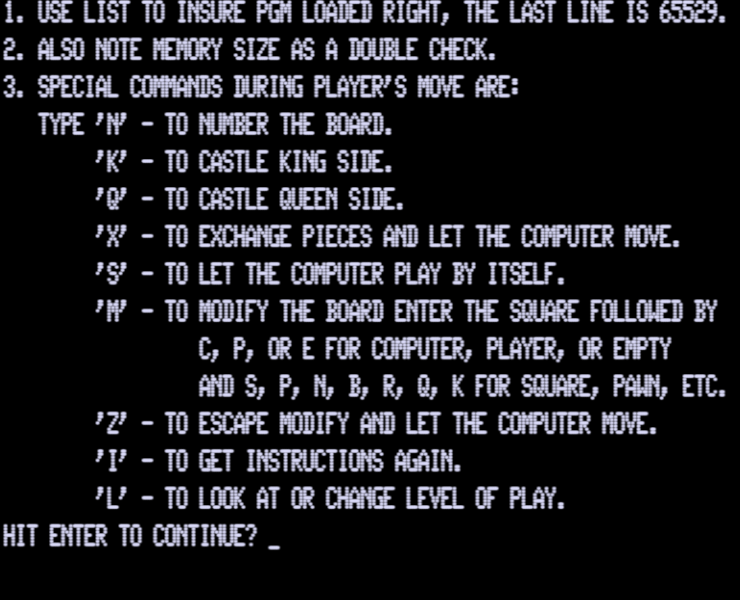
Chess for MS-DOS delivers the timeless challenge of the classic board game in its purest digital form. From the moment you launch the program, you’re greeted by an uncluttered interface that emphasizes the strategic duel between player and machine. Inputting your moves via straightforward keyboard commands may feel archaic today, but it reinforces the deliberate pace and thoughtful decision-making that define a great chess match.
With 24 distinct difficulty levels, the game accommodates everyone from absolute beginners to seasoned tacticians. Lower settings offer a forgiving opponent that helps you learn piece values and basic tactics, while the upper tiers challenge you with deeper calculation and surprising positional play. The progression between levels is smooth, allowing you to monitor your improvement and adjust the AI’s strength to match your growing skillset.
Since there’s no multiplayer mode, every confrontation is a solo affair against the computer’s algorithms. This single-player focus ensures consistently available competition—no waiting for human opponents online or off. Although you lose the social aspect of human-versus-human play, the reliable AI ensures every game is a fresh encounter, pushing you to refine your openings, midgame strategies, and endgame technique.
Graphics
Being one of the earliest PC titles from 1981, Chess runs entirely in text mode using ASCII characters to render the board and pieces. The simplicity might strike modern players as minimalistic, but it has a certain charm: every pawn, knight, and rook is represented with clear symbols, and the alternating square colors are suggested through inverted text attributes. This design choice keeps the focus squarely on the gameplay rather than flashy visuals.
The lack of graphical frills also means the game launches instantly, with virtually zero load times. On contemporary hardware, you’d barely see a flicker before the board appears. This immediacy was critical in an era when computing resources were scarce, and it still offers a satisfying, distraction-free environment for deep concentration.
For enthusiasts of retro computing, the ASCII board carries nostalgic appeal. Watching the pieces materialize in crisp, monochrome characters evokes the dawn of personal gaming and reminds you how far technology has come. Even without pixel-perfect sprites or animated captures, the ASCII art does its job elegantly, letting your imagination fill in the gaps.
Story
While Chess contains no narrative or campaign mode, its “story” is woven through its place in computing history. Developed in March 1980 and ported to the IBM PC by December 1981, it stands as perhaps the first ever MS-DOS chess program. In that sense, playing the game is like stepping into a time machine and experiencing the birth of PC gaming.
The real narrative unfolds in the gradual ascent of your own skill. Each match becomes a chapter in your personal development as a player, whether you’re learning to guard against forks or mastering opposition in king-and-pawn endgames. In lieu of scripted cutscenes or characters, the game’s plotline is the evolving battle between human ingenuity and artificial logic.
Beyond individual growth, Chess also tells a broader tale of early A.I. on personal computers. When you select a higher difficulty, you’re inviting the coded algorithms—honed on hardware less powerful than a modern calculator—to test your strategic mettle. That historical context transforms every checkmate into a small triumph over the pioneering constraints of early software design.
Overall Experience
Chess for MS-DOS excels as a pure, unadorned rendition of the world’s most enduring board game. Its stripped-down presentation and keyboard-only interface may feel dated, but they also provide a laser-sharp focus on tactics and strategy. There’s no trial mode to unlock or flashy animations to distract you—just the 64 squares and two warring sides.
For players seeking a quick match, the low resource demands and instant startup make this version ideal. It’s perfect for running on vintage hardware, emulators, or even a modern PC’s terminal window. The 24 AI levels ensure that the game remains challenging over many sessions, giving you ample room to grow and experiment with different styles of play.
Ultimately, Chess captures the essence of competitive strategy in its simplest digital incarnation. It offers a reminder of the early days of PC gaming and stands as a testament to how compelling gameplay need not rely on sophisticated graphics or complex interfaces. Whether you’re a history buff, a chess novice, or a veteran player looking for a lightweight opponent, this MS-DOS classic still delivers a rewarding mental workout.


Reviews
There are no reviews yet.