 Retro Replay Retro Replay gaming reviews, news, emulation, geek stuff and more!

Retro Replay Review
Gameplay
The first few matches ask for more patience than a typical button-heavy fighter. Horangi-eui Bunno 2 gives you six keys assigned to different moves, with no combination attacks or special abilities to bail you out. If you come in expecting to discover a big chain of canned attacks, you will hit a wall. The point is to learn which individual move has the advantage against a particular opponent.
That creates a more deliberate rhythm. Winning is less about showing off and more about recognizing the situation, choosing a response, and not handing momentum back through careless inputs. There is a real pull in that simplicity: every button has to earn its place, and a better result should come from understanding the matchup rather than stumbling into a spectacular attack.
It can also be a stern, narrow kind of fun. Without special moves and combos, the game has fewer obvious thrills to lean on when a fight is not clicking. You need to enjoy testing the move set and accepting that the useful answer may be a plain, well-timed move. For a 1994 DOS fighter, that focus has character, but it will not suit anyone wanting immediate arcade excess.
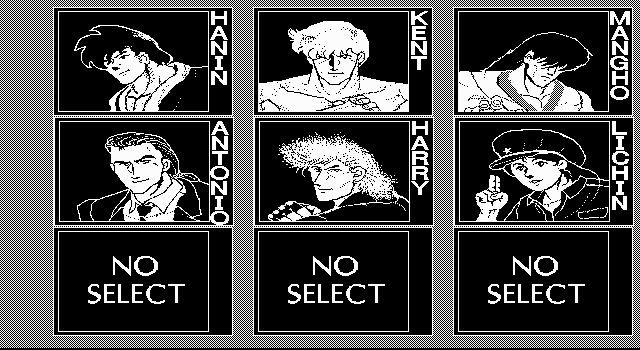
Dual mode is the better place to explore the roster. Nine characters are controllable in total, though three are unavailable at the start, while Story mode restricts control to the three main heroes: Hanin, Kent, and Mangho. That makes versus play important if you want the game’s broader fighting selection rather than a single guided route.

Graphics
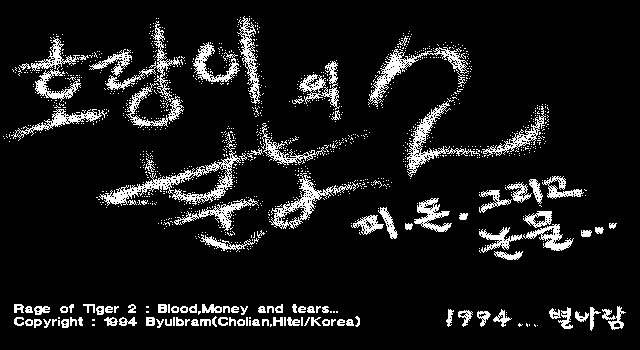
Every part of the game apart from the life bars is drawn in monochrome black and white. Characters and fights therefore trade colorful arcade punch for a stark, high-contrast look. It is an unusual sight for a fighting game, and the life bars stand apart as the one exception to the black-and-white screen.

Story
Story mode gives the sequel a path through its fights, but it does so through only Hanin, Kent, and Mangho. That limitation makes the mode feel more like a focused route for its three heroes than a way to sample every combatant.
The title—Blood, Money, and Tears—promises a melodramatic edge, and the story mode at least gives those central fighters a dedicated place in the structure. Still, the game’s known priorities are clearly the fights themselves: your practical reason to continue is to get better with the three available heroes and face the next opponent.
That split is worth knowing before you start. Choose Story mode when you want a defined run with its central trio; choose Dual when your interest is the full fighting roster. Neither mode needs to be mistaken for the other, and the game is clearer for keeping that distinction straightforward.
Overall Experience
Horangi-eui Bunno 2 is most interesting when you meet it on its own terms. As a sequel to Korea’s first fighting game, it has historical appeal, but its strongest practical hook is the unusual commitment to individual moves and matchup knowledge. The game asks you to slow down, stop fishing for fireworks, and make smarter choices.
Its limits are just as plain. A six-button fighter without combinations or special abilities has to win you over through the feel of those basic decisions, and not every player will find enough variety there. The story route’s three-character restriction further means the broader roster is not woven into that mode.
Give it a chance if you enjoy early fighting games, Korean game history, or the satisfaction of learning a compact move set until your choices become intentional. Skip it if you need colorful visuals, combo experimentation, and constant spectacle to stay engaged. The payoff is modest but genuine for the right kind of fighting-game curiosity.


Reviews
There are no reviews yet.