 Retro Replay Retro Gaming History, Reviews & Emulation

Retro Replay Review
Gameplay
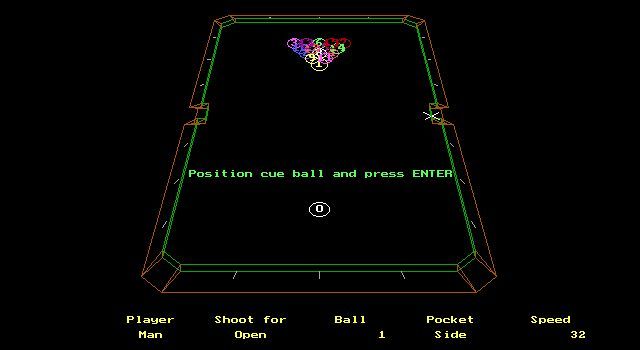
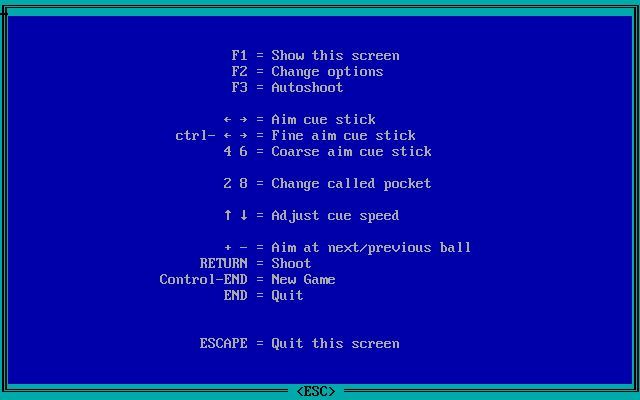
The first rack tells you exactly what kind of pool game this is: direct, solitary, and unapologetically mechanical. You play standard 8-ball against the computer, with no excess framing around it. That focus can be refreshing when you simply want to line up shots and work through a rack, but the entirely keyboard-driven play gives the game an immediate old-school stiffness that you will either tolerate or bounce off hard.
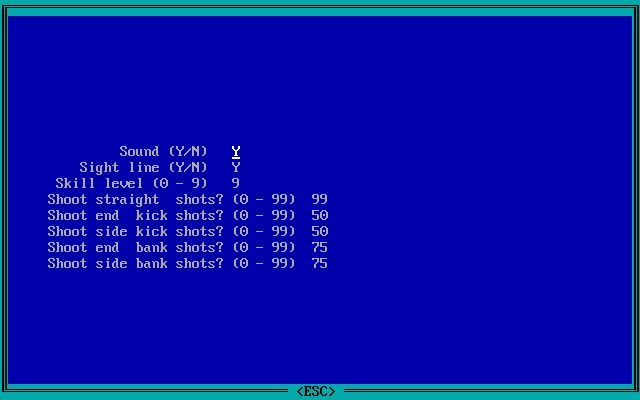
Its strongest idea is not the basic pool itself, but the control it gives you over the computer opponent. You can set its skill level, then adjust weighting for shot types such as Straight, End Kick, and Side Bank. A value of zero prevents a shot type from being selected, while a high value makes it a favored choice. That is unusually hands-on: rather than merely choosing Easy or Hard, you can push the computer toward particular habits and see how that changes the match.
This customization has real value for someone who likes testing the logic behind a sports-game opponent. You can create a computer that leans into one kind of attempt and avoids another, making repeat games less fixed than a single difficulty slider would suggest. It is also a useful way to tailor the challenge without pretending that the game has deep variety beyond its one-on-one 8-ball foundation.
Frustration is likely to set in if you want pool to feel effortless. Keyboard-only input and the sparse interface ask more of you than a pick-up-and-play cue-sports game would. Still, if you enjoy old PC simulations with knobs to turn, the opponent settings give you a reason to stay with it after the initial novelty of the wire-frame look fades.
Graphics
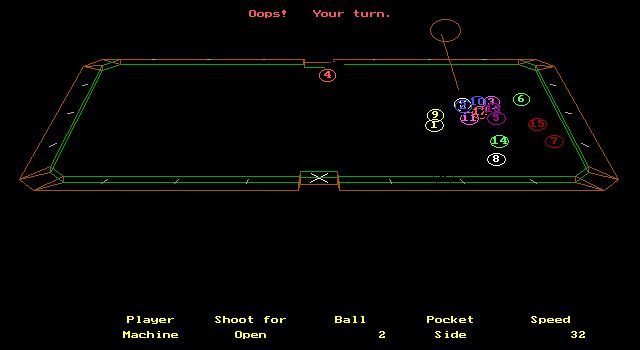
The table and game elements are drawn entirely in wire frame, giving every match a stark, geometric look. It is a functional image rather than a convincing pool-room scene: you are looking at lines and shapes arranged for play, not richly drawn felt, wood, or atmosphere.
That rough simplicity can make the game feel charmingly primitive, especially for a 1990 DOS release, but it will not draw you in on looks alone. The wire-frame approach suits players who value the match and its shot choices over decorative detail.
Story
There is no story pulling you from match to match. This is a computer-pool game built around the next rack, the next shot, and the next adjustment to your opponent’s tendencies.
That absence is not a flaw in itself; pool games rarely need a plot to work. Here, though, it means your motivation has to come from improving at 8-ball or from experimenting with the computer’s shot preferences.
If you need a campaign, characters, or any larger reason to continue beyond competition, this will feel dry quickly. If a clean head-to-head game is enough, the lack of narrative gets out of the way.
Overall Experience
Jim Kobbe’s Pool Game in 3D is most interesting as a piece of focused, configurable DOS sports software. The actual pool game is deliberately plain, but the ability to tune which shots the computer favors gives it a small, distinctive personality that many straightforward computer-opponent games lack.
The payoff depends on what you bring to it. A patient pool fan may enjoy setting up different computer behaviors and taking on a tailored challenge; someone looking for smooth controls, rich visuals, or a lively pool-hall vibe will likely be done after a rack or two.
Give it a chance if you have a taste for wire-frame DOS curiosities and enjoy poking at opponent AI settings. For everyone else, its virtues are too specialized to overcome its severe simplicity.



Reviews
There are no reviews yet.