 Retro Replay Retro Gaming History, Reviews & Emulation
Retro Replay Review
Gameplay
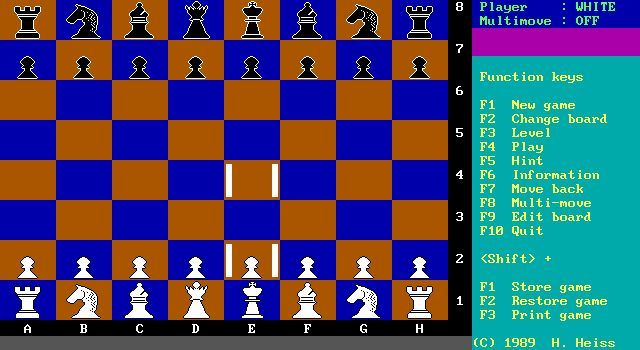
The first few moves in PowerChess are a test of patience. Rather than selecting squares with a mouse, you guide a cursor with the arrow keys, press Enter to choose a piece, move another cursor to its target, and press Enter again. It is deliberate to the point of awkwardness at first, especially when you want to make a quick, obvious pawn move. Give it a little time, though, and the routine becomes predictable enough that your attention returns to the position instead of the input method.
Under that old-fashioned control scheme is proper chess rather than a stripped-down imitation. Standard international rules are included, with en passant and the 50-move draw rule explicitly accounted for. That matters: when a program is intended for repeated, serious games, you do not want its rule handling to fall apart as soon as a position gets unusual.
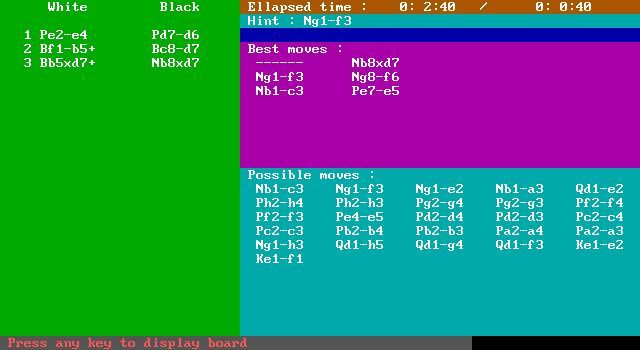
The strongest reason to spend time here is the collection of tools around the matches. You can set up positions, save games for later, replay them, ask for a hint, and work through a library of ten chess problems. Position setup is particularly valuable if you want to test an idea from a book or resume a tricky endgame. Printing the current game is a charmingly practical feature from an era when taking analysis away from the computer often meant putting it on paper.
Graphics
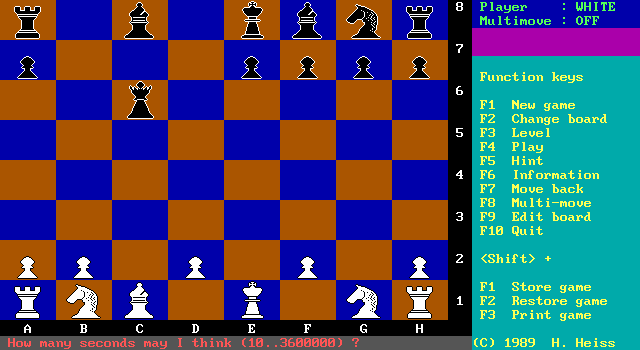
PowerChess keeps the view centered on the chessboard, with keyboard-controlled cursors marking the squares involved in a move. The top-down board view makes the state of play straightforward to follow, although the cursor-by-cursor movement is more functional than graceful.
Story
There is no narrative campaign dressing up the matches. Your story is the familiar one a chess program can generate: an opening you thought you understood, a position that quietly becomes dangerous, and the satisfaction or irritation of seeing the final result on the board.
That absence of a built-in plot suits the software’s practical nature. PowerChess is interested in letting you play, study, save a position, and return to it, not in manufacturing drama around the game of chess.
The puzzle library adds small self-contained challenges, which gives a session a sense of purpose when you do not want to commit to a full game. They are the closest thing here to structured progression, and they fit the program better than any forced storyline would.
Overall Experience
PowerChess is easy to respect more than it is easy to recommend without qualification. Its keyboard-only move entry is undeniably cumbersome beside even the simplest mouse-driven chessboard. If that friction bothers you in the opening minutes, it is unlikely to disappear entirely.
Still, the program has enough substance to justify its existence. Complete rule support, saved and replayable games, position editing, hints, printed records, and chess problems turn it into more than a novelty opponent. It feels like a compact chess desk: plain, practical, and ready when you want to examine a position rather than chase a flashy mode.
Try it if you enjoy DOS software, prefer deliberate keyboard interaction, or want a no-frills chess program with useful study options. Everyone else will likely find the interface a historical curiosity, but for the right kind of patient chess fan, the payoff is a solid and surprisingly capable board game companion.



Reviews
There are no reviews yet.