 Retro Replay Retro Gaming History, Reviews & Emulation

Retro Replay Review
Gameplay
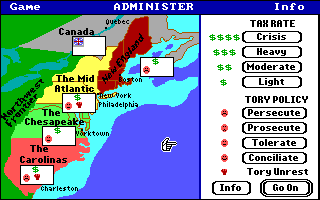
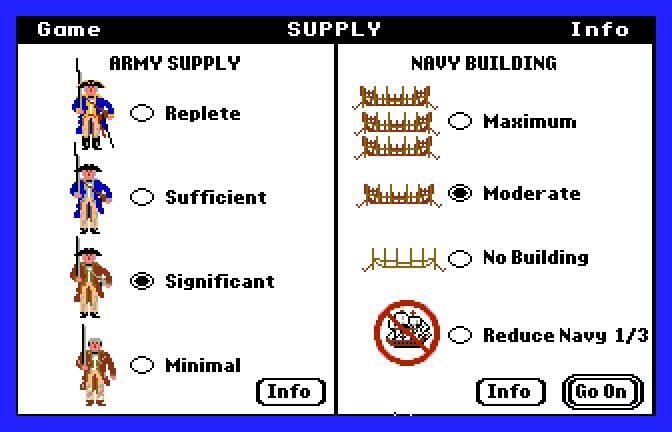
The first hour of Revolution ’76 is less about charging the British than learning how many ways a revolution can come apart. Starting with the Second Continental Congress, you make annual decisions on policy, leadership appointments, recruiting, diplomacy, taxes, and inflation. That broad remit is the game’s strongest hook. You are not simply building an army; you are trying to create a government capable of funding, supplying, and politically surviving the army it needs.
The yearly turn structure gives decisions a satisfyingly weighty rhythm. Taking a hard line toward loyalists, seeking European help, expanding Continental forces, leaning on state militia, or backing privateers all belong to the same larger balancing act. Historical leaders have their own characteristics, so administrative assignments are more than a decorative nod to the period. What begins as a list of responsibilities starts to click once you see that a weak economic or political choice can undermine the military effort before a battle is even calculated.
Combat is where your expectations need to line up with the design. Battles resolve automatically from strength, quality, generals, morale, and supply, so you do not maneuver units or turn a desperate engagement around with clever tactics. That can be frustrating when a campaign goes badly, but it fits a game focused on national leadership rather than field command. Give Revolution ’76 a chance if you enjoy being held accountable for the conditions that make victory possible; skip it if the battles themselves are why you play historical strategy.
Graphics
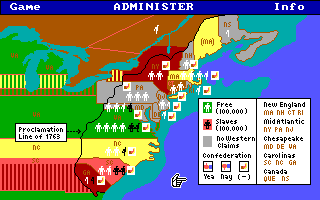
Revolution ’76 uses a top-down view, putting its emphasis on following a strategic simulation from above rather than placing you in a close-up battlefield perspective. The visual side serves a 1989 DOS strategy game’s functional, map-oriented approach.
Story
There is a real dramatic arc here even though the game tells it through policy decisions instead of scripted scenes. You begin before the formal break with Britain, when the colonies are still trying to decide what kind of resistance they can sustain. Eventually, declaring independence turns the political crisis into civil war and makes defense of the confederated colonies the central problem.
Its most interesting story choice is refusing to treat independence as inevitable. A successful defense of a fledgling nation is only one possible result. Partial autonomy or unconditional surrender can close the campaign instead, which gives each run a historical tension that many victory-only strategy games lack.
The game also earns credit for making domestic questions part of the struggle rather than background flavor. Loyalist policy, taxation, inflation, and the slave issue sit beside alliances and recruitment. That does not make every decision comfortable, nor should it. The Revolution emerges here as a contested political project with costs and contradictions, not a clean march toward a predetermined ending.
Overall Experience
Revolution ’76 is an ambitious simulation with a clear point of view: winning a war for independence depends on governing well enough to keep the war effort alive. Its abstraction is both its virtue and its limitation. You get the pressure of balancing a young nation’s competing needs, but you must accept that decisive battles happen through calculations rather than your direct commands.
For the right history-minded strategy fan, that trade is worth making. The game’s strongest moments come when your military plans, finances, diplomatic hopes, and internal policies refuse to cooperate, forcing you to decide what the rebellion can afford to compromise. It is a more demanding and less immediately flashy experience than a conventional war game, but it has the backbone to reward patience.
If you want a little background on the game itself, its historical and release information is useful context. For a separate revolution-titled game, Retro Replay also has a page for Revolution X. Revolution ’76 remains the one to choose when you want the American Revolution treated as a difficult exercise in politics, economics, and survival.


Reviews
There are no reviews yet.