 Retro Replay Retro Gaming History, Reviews & Emulation

Retro Replay Review
Gameplay
Your first few turns in Segyun-jeon are easy to understand: you and the AI alternate placing red or blue blob creatures on a grid, aiming to capture adjacent opposing blobs and convert them to your own color. The board can swing quickly, so a move that looks like a modest gain can also give the computer the exact opening it needs to reverse your work. That tension is the game’s strongest quality.
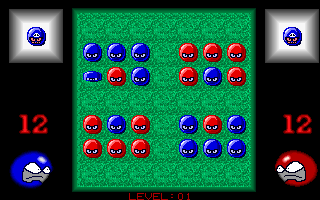
It resembles Reversi in spirit, but the different opening formations matter. Instead of settling into one familiar start, each stage asks you to read the pieces already on the board and work out where a chain of captures could begin. The basic rule is simple enough to grasp almost immediately; planning several turns ahead is where the challenge starts to bite.
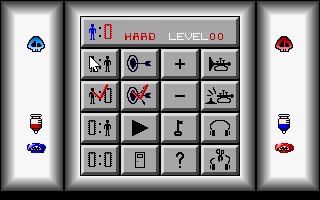
Difficulty levels give the AI matchups some useful range. At easier settings, you can concentrate on understanding how adjacent conversions spread across the grid. Raise the difficulty and impatience becomes costly: grabbing a nearby enemy blob may be less important than preserving a position that prevents the AI from building momentum.
Stages end only when every blob has become one color, which gives each match a clean, definitive finish. That also means there is little room to coast once the board tilts against you. Segyun-jeon is best when you enjoy that concentrated board-game pressure, where each placement can either tighten your control or hand control away.
Graphics
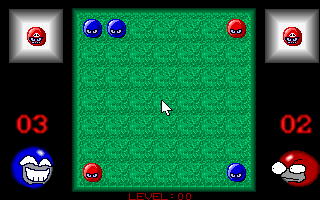
For a 1992 Korean DOS release, Segyun-jeon holds a notable place as Korea’s first game released with VGA graphics. The battlefield is a straightforward top-down grid populated by blue and red blob-like creatures, and the color contrast makes ownership easy to read while you weigh your next move.
Story
Segyun-jeon does not build its matches around a narrative journey. The conflict is conveyed directly through the board: blue blobs against red blobs, each side trying to erase the other’s presence one conversion at a time.
That stripped-back approach fits the game’s board-game roots. You are not pushed through story scenes or character drama; the changing stage formations supply the context, putting a different tactical problem in front of you each time.
The result is a game where the little story of a match is the one you create through play. A board that begins evenly split can end with every creature wearing your color, and that total takeover is a more fitting payoff here than any elaborate plot would be.
Overall Experience
Segyun-jeon is a modest but engaging grid strategy game whose strength lies in how quickly its simple rules become demanding decisions. It does not need a huge rulebook to make you pause over a placement; the possibility of an immediate counter-conversion gives even a small board real friction.
The varying starting formations are important because they stop the game from feeling like a single Reversi puzzle repeated forever. You still need patience, spatial awareness, and a willingness to accept that a flashy capture may be a bad long-term trade, but each stage has its own shape.
Give it a chance if you like traditional abstract board games and can appreciate a focused contest against an AI opponent. Its historical significance is a bonus, not the sole reason to play: the real draw is a clean turn-based duel that rewards careful board reading and makes a full-color conversion feel earned.


Reviews
There are no reviews yet.