 Retro Replay Retro Gaming History, Reviews & Emulation

Retro Replay Review
Gameplay
The first hour of Solidarność has a tense, slightly daunting pull because you are not handed an army or a simple route to victory. You are trying to build popular support under martial law, region by region, while the communist government works to contain you. That objective immediately makes ordinary strategy-game thinking feel inadequate: your activists are not units to throw away, and a successful action can be followed by an arrest that changes the mood of the whole campaign.
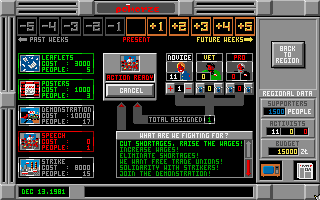
Your toolkit is admirably direct. Activists can distribute leaflets, put up posters, call strikes and anti-Soviet demonstrations, make speeches, demand the release of political prisoners, or undertake hunger strikes. Illegal radio and television stations, along with photocopiers, broaden the means of spreading your message. What starts to click is the value of choosing an action that fits the moment rather than merely repeating the loudest option; the game is about sustaining pressure and converting it into support, not winning a single dramatic confrontation.
The seven-region structure gives your decisions a useful geographic focus, and the news reports make the consequences feel less abstract. Still, the real-time format can be unforgiving. When activists are arrested, frustration is part of the intended tension, but it can sting if you were building momentum in a particular area. Go in ready to watch conditions, react to setbacks, and accept that this is a political struggle where progress is vulnerable.

Graphics
This is a top-down DOS strategy game built around Poland’s regional political contest. The view is functional rather than lavish, keeping attention on where your activists are acting and how the campaign is developing across the country.

Story
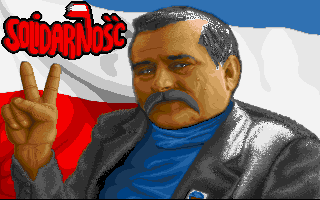
The historical frame does much of the heavy lifting. The campaign begins with the declaration of martial law on December 13, 1981, then asks you to guide an underground movement toward the Solidarity trade union’s breakthrough. That is a much more charged premise than a fictional rebellion, because the actions at your disposal—printing material, organizing strikes, operating illegal broadcasts—are rooted in the kind of resistance the game is depicting.
Rather than treating history as a backdrop for combat, Solidarność makes political legitimacy the battlefield. Winning citizens matters because it weakens the oppressive government, and the possibility of political prisoners and arrests keeps the conflict personal even without a conventional character-driven plot. The news is especially important here: it gives your campaign a sense of being observed and recorded as events escalate.
The USSR’s support for the regime and the USA’s attention add an international edge to a conflict that remains focused on events inside Poland. That wider Cold War pressure helps the stakes land. You are not simply maximizing a number; you are trying to shift a country’s political balance under the gaze of two superpowers.
Overall Experience
Solidarność is most interesting when it makes you feel the cost of organizing under repression. Its actions are familiar strategy verbs on paper, yet they carry unusual weight in this setting. A leaflet campaign, a strike, or an illegal broadcast is not busywork when the authorities can respond by taking people away.
Its age and real-time demands mean this will not be an easy recommendation for anyone after a relaxed historical tour. You need patience for pressure, reversals, and a simulation that asks you to infer the right political response rather than chase battlefield dominance. The payoff is a strategy game with a rare subject and a stronger sense of consequence than its modest scale might suggest.
Give it a chance if you enjoy historical strategy that asks you to manage influence, public support, and risk instead of weapons and territory. If you need constant tactical action or a forgiving learning curve, the arrests and mounting pressure may wear you down. For the right gamer, though, its focused depiction of underground resistance remains genuinely gripping.


Reviews
There are no reviews yet.