 Retro Replay Retro Gaming History, Reviews & Emulation
Retro Replay Review
Gameplay
The best part of TEGL Klondike Solitaire is that it understands why Klondike survives: a simple deal can turn into a stubborn little puzzle. You begin by working through the familiar staggered seven-column tableau, exposing face-down cards and building downward in alternating colors. Every move has that satisfying double purpose of organizing the table while trying to free the cards that are blocking your next decision.
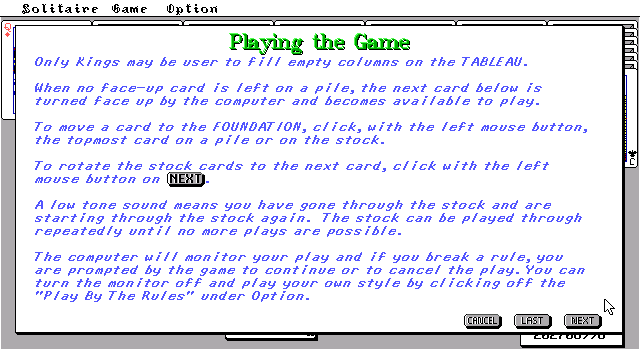
Nothing here softens the central Klondike tension. Empty columns only accept kings, so clearing a space can be brilliant or useless depending on what is available. You will spend plenty of hands deciding whether to move a whole run now, hold it in place for later, or take a chance on the remaining deck. When several cards suddenly become available in sequence, the game delivers the same modest but real rush that makes solitaire an easy time sink.
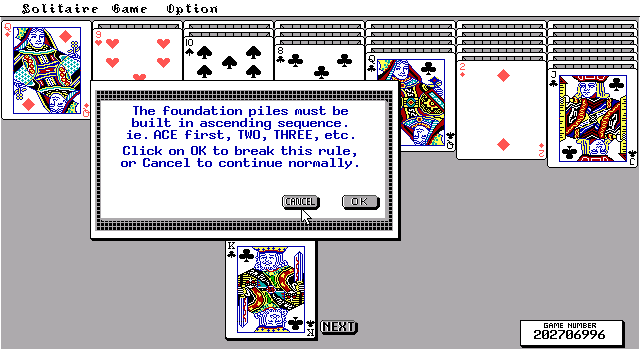
The cheating options change the tone more than you might expect. Allowing a single exception can rescue a hand that has become annoying rather than interesting, and unrestricted cheating turns the rules into a suggestion. That is handy if you treat solitaire as a quiet pastime instead of a pure challenge, but it also means the game relies on your own restraint to preserve the satisfaction of a legitimate win.
The game-number system is a genuinely useful touch. A layout worth revisiting does not vanish just because you start another deal; you can note its number and try it again. For a game built around individual card arrangements, that adds welcome replay value and gives stubborn players a way to take another run at a deal that nearly worked.

Graphics
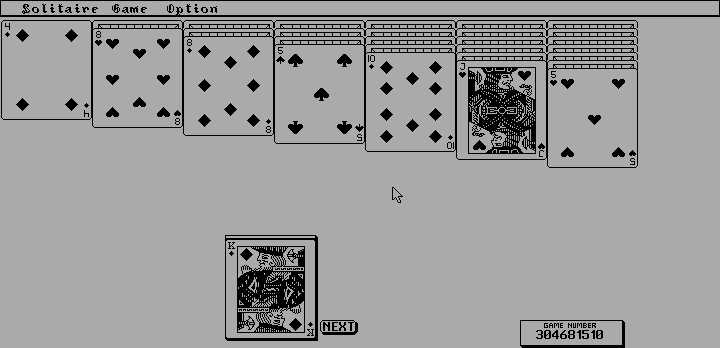
The screen is built around the card table: seven columns grow across the main play area, with four foundation stacks above them. The face-up diagonal at the start makes it easy to see where the immediate opportunities are, and the game number sits in the lower-right corner for players who want to replay a specific deal.
Story
There is no authored story to distract from the cards, which is exactly right for Klondike. The game’s drama comes from the deal itself: a buried ace, a newly exposed card, or the unpleasant realization that the king you need is still trapped.
Each hand creates its own tiny arc. Early turns are about opening the tableau, the middle game is a tug-of-war between sensible moves and tempting risks, and the end either becomes a clean march toward the foundations or a slow confirmation that the deal has beaten you.
The cheat settings let you decide what kind of story a losing hand tells. You can accept defeat, use one exception to see whether the puzzle can still be salvaged, or disregard the rules and simply clear the table. That flexibility makes the game feel less punitive, although the honest victories remain the memorable ones.
Overall Experience
TEGL Klondike Solitaire is a straightforward version of a classic, and its confidence lies in not complicating a game that already has a strong loop. You sit down for one deal, start hunting for exposed cards, and can easily find yourself replaying a troublesome layout because you are convinced there was one better decision twenty moves ago.
The rule-breaking options are either its friendliest feature or its biggest temptation. If ordinary Klondike sometimes feels too dependent on a bad draw, the ability to make a limited correction can keep a session enjoyable. If you want every win to feel earned, stick to the standard rules and treat the cheat controls as an emergency convenience rather than part of the puzzle.
Give it a chance if you want no-frills DOS solitaire with the familiar Klondike structure intact and a useful way to revisit specific deals. It will not convert anyone who finds card solitaire dull, but for the right mood, its cycle of careful rearrangement, lucky reveals, and occasional dead ends still holds up.



Reviews
There are no reviews yet.