 Retro Replay Retro Gaming History, Reviews & Emulation
Retro Replay Review
Gameplay
The first few turns feel comfortingly familiar. You select a credit limit, choose a coloured person as your token, and click the dice icon once to set the roll in motion and again to stop it. Your piece then walks its spaces and you handle the expected Monopoly business: buy a property, pay rent, or send it to auction. Mouse and keyboard controls give you options, though the mouse-driven turn flow sounds like the natural way to play.
Where TEGL Monopoly becomes more than a straight recreation is in the rules it loosens. Houses and hotels never run out, building does not need to be spread evenly, and properties can be traded without first clearing their buildings. That last change alone can make negotiations much livelier, because developed territory remains part of the deal instead of becoming a barrier to it. If your group has spent years arguing over custom Monopoly rules, this is exactly the kind of version that invites experimentation.
The flipside is that these changes undercut the tight scarcity that gives traditional Monopoly some of its bite. Unlimited houses and hotels can make aggressive development easier, while uneven building lets a leading owner concentrate power quickly. Credit limits add another useful pre-game lever: a low limit should make money pressure matter sooner, while no credit removes that safety net altogether. Pick the limit and altered rules with your group in mind, because TEGL Monopoly is happier being bent to the table’s preferences than enforcing one definitive ruleset.
The biggest practical frustration is the missing save function. Monopoly is not famous for being brief, and an unfinished game cannot simply be parked for later. That makes this a much better choice for a deliberate session when everyone can stay put than for a casual game squeezed between other plans.
Graphics
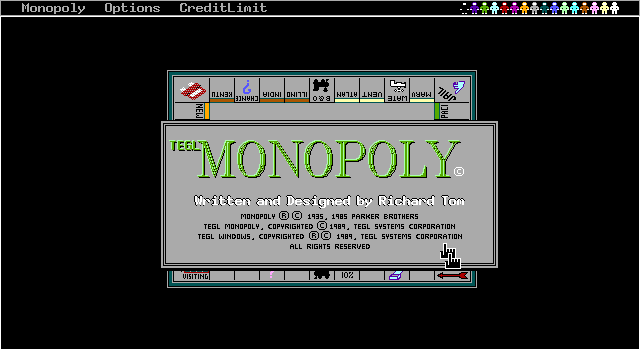
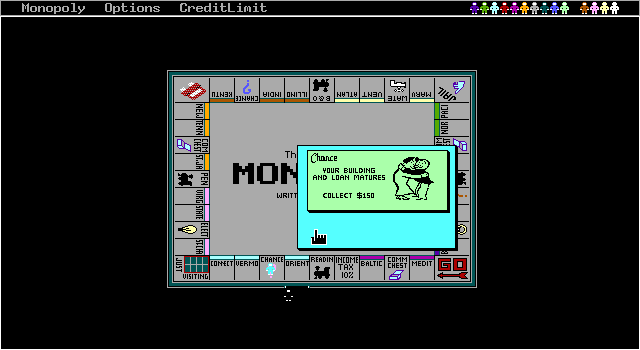
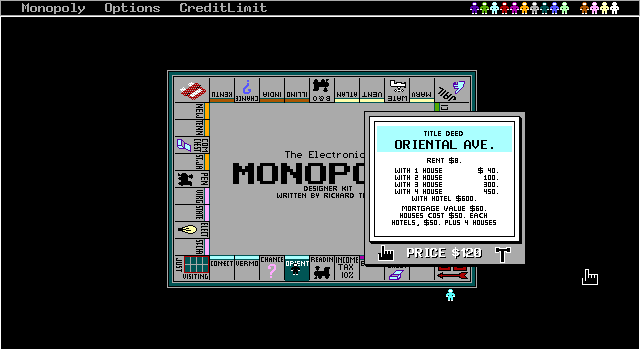
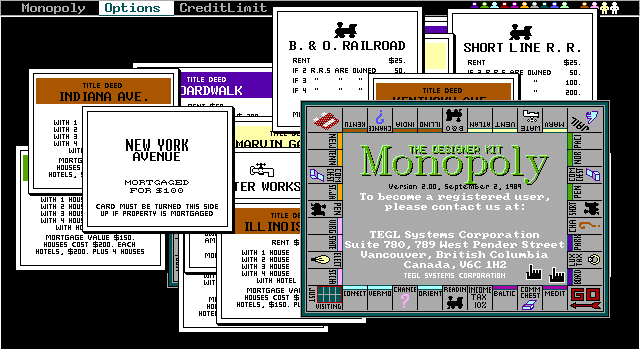
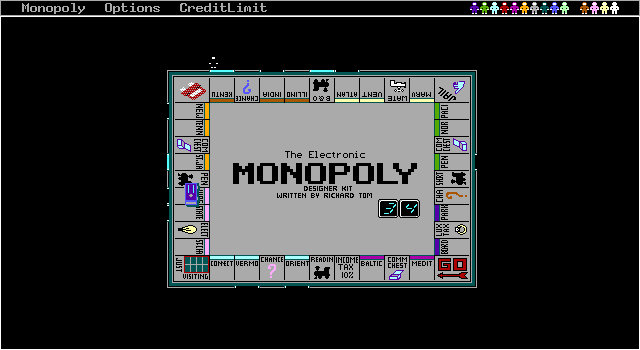
The board is represented through tiny, differently coloured people rather than Monopoly’s familiar object tokens. Watching a little figure walk the rolled distance gives each turn a clear visual result, but this is plainly a functional DOS board-game look rather than a lavish recreation.
There is little audio accompaniment beyond a few beeps, so the dice clicks, property decisions, and table talk have to carry the atmosphere.
Story
There is no authored tale here; the story is the one your group creates out of purchases, rent demands, auctions, and increasingly pointed trades. That is the right kind of narrative for Monopoly: somebody catches a lucky run of properties, somebody else tries to bargain their way back into contention, and every deal changes the mood around the board.
TEGL’s altered building and trading rules make that table drama less predictable than in a strict game. A developed property can stay in circulation during negotiations, so alliances and desperate rescues can feel more consequential. The game gives you the framework, but the memorable moments come from what everyone agrees to risk.
The opening credit-limit choice also gives each match a different financial tone before the first roll. You can use that to shape the story from a cautious contest into a more volatile one. It is a small setup decision, yet it can define whether early trouble feels recoverable or final.
Overall Experience
TEGL Monopoly is a solid fit when you want recognizable Monopoly on DOS but do not want to be locked into every standard restriction. It respects the familiar turn-by-turn structure while making room for the kind of rule tinkering that many home groups already do. The documentation’s designer-kit attitude suits it: this is a board-game program meant to be adjusted, argued over, and made your own.
Purists may bristle at inexhaustible buildings, uneven construction, and property trades that retain development. Those are not tiny cosmetic changes; they can reshape the balance of a match. But if you see Monopoly as a platform for negotiation and house rules rather than a fixed rules document, the flexibility is the reason to play this version.
Go in with time set aside and a group willing to settle on its preferred credit limit and rule interpretation. The no-save limitation is real, and the spare sound will not supply much excitement on its own. Still, the core loop of rolling, moving, buying, collecting, and cutting deals remains durable, and TEGL Monopoly earns its place as an unusually customizable old-school take on the board-game staple.



Reviews
There are no reviews yet.