 Retro Replay Retro Gaming History, Reviews & Emulation
Retro Replay Review
Gameplay
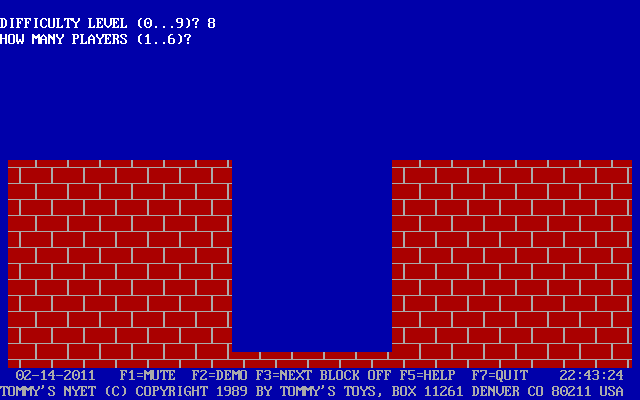
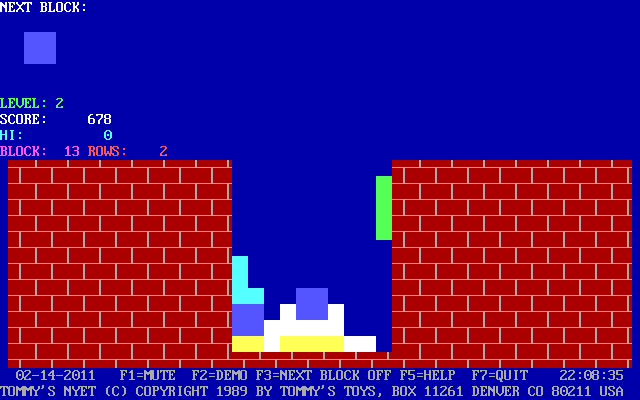
Tommy’s Nyet earns your attention by taking a standard falling-block routine and putting a nasty little trap under it. At first, you are simply steering pieces left and right, rotating them, and trying to complete solid horizontal rows. Then a piece settles a half-brick off the grid, and you understand the stakes: that damaged row can never be finished. A move that looks harmless can quietly ruin the lower part of the pit.
That makes every placement more deliberate than in a forgiving line-clearer. You are not merely hunting for a space that fits; you are protecting the possibility of future rows. The numeric keypad controls suit the direct, old-school setup, but the challenge comes from keeping your head clear when a falling shape invites an easy, destructive answer. If you hate a puzzle game that punishes imprecision permanently, Nyet will test your patience fast. If you enjoy recovering from your own bad decisions, its central rule has real bite.
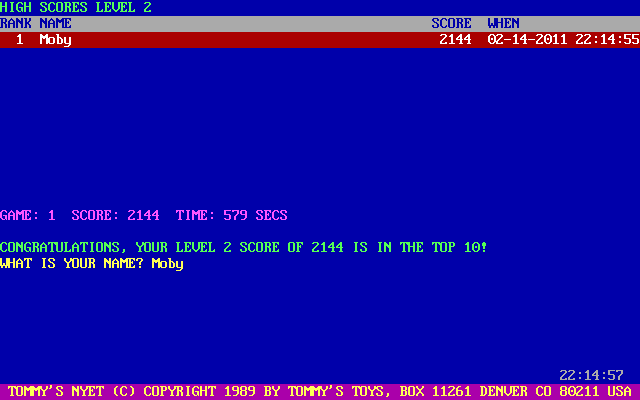
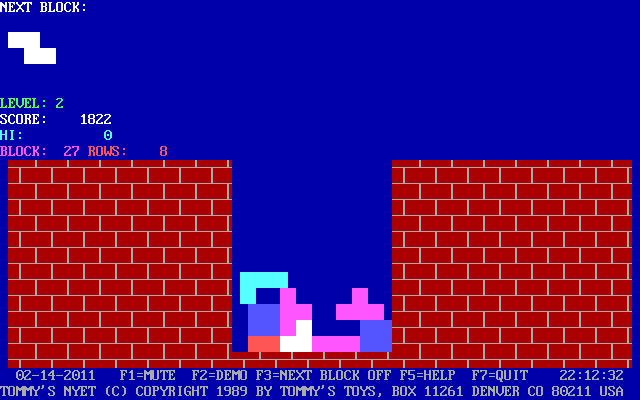
The scoring gives that tension a useful extra layer. Each cleared row is worth 100 points, while falling pieces score according to how far they drop and the selected difficulty. Peek mode reveals the next shape, but lowers those falling-block points from three times the difficulty level to just the difficulty level itself. That is an unusually clean choice: play with information and accept smaller rewards, or go blind for a better score. Nine difficulty levels and top-ten scores for every level give you a good reason to revisit the game once the basic survival game starts to click.
Graphics
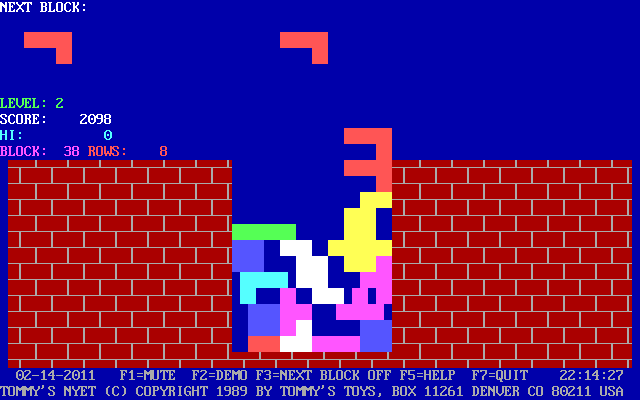
The view is a straightforward side-on pit of falling block shapes. Its strength is clarity: you can watch a piece descend, judge its position against the pile, and immediately see whether a half-brick landing has created a fatal mismatch.
Story
Tommy’s Nyet does not ask you to follow a character or unravel a plot. Its drama comes entirely from the board: a clean stack, an awkward incoming shape, and the sinking feeling that one misplaced half-step has spoiled your plan.
That spare approach fits the game. You begin each attempt with a simple objective—make full rows—and the tension builds from the consequences of every choice rather than from any outside framing.
The closest thing to a narrative arc is the score run itself. Early placements establish order, pressure accumulates as the pit fills, and a late recovery or collapse becomes the ending you remember. It is bare-bones, but puzzle games can live or die on that kind of self-made story.
Overall Experience
Tommy’s Nyet is worth a look if you want a falling-block game that is less about relaxed pattern matching and more about preserving a workable grid under pressure. The half-brick rule is both its best idea and its harshest demand. It creates a distinct identity, but it also means careless input can make an attempt feel doomed long before the pit is full.
Peek mode is the feature that makes the game feel thoughtfully tuned rather than merely cruel. Newer or more cautious players can use the next-piece preview to make better plans, while confident players can sacrifice that help for stronger scoring. The choice gives repeated sessions a purpose beyond simply trying to last longer.
Six-player support also makes sense for short competitive turns, especially with separate high-score tables across the nine levels. Still, the payoff depends on whether you enjoy strict puzzle rules. Nyet is not the kind of game that smooths over a mistake; it puts the mistake on the board and makes you play around it. For score-focused block-puzzle fans, that severity is exactly why it is interesting.


Reviews
There are no reviews yet.