 Retro Replay Retro Gaming History, Reviews & Emulation
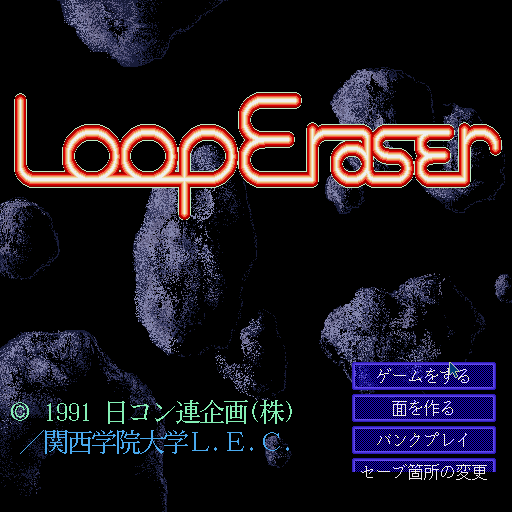
Retro Replay Review
Gameplay
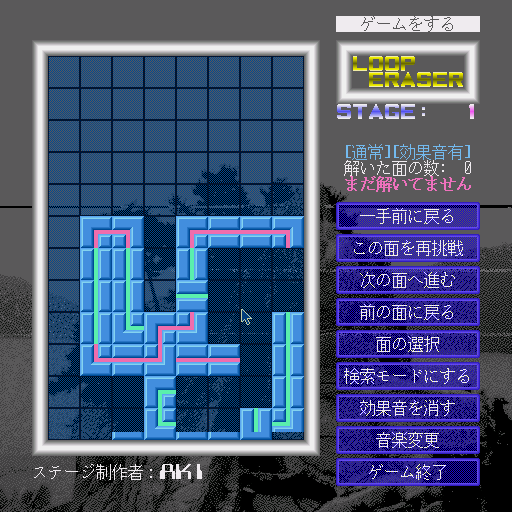
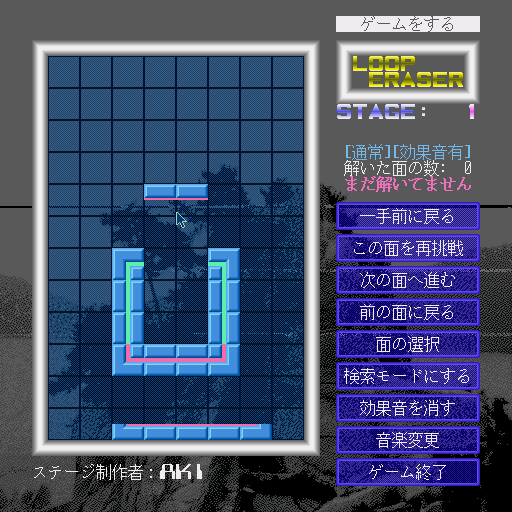
Loop Eraser gets you working quickly. Every stage puts a set of line-marked pieces in front of you, and the immediate task is easy to read: rotate them left or right, make their lines meet at the proper angles, and complete enclosed loops. Finish a loop and it vanishes; erase every line and you are through. That direct cause-and-effect makes the opening stages satisfying rather than intimidating.
The falling rule is what keeps this from being a static rotation puzzle. Any downward-facing line without a connection drops until it reaches another line, so every turn can alter the board’s layout as well as its connections. You are not merely hunting for shapes; you are judging when to let a piece fall, what it will land beside, and whether that new arrangement leaves room to close a loop. When a messy-looking board suddenly collapses into a sequence of clean shapes, it has the tidy payoff good puzzle games live on.
With 120 stages, the game has enough runway for the central idea to become demanding. Frustration is likely to arrive when a promising arrangement leaves one stubborn line stranded, forcing you to rethink the board rather than simply polish the last move. That is part of the deal: Loop Eraser favors patient spatial reasoning over fast reactions. Give it a chance if you like puzzles that ask you to pause, inspect the consequences of a move, and enjoy the relief of clearing a screen completely.
Graphics
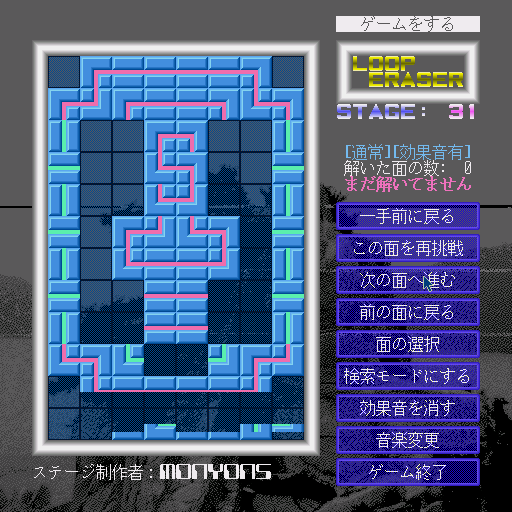
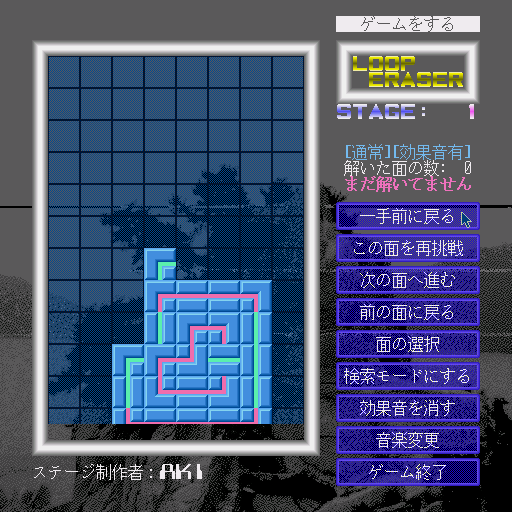
The game uses single-screen puzzle boards filled with patterned arrangements of pieces and their drawn lines. The side-view, fixed-screen format keeps your attention on rotations, falling segments, and the changing geometry of the board; loop completion is visually easy to understand because the finished form disappears.
Story
Loop Eraser is built around its puzzle boards rather than a narrative journey. You move from one self-contained stage to the next with a clear practical objective: turn every loose arrangement of lines into completed loops.
That stripped-back structure suits the game’s focus. There is no need to carry plot details from one board to another when each stage creates its own little problem, its own false starts, and its own moment of resolution.
If you need characters or a larger tale to keep pushing forward, the motivation here is more immediate: you want to see whether the next arrangement can be untangled. The game asks you to supply the momentum through curiosity and stubbornness.
Overall Experience
Loop Eraser is a compact, clear-headed puzzle game whose strongest idea is the interaction between rotation and gravity. Closing loops is inherently satisfying, but the falling-line rule gives each board enough uncertainty to prevent the task from becoming rote. It rewards deliberate experimentation more than random turning.
The main limitation is also its defining trait: everything rests on variations of one concept. If that concept clicks, 120 stages sounds like a welcome supply of puzzles. If it does not, there is little else competing for your attention. The first handful of boards should tell you quickly which side you are on.
For fans of classic screen-by-screen logic puzzles, though, this is easy to recommend. Loop Eraser understands the value of a rule you can grasp in seconds and master only through repeated mistakes. The payoff is modest but real: a board that looked impossible a minute ago disappears because you finally saw the right sequence.


Reviews
There are no reviews yet.