 Retro Replay Retro Gaming History, Reviews & Emulation
Retro Replay Review
Gameplay
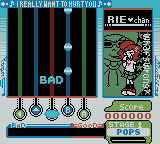
pop’n music GB makes a strong first impression because there is almost no distance between starting a song and understanding the challenge. Notes scroll down toward your inputs, you tap the matching button in time, and the groove meter immediately tells you whether you are holding it together. That feedback loop is blunt in the best way. A few clean hits can build confidence, while a rough stretch makes the end of a track feel suddenly urgent.
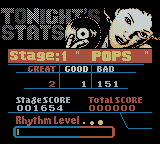
The Game Boy adaptation cuts the original nine-button setup down to five buttons, and that change gives the game its own practical rhythm. You are not wrestling with an intimidating panel of inputs; you are learning how to keep time while handling increasingly demanding note sequences on a handheld. It is easy to begin, but not necessarily easy to clear everything. The meter requirement means merely limping through a song is not enough, so improvement has a concrete payoff: better play earns access to the next track.
Its 25-track selection is a meaningful reason to keep returning. Fifteen arranged tracks drawn from the early arcade and console releases sit alongside ten original songs, giving the package both series history and material made for this version. Original mode supplies the core solo climb, while two-player Versus is a welcome excuse to put your timing against someone else’s. If you enjoy chasing cleaner runs more than exploring elaborate modes, this focused structure is exactly the point.

Graphics
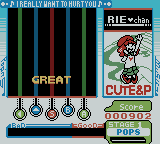
The action is built around notes scrolling toward the bottom of the screen, keeping your eyes fixed on the timing lane rather than asking you to parse a busy playfield. On a Game Boy Color, that direct layout suits the split-second decisions rhythm games demand.
Story
There is no narrative detour here, and that is fitting. pop’n music GB is organized around advancing through songs by keeping the groove meter high enough, so the momentum comes from your performance rather than from characters or plot turns.
That simplicity makes a failed song feel personal rather than dramatic: you know why progress stopped, and you know the remedy is to replay it with sharper timing. The game does not need a story to manufacture stakes when the next track is sitting just beyond a successful clear.
If you want a rhythm game wrapped in a campaign or a cast-driven premise, this will feel spare. If you prefer a clean sequence of musical challenges where each track becomes its own small hurdle, the lack of narrative clutter is a strength.
Overall Experience
This is a smartly scaled-down rhythm game rather than a compromised one. The five-button format preserves the satisfying core of matching inputs to music, and the groove meter gives the familiar act of playing along a real sense of consequence. It is immediately approachable, then gradually more demanding once you care about clearing songs instead of simply hearing them.
Frustration can set in when a song pushes your meter too low and bars the way forward, especially if you are just short of a clear. Yet that pressure is also what makes a successful retry land. You are not just checking tracks off a list; you are earning the right to move on.
Give pop’n music GB a chance if you want a concise handheld rhythm game with a substantial set of songs and a straightforward reason to practice. It will not win you over with excess or complication. It wins by making five buttons, a scrolling note line, and one increasingly nervous meter feel like enough.


Reviews
There are no reviews yet.