 Retro Replay Retro Gaming History, Reviews & Emulation
Retro Replay Review
Gameplay
The first thing you notice is that this is not a platformer built around a single all-purpose hero. You pick Chiaki or Zenki before each level, and that decision has consequences. Chiaki can break stones, open up routes, and search for power-ups; Zenki has the spinning attack. That split immediately gives you a reason to consider a stage instead of simply charging right through it.
What starts to click is the freedom to leave a level and pick the other character. A blocked stone route is not just a dead end, and Zenki’s more direct combat-oriented approach does not have to cover every task alone. The structure invites you to treat character selection as part of solving the level, which is a stronger idea than a licensed platformer merely swapping character portraits.
There is a potential snag in that same design: progress can mean backing out and replaying a stage with the appropriate hero. If you want constant forward momentum, that can feel like interruption rather than discovery. But for a Game Gear action game, the choice adds useful texture, especially if you enjoy figuring out which character is the better fit before committing to a route.
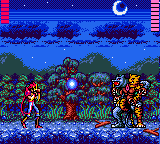
Bosses deliberately break from the platforming. Zenki takes a more powerful form and fights in a mode reminiscent of a one-on-one fighter. It is a smart way to give the confrontations a distinct rhythm: you are not merely repeating the level’s obstacle-clearing routine against a larger enemy.
Graphics
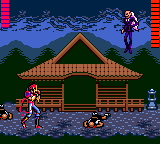
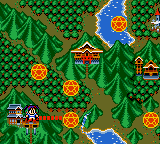
The action is viewed from the side in 2D scrolling levels, while boss encounters shift to dedicated one-on-one battle screens. That camera change should make the handoff from exploration to direct confrontation easy to understand, even on the Game Gear’s small screen.
Story
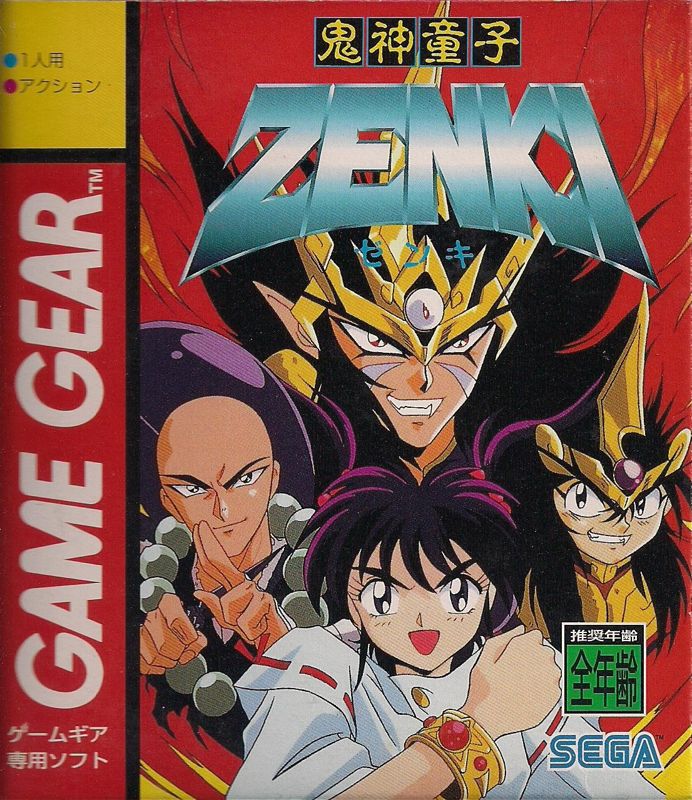
This is a proper adaptation of the anime setup, not a generic fantasy plot with the license pasted over it. Centuries after Enno Ozuno sealed the demon spirit Zenki, his descendant Chiaki Enno frees him as the seeds of the demon goddess Karuma begin turning people into monsters. That gives the game a clear reason for its paired heroes and monster-fighting action.
Zenki’s childish, ill-mannered sealed form also explains why Chiaki matters instead of being a bystander. Her magic bracelet transforms him into the useful, powerful version needed for battle. The game’s central partnership therefore has an actual dramatic function, and the boss transformation feels connected to the premise.
You will get more from it if the series already means something to you, but the conflict is clear enough on its own: Karuma’s threat is resurfacing, ordinary people are endangered, and Chiaki and Zenki have to work together despite their mismatch. It is direct, pulpy anime-fantasy material, which suits an action platformer.
Overall Experience
Kishin Dōji Zenki stands out most through its two-character level structure. Chiaki’s stone-breaking and power-up searching give the platforming a different purpose from Zenki’s spinning offense, and the ability to switch by exiting a stage makes the game more thoughtful than a purely linear run-and-jump affair.
The trade-off is clear: revisiting a level for the other character may test your patience. If that sounds tedious, the game’s best idea may become its friction point. If you like compact action games where a route can ask for the right hero rather than just sharper reflexes, it is precisely the sort of limitation you may be willing to work with.
The one-on-one boss format helps keep the pace from flattening out, and the story gives the character changes a welcome bit of logic. This is worth a chance for Zenki fans and for Game Gear platformer fans who want a small but meaningful twist on the genre’s usual single-character formula.


Reviews
There are no reviews yet.