 Retro Replay Retro Replay gaming reviews, news, emulation, geek stuff and more!
Retro Replay Review
Gameplay
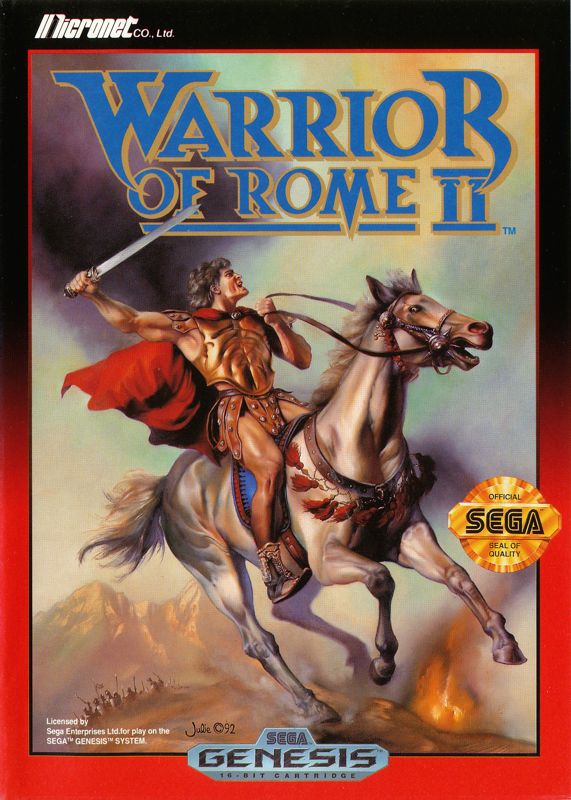
The first hour of Warrior of Rome II is a brisk lesson in juggling. You are directing individual Roman units in real time, deciding who approaches an enemy, who attacks, and who should be working on structures instead. That immediate, hands-on control gives its battles a different feel from turn-based ancient-war games: hesitation matters, and a plan can unravel while you are occupied elsewhere.
Its comparison to Populous makes sense in the broad sense that you command activity from an overhead isometric view, but Warrior of Rome II is much more concerned with direct military management. You can form and disband units, construct or demolish structures, and send soldiers toward specific targets. The result is appealing when you enjoy constantly revising orders rather than setting a formation and watching it play out.
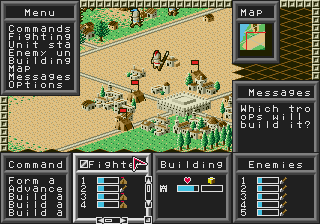
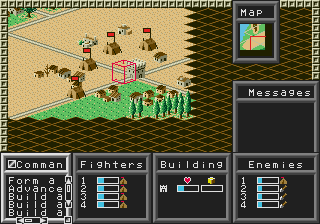
The configurable window system is the standout idea. Being able to shift, resize, rearrange, or close information windows lets you tailor the battlefield view to what you need at that moment. It is especially useful in a game where attention is split among several individual units and ongoing tasks. The flip side is that this is still a busy real-time strategy game on Genesis, so you need to be comfortable with some management friction before that flexibility starts feeling like a genuine advantage.
Beyond the single-player scenario, free battle supports one or two players across several dozen maps. That makes the game more than a one-and-done Roman campaign: once the core command style clicks, there is room to experiment with different battlefields and test your decisions against another person.
Graphics
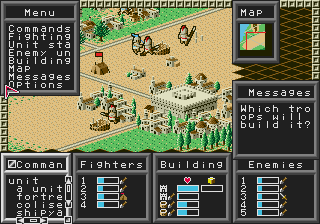
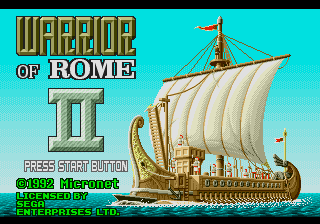
The isometric, diagonal-down battle screens give you a useful view of Roman units, structures, and opposing forces at once. It is a practical angle for following movement and targeting across a map, which matters far more here than elaborate battlefield decoration.
Story
The campaign starts with a straightforward Roman assignment. Caesar receives orders from Rome to suppress a revolt in Asia, putting you in command of the army tasked with carrying that order out.
That is a clean setup for a strategy game: authority comes from Rome, the crisis is already underway, and your role is defined by the campaign’s military objective. It does not need a complicated hook to establish why the next battle matters.
If you want a more detailed account of the game’s background and release, its game history is a useful companion. In play, though, the story mainly serves as a frame for the command decisions rather than competing with them.
Overall Experience
Warrior of Rome II is for the retro strategy fan who likes being kept busy. Its strongest moments come when several small decisions collide—an attack needs attention, units need regrouping, and a structure-related task is waiting—and you manage to impose order before the map gets away from you.
The payoff is a distinctly hands-on Roman RTS that offers more interface freedom than you might expect from its era. That freedom will not erase the demands of controlling individual units in real time, but it gives committed players a meaningful way to make the game work on their terms.
A 7.1 feels right: this is a solid, interesting strategy game rather than an effortless recommendation for every Genesis owner. Give it a chance if its Roman setting, real-time unit direction, and customizable command windows sound engaging. Series newcomers may also want to look at the earlier Warrior of Rome for context.



Reviews
There are no reviews yet.