 Retro Replay Retro Gaming History, Reviews & Emulation



Retro Replay Review
Gameplay
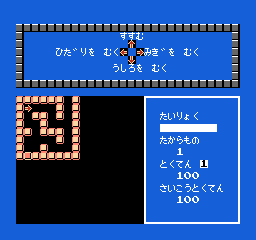
Sansū 2-nen: Keisan Game gets straight to the point: arithmetic is the obstacle between you and a small, immediate goal. In the dungeon game, you guide an arrow through a maze looking for a treasure chest, but monster encounters stop the search with an addition or subtraction problem. That is a sensible hook for younger learners. Finding the exit depends on exploring, while each interruption brings the lesson back into focus.
The golf game has the strongest little risk-and-reward loop. You set the strength of a penguin golfer’s swing, then must answer the selected addition or subtraction problem correctly for that shot to count. A wrong answer sends the ball back to where it was hit, so the math is not merely decoration after the action. It can be frustrating to lose progress, but that consequence makes a correct answer matter.
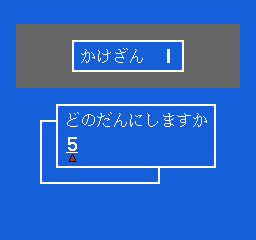
Multiplication gets two very different treatments. The factory game asks you to solve problems before robot parts fall from a conveyor belt; wrong answers drain a meter, and an empty meter restarts the game. That creates genuine pressure, though it may be a harsh fit for a child still learning the tables. The other multiplication game is more direct: solve the problem and whack the mole on a multiplication-table screen. Together, the four games offer a useful spread between exploratory play, timing pressure, and simple recall.
Graphics
The visuals are built around easy-to-recognize activity spaces: a dungeon maze and monsters, a golf course with a penguin golfer, a robot-parts conveyor belt, and a multiplication table with a popping mole. These clear scene changes do more for the game than fancy decoration would; each arithmetic drill has its own picture and its own goal in front of you.
Story
There is no grand adventure to carry you from one exercise to the next. Instead, each minigame gives the math a small bit of context: a chest to locate, a golf ball to advance, robot parts to save, or a mole to hit. For this kind of educational game, that is the right scale.
The dungeon has the closest thing to a miniature quest, since you search a maze while random monster encounters trigger problems. It gives addition and subtraction a reason to interrupt your movement, even though the focus remains on reaching the treasure chest rather than following a larger tale.
The other scenarios are brisk sketches rather than stories, and that keeps the pace from bogging down. The penguin, factory worker, and mole game are memorable enough to separate the exercises in your mind. You are unlikely to come away for narrative drama, but the framing does prevent the four drills from blurring into one another.
Overall Experience
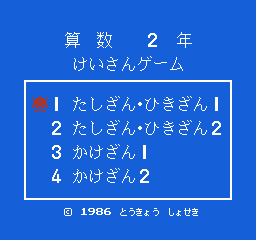
This is a compact educational package whose variety is its biggest strength. The opening stretch makes its intention clear quickly, then the different setups keep basic sums and multiplication from feeling like exactly the same assignment four times. The golf and maze activities add a little more game-like momentum, while the factory and mole games lean harder into speed and recall.
The tougher penalties are a mixed blessing. Sending the golf ball back or restarting the factory game can make an incorrect answer sting, which may encourage concentration but can also wear down a child who is already struggling. It works best when you treat it as practice with stakes, not as a test that demands perfect performance.
Give Sansū 2-nen: Keisan Game a chance if you want arithmetic exercises wrapped in short NES-style challenges and can appreciate repetition with a bit of play around it. It is not likely to hold you for long once the math is easy, but for its intended early-learning job, the four-game structure gives practice a more engaging shape than a bare page of problems.


Reviews
There are no reviews yet.