 Retro Replay Retro Gaming History, Reviews & Emulation
Retro Replay Review
Gameplay
The first few stages should pull you in quickly because SD Hero Sōkessen does not waste much time explaining itself. You are moving through side-scrolling stages, fighting a rotating assortment of enemies, and driving toward a boss at the end of each level. That clean arcade-like structure suits the crossover well: it keeps the focus on seeing which familiar hero or villain shows up next rather than bogging the game down in unnecessary detours.
Its strongest wrinkle is also the one most likely to test your patience. There are twelve playable heroes, with three drawn from each of the four featured series, and each has distinct abilities. But you can only switch by collecting power-ups enemies drop. Instead of treating the cast as a menu of reliable tools, the game makes you react to what appears during a run. When the right pickup turns up at the right moment, the system gives the action a welcome bit of variety. When you want a particular character and cannot get one, it can feel restrictive.
Nine stages and nine boss encounters make this a compact action game rather than a sprawling adventure. That is a benefit if you want a focused NES challenge with a clear finish line. Go in ready to work with the character you have rather than demanding constant access to the one you prefer, and the power-up system starts to feel like part of the game’s personality instead of a needless limitation.
Graphics
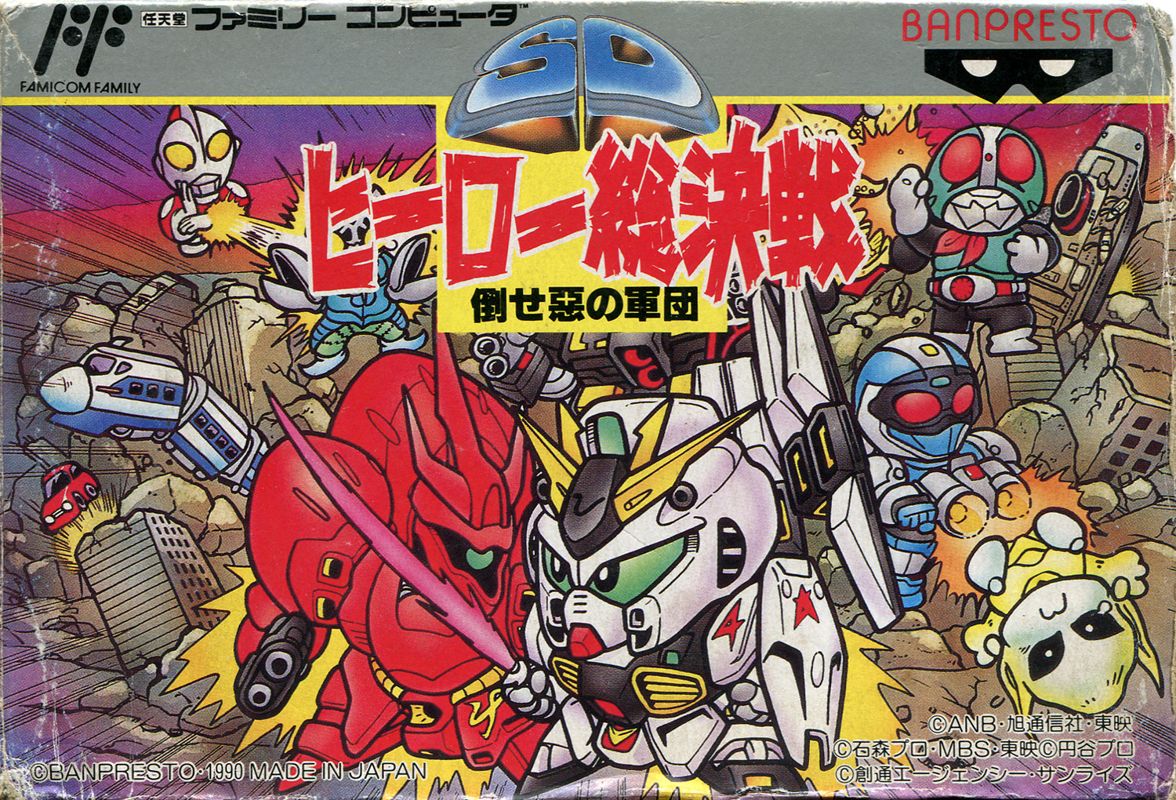
The 2D side-view action puts miniaturized television heroes front and center, and that SD treatment is a natural fit for an NES platformer. Seeing Ultraman, Kamen Rider, SD Gundam, and Uchū Keiji share the same scrolling stages is the main visual treat, especially as enemies from their respective series show up to oppose them.
Story
This is a simple rescue story, but it has the right kind of Saturday-morning urgency. SD Nation is peaceful until a mysterious UFO captures the SD Mother and Amy, her engineer. Dark Brain’s plan to build an evil SD empire gives the heroes a straightforward reason to head out together and start knocking through enemy territory.
Do not expect the plot to carry the game through elaborate turns. Its job is to connect the stages and justify the all-star lineup, and it does that efficiently. The real charm comes from the fact that these otherwise separate Japanese hero series are united under one small-scale, toy-like SD banner.
Amy’s rescue remains the concrete goal from start to finish, while restoring peace to SD Nation gives the finale a proper sense of closure. It is light material, but it fits a short platform action game: clear stakes, clear villains, and no confusion about why you are heading toward the next boss.
Overall Experience
SD Hero Sōkessen: Taose Aku no Gundan is more enjoyable for its crossover flavor than for any attempt at reinvention. The combination of a nine-stage action run, boss fights, and a dozen heroes with their own abilities gives it enough variety to stand apart from a more anonymous NES platformer.
The character-switching restriction is the key dividing line. If you like adapting to drops and making the most of whichever hero is currently available, it adds tension and makes the roster matter. If your idea of a crossover game is freely selecting your favorite character at every turn, it will be the source of most of your frustration.
For fans of Japanese tokusatsu and SD Gundam, the payoff is the unusual chance to see all four franchises occupy the same action game. Everyone else may find it a modest, compact platformer, but the licensed cast and reactive switching system give it a specific enough hook to merit a look.


Reviews
There are no reviews yet.